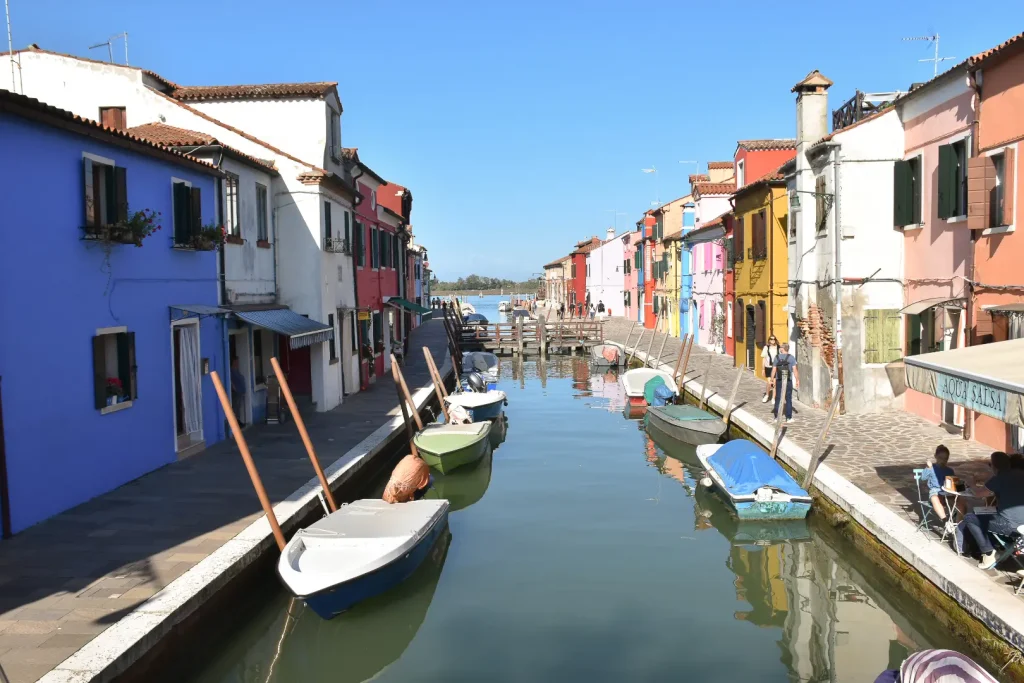
Venice isn’t one island but well over a hundred, and beyond the six central districts the lagoon is dotted with islands that each have a character of their own. On our half-term trip we spent a day hopping out to Burano and Murano on the public water bus, and when we asked the kids at the end of the week, it was their favourite day of the whole holiday.
Here’s exactly how we did it – which vaporetto to catch, which island to visit first, where we had lunch and what to see on each.
Catch vaporetto Line 12 from Fondamente Nove in Cannaregio, go all the way to Burano first while it’s quiet, then stop at Murano on the way back in the afternoon. You don’t need a tour, and a full day covers both comfortably.
There are plenty of organised Murano and Burano tours, and they take care of everything: the boat, the timings and usually a glass-blowing demonstration. We decided to go under our own steam instead, partly for the fun of travelling on the vaporetto with the locals and partly for the freedom to spend as long as we liked on each island.
Doing it yourself isn’t difficult, but there are a couple of places where it’s easy to go wrong, so read on. If you’d rather someone else did the organising, the Murano, Burano and Torcello: Half-Day Boat Tour also takes in Torcello, which we didn’t have time for.
If you’re wondering how long to allow, here’s how our day ran:
Mid-morning: Line 12 from Fondamente Nove, straight through to Burano.
About 40 minutes later: Arrived on Burano to quiet streets. Coffee first.
Late morning: Wandered the canals and the main square.
Lunch: Trattoria da Romano, leaving around 1.30pm as the streets filled up.
Afternoon: Vaporetto back to Murano to explore the island and watch a glass-blowing demonstration.
Sunset: Walked back to the lighthouse vaporetto stop and caught the short hop back to Fondamente Nove.
We were very happy with the order, and felt we’d dodged the worst of the crowds by reaching Burano early and Murano later in the day.
The vaporetto to Murano and Burano leaves from Fondamente Nove, on the northern edge of Cannaregio. It’s roughly a 20-minute brisk walk north from St Mark’s Square, or you can take vaporetto Line 4.1 or 4.2 from the San Zaccaria stop on the waterfront by St Mark’s.
Both islands are on the same line, Line 12, which left from Dock A at Fondamente Nove when we went. This is where it’s easy to slip up: there are several docks at Fondamente Nove, each serving different lines, so check the letter over the gangway before you join a queue.
While you wait, look north across the water. On a clear day you can see the Alps in the distance, looking surprisingly close.
We got there a good 20 minutes early and were at the front of a long queue, and this was in October, so expect longer queues in high season.
You’ll make at least three journeys on a Murano and Burano day trip (out to Burano, across to Murano and back to Venice), so a day pass works out cheaper than single tickets. We bought ours from the machine at the stop. Our guide to getting around Venice covers the ticket and pass options in more detail.
Murano is the closer of the two, only around ten minutes from Fondamente Nove, while Burano is about 40 minutes from Fondamente Nove. You could visit them in either order, but Burano is tiny and fills up quickly once the tour boats arrive. So we stayed on the vaporetto for the full journey, reached Burano first, and stopped at Murano on the way back after lunch.
It worked perfectly. We caught a mid-morning boat on a weekday and the streets of Burano were quiet when we arrived. By the time we left after lunch they were much busier, and by the time we got to Murano in the afternoon, the morning crowds there had thinned.
The best thing to do on Burano is simply to wander and soak up the colour. Every house seems to be painted a different shade, and many of the locals hang fabric over their front doors in matching colours to complete the look. There are cheerful details everywhere: a pink postbox, green shutters, a rainbow umbrella by a doorway. It’s a joy.
The story goes that the houses were first painted brightly so fishermen could find their way home through the lagoon fog. Today the colours are still carefully controlled, and residents need permission before repainting.
Follow the little canals and you’ll see the houses reflected in the water on both sides. The afternoon light is said to give the best reflections, but we had plenty by midday.
The main street, Via Baldassare Galuppi, is lined with restaurants and shops, and leads to Piazza Baldassare Galuppi, with a statue of the composer, who was born on the island. The square is also home to the church of San Martino Vescovo, whose leaning bell tower pops up above the rooftops wherever you wander.
Burano is also famous for lace-making. I almost forgot about it in all the colour, but there’s a lace museum on the main square if you want to see the craft properly.
We didn’t get off to a perfect start. Within minutes of arriving, one of us was stung by a wasp, so our first stop was the island’s pharmacy. They sorted us out quickly, and it’s worth knowing there’s one on the island if you need it.
We’d booked a table at Trattoria da Romano after seeing Anthony Bourdain visit on his No Reservations series. We sat outside and had delicious Venetian food with faultless service, though the inside is lovely too, with glass chandeliers and walls of black and white photographs. We didn’t even order the famous risotto di gò, made with little lagoon fish, which gives us a reason to go back.
It was the most expensive meal of our whole trip, but it was worth the splurge. Book ahead. If you’d rather keep lunch simpler, Al Fureghin and Ristorantino Al Museo on Burano are well reviewed for good-value food, though we haven’t tried them ourselves.
Murano is like a mini Venice, made up of several small islands linked by bridges across its own Grand Canal. It’s compact enough to see in an afternoon.
There’s no getting away from it: Murano is all about glass. Venice’s glassmakers were moved out to Murano in 1291, partly to protect the industry’s trade secrets and partly because the furnaces were a fire risk in the crowded city. The island has been famous for glass ever since, and in the 15th century the glassmaker Angelo Barovier developed cristallo, a remarkably clear glass. Many of the old factories have closed, but glass is still made here and the shops are endless.
Whichever stop you arrive at, you’ll be greeted by shops full of glass, many claiming to sell work made on the island by traditional glassmakers. Not all of it is, so if you’re buying something special, look for the Vetro Artistico Murano trademark, which guarantees it was made on the island.
To understand the tradition properly, you can visit the Glass Museum, watch a glass-blowing demonstration (more on that below) or step inside one of the island’s churches.
We popped into the church of Santi Maria e Donato, one of the oldest churches in the lagoon. It has a beautiful Byzantine mosaic floor, a gold mosaic apse and, according to legend, dragon bones kept behind the altar. You can decide for yourself whether to believe that one.
Your wander will probably bring you to Campo Santo Stefano, the main square, with its 19th-century clock tower. Sometimes there’s a glass sculpture at its base, though there wasn’t when we visited. Round the corner, the bridge across Murano’s Grand Canal gives lovely views up and down the water.
You’ll probably want to watch some glass-blowing while you’re on Murano, and there are plenty of places offering it. We visited the Original Murano Glass (OMG) factory, where we watched a craftsman turn molten glass into a vase and a horse in a matter of minutes, before leaving through the showroom. I’d read that you’d be pressured to buy something, but that wasn’t our experience at all.
It was over quite quickly, so if you want more time with the glassmakers, choose a longer, timed furnace visit. The free demonstrations touted along the waterfront get more complaints about hard selling. Some workshops even let older kids, roughly 10 and up, have a go themselves. The OMG visit can now be booked ahead as Glass Blowing Show Visit Murano Glass Factory and Showroom OMG.
Burano sits right beside Torcello, just a short hop away on vaporetto Line 9, the first part of the lagoon to be settled and once far busier than Venice itself. Today it’s a quiet island with only a handful of residents, a very old cathedral famous for its mosaics, and a stone seat known as Attila’s Throne. It would have made a lovely contrast to colourful Burano, and it’s top of my list next time.
The Lido is the other island I’d like to see, as the complete opposite: a long sandy strip with beaches, cycle paths and actual cars. We haven’t visited either island yet, so treat this as a researched suggestion rather than first-hand advice.
In closing
Our day out to Murano and Burano was a real highlight of our time in Venice, and it didn't need a tour, just the right vaporetto and an early start.
If you're planning your wider trip, our guide to Venice with teenagers shows how this day fits into five days in the city, and our guide to visiting Venice responsibly has tips for spreading your visit beyond the busiest spots.
Happy holidays!
Thank you so much for reading my blog. For more stories, itineraries, and advice, check out my Related Posts and sign up to receive my blogs by email.
If you have a blog-related question, please do ask in the comments box below and I'll try to help.
A little request: if you use my photos, please credit Love Travel Planning on your social media or give me a shout out on Instagram @lovetravelplanning as I am growing my website. Huge thanks.
Join thousands of travelers looking for inspiration from our FREE Planet Travel newsletter!
Your step-by-step framework for stress-free, unforgettable trips — from first idea to final itinerary.