If I were to live anywhere I visited in Australia, Lorne would be it. I liked the long beach, the hills behind town and how easy it felt to spend time there without doing very much. It was my last overnight stop on the drive from Adelaide to Melbourne, travelling the Great Ocean Road from west to east, and the place I was most reluctant to leave.
My visit fell during an unusually quiet summer spell, with fires further west affecting travel along the coast. I didn’t see Lorne at its busiest, and I only had one night. Alongside the places I stayed, ate and explored, I’ve included the options I researched for a longer visit.
Lorne pairs one of the Great Ocean Road’s best beaches with its most liveable town, reached via a clifftop drive from Apollo Bay and a koala rich stop at Kennett River. One night minimum; longer if you surf.
Lorne works well as the final overnight stop on a west-to-east Great Ocean Road trip. It’s around 50 minutes’ drive from Apollo Bay, with Melbourne roughly another two hours away, depending on traffic and your route.
The approach from Apollo Bay is a drive to take slowly, with bends above the sea and eucalyptus-covered slopes rising beside the road. Allow extra time if you want to stop at Kennett River or Wye River along the way.
Staying in Lorne leaves you time to enjoy the beach and have dinner without another drive afterwards. The following day, you can continue east towards the Memorial Arch and Torquay, then stop in Geelong before heading into Melbourne.
Lorne became a seaside holiday destination before the Great Ocean Road reached it in 1922. Its history goes back much further, though — this is Gadubanud Country, and shell middens along the coast record a long Aboriginal presence.
Louttit Bay takes its name from a captain who sheltered here during a gale in 1841. The Mountjoy brothers opened a guesthouse in 1868, the township was surveyed the following year, and in 1871 it was named after the Marquess of Lorne, who had recently married Queen Victoria’s daughter.
Early holidaymakers arrived by boat or travelled over the Otways by coach. The coastal road came later, built by returned First World War servicemen and dedicated as a war memorial. Knowing that gives the drive into town a significance you could easily miss from the car.
Lorne has also lived through devastating fires, including Ash Wednesday in 1983. That history felt less distant during my visit, when fires elsewhere along the coast were affecting where people could travel.
Lorne is busiest during the summer holidays, particularly between Boxing Day and Australia Day, and on major event weekends. Accommodation fills, traffic slows along the main street and finding a parking space can take patience.
The town has a small permanent population but accommodates many thousands of visitors in summer. With shops, cafés and beach traffic concentrated around Mountjoy Parade, you don’t need to be driving far to get caught in a queue. Midweek visits outside the school holidays are generally quieter.
The Pier to Pub ocean swim is one of the biggest dates in the calendar, bringing thousands of swimmers and spectators to town in January. If your stay coincides with it, book accommodation well ahead and check the event’s traffic arrangements before travelling.
Usually, the event causes a traffic jam coming into town, and on Mountjoy & the Great Ocean Road. The official advice is to approach via Winchelsea-Deans Marsh, and park at Lorne Country Club, then use the free shuttle bus.
The Lorne Sculpture Biennale is another event to look out for, with artworks along the foreshore; check the programme for your travel year. Normally, it happens every second March (so the next one in 2027), but not as busy as the Pier to Pub ocean swim.
My own visit was quieter than a typical summer stay because of the conditions further west. I enjoyed having room to wander, but it wasn’t necessarily an easy season for the businesses relying on visitors.
Kennett River is a popular place to look for wild koalas between Apollo Bay and Lorne, particularly in the eucalyptus trees along Grey River Road behind the village. Sightings aren’t guaranteed – I didn’t see one during my stop.
It’s still a worthwhile place to get out of the car. The village has a shop and toilets, and you can spend a little time walking by the river or continue further among the trees. I took the longer walk into the forest and enjoyed the quiet, even without a koala sighting. I did get some very good photographs of a kookaburra, which helped.
Allow about 45 minutes to an hour if you want time to look properly. Grey River Road is the place often recommended for spotting koalas, so look up into the branches as you go. Keep clear of traffic and avoid stopping a car where it blocks the road.
Don't feed the parrots or approach a koala for a photograph. Keep your distance, even if an animal is low down or seems unbothered by people.
If you fancy another break before Lorne, Wye River has a beach and a bakery. It could also make a useful lunch stop if you’d rather eat before reaching town.
Lorne Beach is a long sandy beach (around 1.2 kilometres) on Louttit Bay, with a foreshore path, playground, barbecues, showers and toilets close by. You can come for a swim or spend an hour walking beside the water without needing to move the car.
The hills rise just behind the town, so the forest is part of the view even when you’re down on the sand. That closeness between the beach and the Otways was one of the things I liked most about Lorne.
Follow the foreshore towards Point Grey for the pier, where people fish and walk out over the water. Back towards town, the cafés and shops are close enough to combine a beach visit with breakfast or lunch.
It is patrolled: Volunteer lifesavers run the summer season with extra paid lifeguards through the peak weeks, which is rarer on this coast than you might expect. Swim between the flags.
It is one of the road's most accessible beaches: Matting runs to the water on patrolled weekends and a beach wheelchair can be borrowed free of charge, booked ahead through the surf club.
Dogs are restricted on the patrolled stretch in summer, with North Lorne beach across the river the friendlier option off season; check the current signs either way.
Because the point shelters the bay, Lorne is one of the better places for learning to surf on the entire Great Ocean Road, a safer first wave than the exposed breaks further east.
Go Ride A Wave runs group lessons daily through the summer season with boards and wetsuits included, teaching in waist deep water and taking children from around five with an adult alongside, and Southern Exposure and Dawn Surf Co also operate lessons in the area. Outside summer the public lessons thin out, which is your cue that the water has too.
I ate at the Lorne Hotel and enjoyed spending the evening there, chatting with locals and other travellers. Mountjoy Parade has more cafés and restaurants if you want to look around before choosing somewhere.
Options were more limited during my visit because of the fires affecting the coast, so the hotel became the centre of my evening. It was an easy place to settle in, and I ended up in conversation with a mix of people who lived nearby and people passing through, as I was.
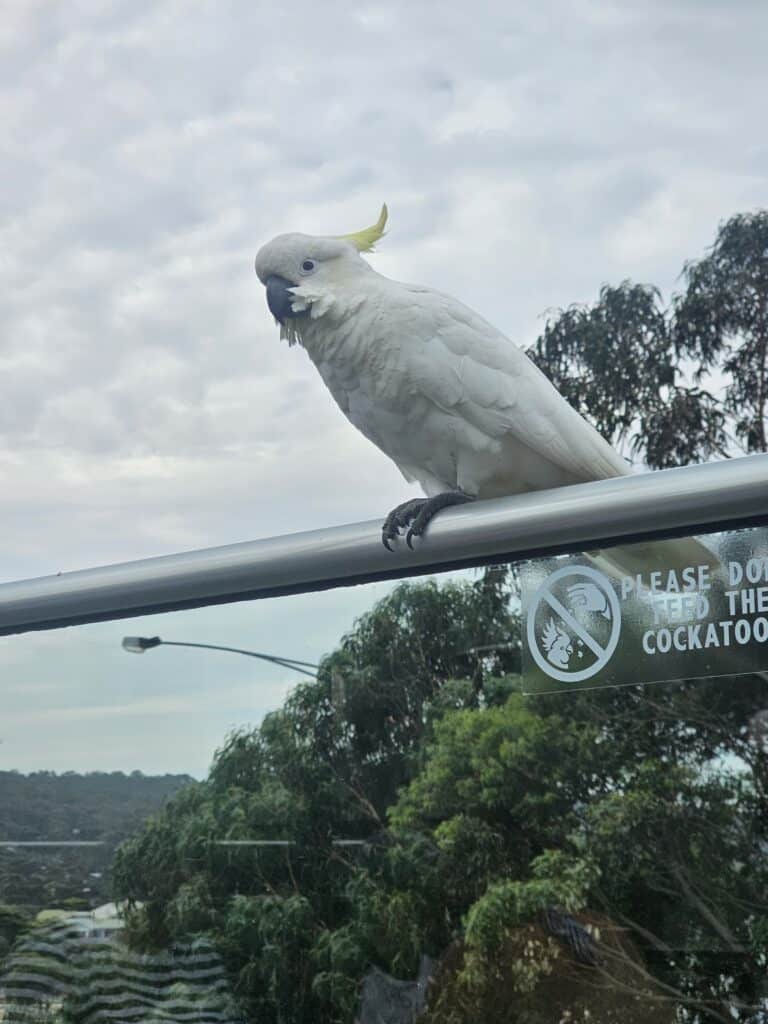
The cockatoos provided much of the entertainment. They kept swooping around the outdoor seating, giving us something else to watch between conversations.
For a longer stay, The Bottle of Milk is one of the places I’d look into for breakfast or lunch. QDOS Fine Arts, in the trees above town, is another option to check for its gallery, sculpture garden and café opening times.
If you have a particular restaurant in mind during the summer holidays, book ahead. Otherwise, a walk along the main street will give you a chance to see what’s open and what takes your fancy.
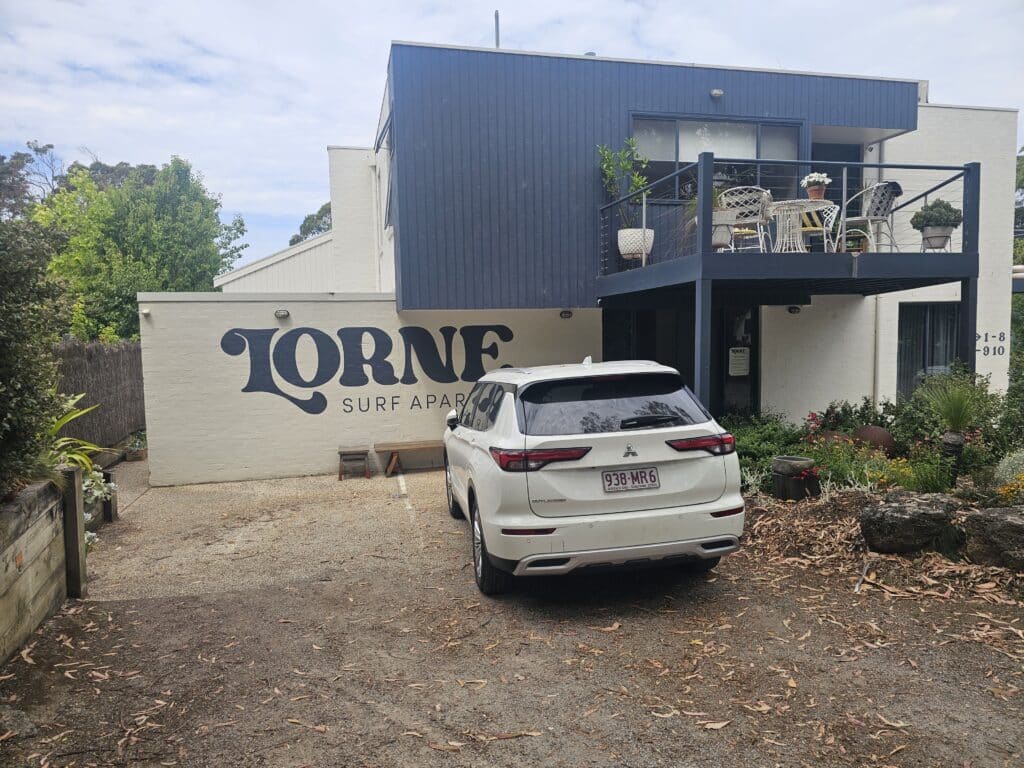
Stay on or near Mountjoy Parade if you want the beach, shops and dinner within an easy walk. For a quieter hillside stay, I really liked Lorne Surf Apartments – they were the best apartments I stayed in on my Great Ocean Road trip.
The apartments sit above town, with the beach and main street below. I liked the outlook and having space to settle in, although the walk back uphill is worth considering if you’re choosing somewhere for a single night & have had a couple pints.
For me, it was worth it. If being close to everything matters more to you, look nearer the foreshore. These are the other options I researched:
Apartments opposite the beach, with kitchens that could be useful for a longer stay. Check the individual room description if you want an ocean view.
A beachfront resort incorporating historic Erskine House. Compare room types and recent photographs before booking, as the accommodation varies.
Handy if you like the idea of dinner downstairs and the beach nearby. Consider possible noise when choosing a room, especially for a weekend stay.
A smaller accommodation option to look into if you prefer something more personal than a large resort.
Worth comparing when you’re looking for a straightforward overnight stay near the main strip.
An option for campers and caravans close to the beach. Book well ahead for summer holidays.
An inland alternative if you would rather stay among the trees and drive into town.
Ask about off-street parking before you book. For popular holiday periods and the Pier to Pub weekend, start looking early and check cancellation terms. On my west-to-east itinerary, I stayed in both Apollo Bay and Lorne. They suited different nights of the drive, so there was no need to choose between them.
I’d recommend staying at least one night in Lorne, so you have time for the beach and an evening in town without rushing back to the car. Two nights would give you more room for the waterfalls, lookouts or a surf lesson.
What appealed to me was how close everything felt. You have the beach in front of town, the wooded hills behind it and places to eat along the main street. I could imagine spending several days there quite happily without planning every hour.
Staying overnight also meant I got to enjoy the pub and talk to people rather than treating Lorne as another place to park, photograph and leave. The apartment helped too – it was somewhere I wanted to spend time, rather than just a bed for the night.
My visit was unusually quiet, so I can’t tell you that a peak-summer weekend would feel the same. But even with the disruption elsewhere along the coast, I left wishing I’d booked longer.
Erskine Falls and Teddy’s Lookout are two nearby outings to add if you have longer in Lorne. Live Wire Park offers treetop activities above town, while Lake Elizabeth is a more substantial inland trip.
These are places I researched rather than visited on my overnight stop. I’d choose one or two and leave some time for the beach, rather than try to fit everything into a single day.
A waterfall in the forest around 20 minutes’ drive from Lorne. There is an upper lookout and a steeper descent by steps towards the base. Allow time for the return climb and take care on wet steps; check access conditions before heading out.
If the lower lookout or stairs are closed, do not attempt the climb; this is usually because of a storm, flood or rot. Similarly, if the river is high, there is ice, or Parks Victoria is closed, don’t attempt to climb. The top lookout is usually still usable.
A viewpoint above town overlooking the coast and the bends of the Great Ocean Road. It makes a shorter outing if you don’t have time for a longer walk.
A high ropes and zipline attraction in the trees above Lorne, similar to Go Ape for UK readers. Any under 16’s must be accompanied by an adult with General Admission. For the Short Circuit, the minimum requirements are – 110cm, generally 7+, max 120kg. The Super Circuit / Shockwave Zip Coaster – 135cm, max 120kg.
You must wear closed toe shoes. All circuits not for people who are pregnant, or have heart or serious joint issues.
A forest lake further inland, known for possible platypus sightings. This needs more time than a quick detour from town. Early morning is often suggested for wildlife watching, but go for the lake and forest as well: a sighting is never certain.
Book accommodation early for summer and event weekends, allow extra time for the coastal drive and check road conditions before setting off. Once you’re in Lorne, staying within walking distance of the beach and restaurants makes a short visit easier.
Allow time for Kennett River: About an hour gives you a chance to walk and look for koalas without rushing. You may not see one, so enjoy the walk as well.
Drive carefully around wildlife: Be particularly alert around dawn and dusk, and only pull over where it is safe to do so.
Look closely at your accommodation's location: A hillside view can mean a steep walk home from dinner. Check parking arrangements too.
Check the events calendar: The Pier to Pub weekend can affect accommodation, parking and traffic throughout town.
Check current travel alerts: Fires, floods and other severe weather can affect the coastal road and inland routes. Consult official Victorian emergency and road information before travelling, especially if conditions are changing.
Yes, particularly if you enjoy beaches, coastal walks and having forests close by. It was my favourite town on this part of the trip, and I would happily return for longer than one night.
Try Kennett River, between Lorne and Apollo Bay, especially the eucalyptus trees along Grey River Road. The koalas are wild, so sightings aren’t guaranteed. I didn’t spot one during my visit, although I enjoyed the walk and photographed a kookaburra.
Allow roughly two hours to drive between Lorne and Melbourne, depending on your route, traffic and where in Melbourne you’re heading. Add time for stops if you’re continuing along the coast through Torquay or visiting Geelong.
Lorne gives you a final night by the beach before continuing towards Melbourne, with time to enjoy dinner and a walk after the day’s coastal driving. It worked well after Apollo Bay and left me a manageable onward journey the next day.
Of all the towns I visited on this stretch, it’s the one I can most easily picture returning to for a holiday of its own. I liked the hillside apartment, the beach and the evening at the pub with cockatoos swooping around the terrace. One night was enough to know I’d have enjoyed a few more.
Thank you so much for reading my blog. For more stories, itineraries, and advice, check out our Related Posts and sign up to receive Lucy's blogs by email.
If you have a blog-related question, please do ask in the comments box below and I'll try to help.
This blog was written by Tom at Smyto Creative.
A little request: if you use my photos, please credit Smyto Creative on your social media or give me a shout out on Instagram @smytocreative as we are growing this website. Huge thanks.
Join thousands of travelers looking for inspiration from our FREE Planet Travel newsletter!
Your step-by-step framework for stress-free, unforgettable trips — from first idea to final itinerary.