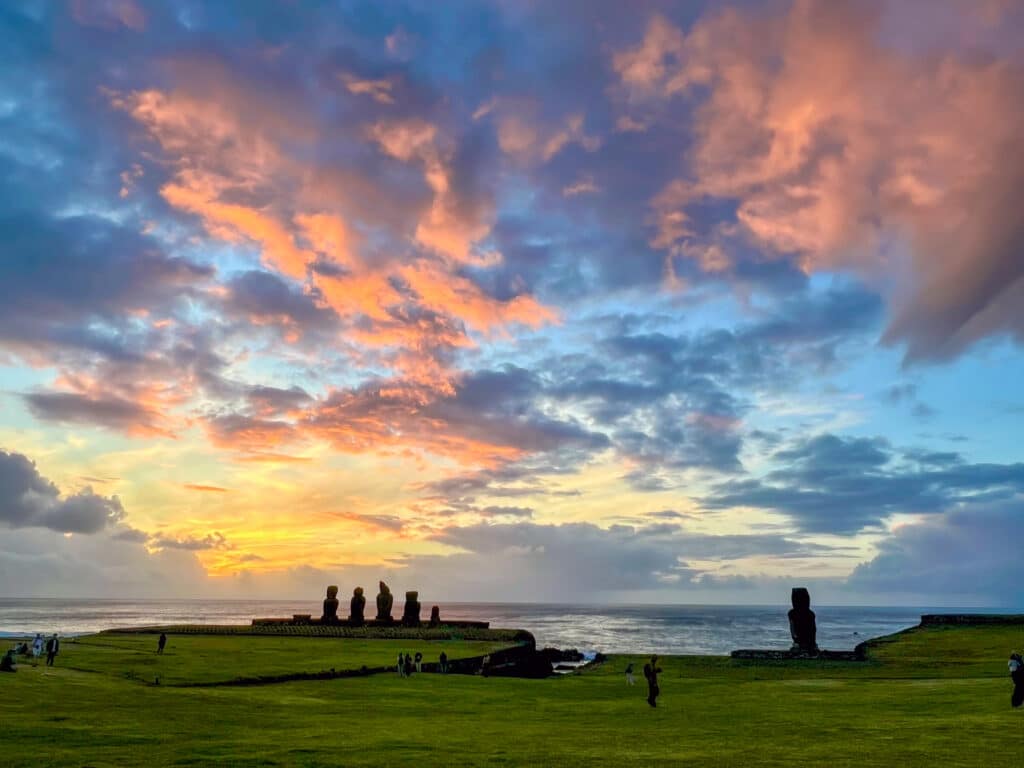
bottom third is green field. Top two thirds is a multi coloured sunset sky with clouds illuminated yellow, pink and orange light against a blue sky. A row of 5 stone statues are silhouetted to against the sky and a single statue to the right.

Sunrise And Sunset: The Best Way To Start And End Your Trip To Easter Island

Everyone loves a good sunset, but a sunset on Easter Island can be on another level, with kaleidoscope skies silhouetting wide platforms of moai. Similarly, if you’re a morning person, the same can be said for sunrisesThere are two perfect places to start and end your trip to Easter Island where you’ll enjoy skies ablaze with colour behind the silhouettes of magical moai on the cliffs with the moai behindIt’s breathtaking.  Here are the details – don’t miss out!

Table of Contents

Sunset at The Tahai Complex

Where is the Tahai Complex?

The Tahai Complex is just north of the town of Hanga Roa, around a 25-minute walk, or a short taxi rideYou don’t need to visit this site on a tour and so you can easily plan to visit under your own steam on a trip to Easter Island. 

What to see at the Tahai Complex

The Tahai Complex comprises: 

Hare Moa – a flat stone structure which was a house to protect the islanders’ chickens during inter-tribal warfare.  There are small openings at the bottom of the chicken house where the chickens would enter, which would be closed with a stone at night to keep the chickens safe inside. 

Bottom half of the frame filled with grassy slop. A long, low structure of dry stone walls with small opening stretches across the horizon. Pale blue sky, pink glow on clouds
Hare Moa chicken house

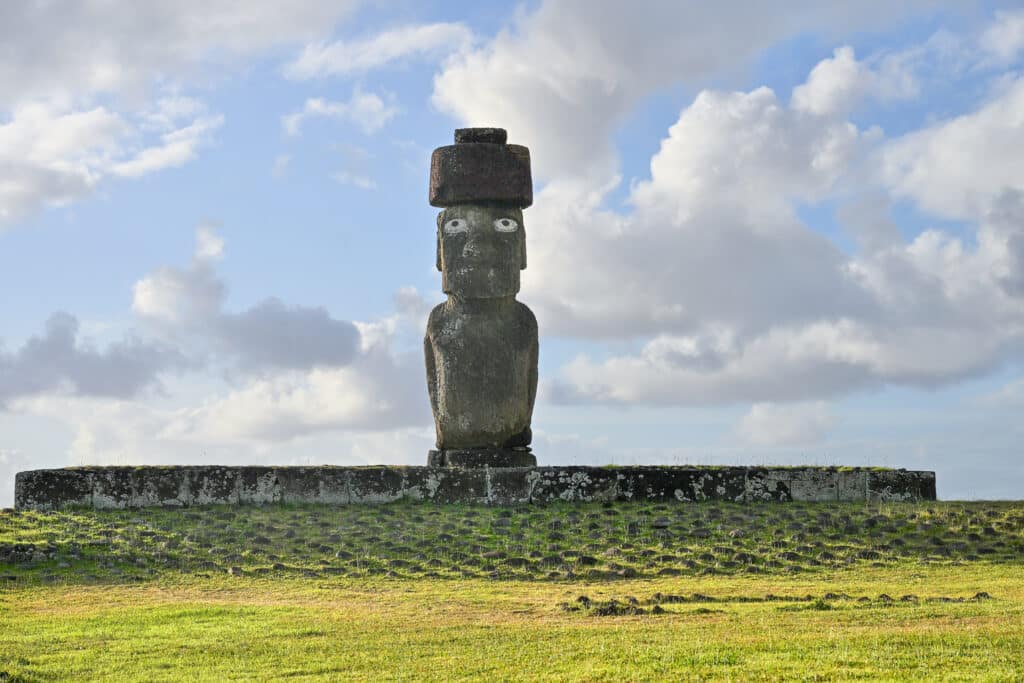
Ahu Ko Te Riku – a single moai on a platform with a red topknot and restored eyes of white coral. 

Grassy field in front. Wide stone platform above. Single carved stone statue stands in the middle of the platform facing the camera. It has white eyes and a red hat. Cloudy, pale blue sky behind.
Ahu Ko Te Riku with white coral and obsidian eyes in situ

Ahu Tahai – a small platform with a small moai in the middle of the site, next to a ramp for canoes to go down to the water. 

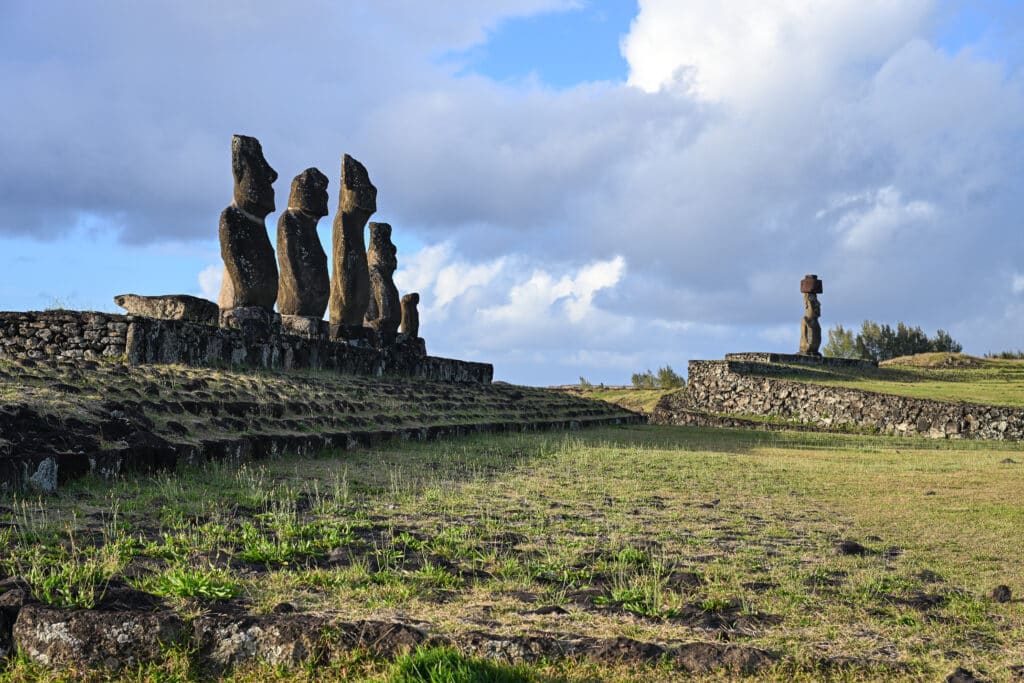
Ahu Vai Uri – an ahu with 5 restored, upright moai. 

Platform of 5 stone statues to the left and a single statue to the right. All on stone platforms. Grassy fields below. Cloudy blue sky above.
Ahu Vai Uri, Hanga Roa

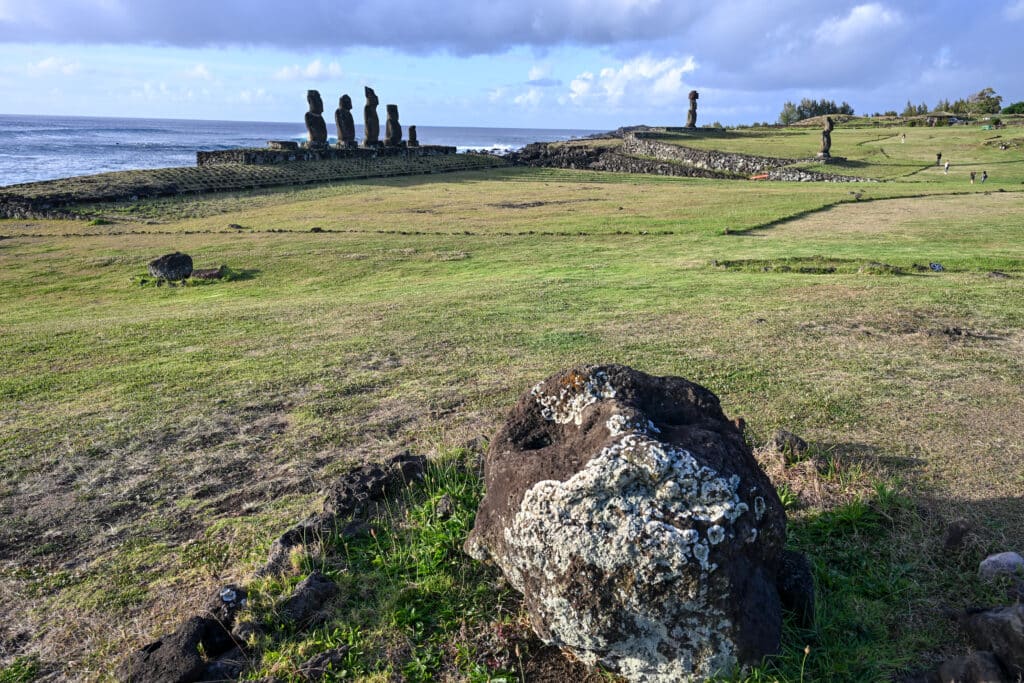
Older moai head – a crudely carved stone head was discovered behind Ahu Vai Uri during excavations which might be one of the earliest human representations on the island. 

A weathered carved stone head lies in the bottom right of the frame, its chin covered in moss. Grass field reaches to the ocean at right hand side. Blue sky with bank of clouds above. A stone platform sits on edge of the grass supporting 5 stone figures. Two other stone figures are visible - one to the right on the coast with a hat on, and one lightly in land from that.
Old moai head in the grass at the Tahai Complex

Face-down moai – there is a moai face-down on the ground to the left of the Ahu Vai Uri which is thought to have been the 6th moai from the platform, but one which was so badly damaged that it was sadly left to the side.  

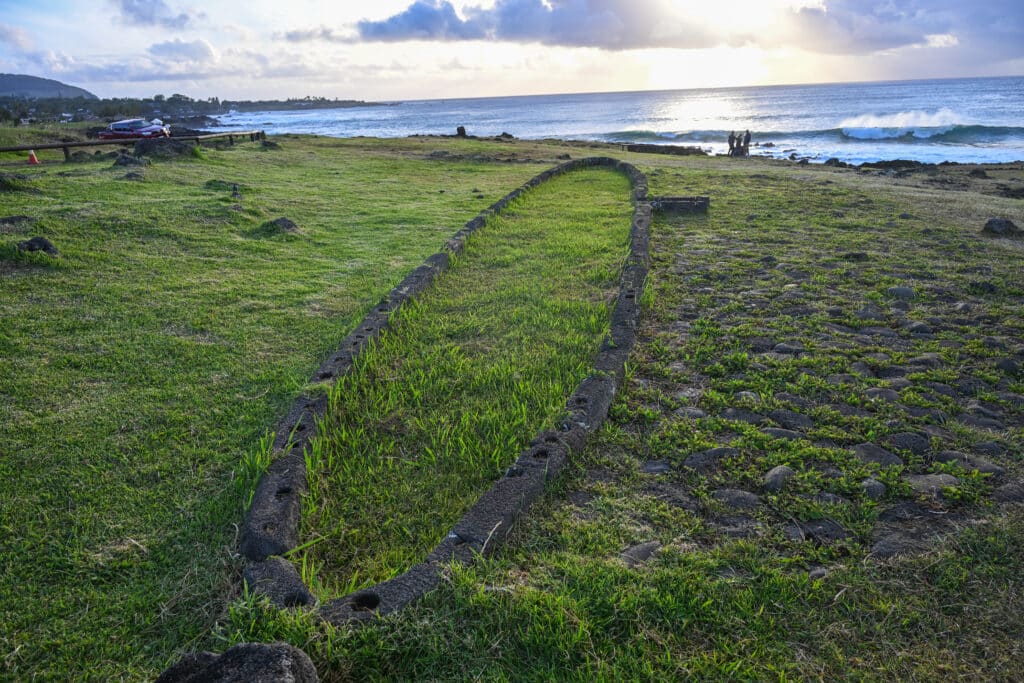
Hanga Paenga – an elliptical shape made of stones in the grass which marks where a Rapanui house would have stood.  Some of the stones have ridges in them showing where branches would have stood, tying in the centre to form a wooden frame like an upturned boat.  A replica version of a boat house was on display at Ahu Viahu. 

A grass field reaches towards the ocean at the top of the frame. The sun is setting at the top of the frame - sun rays and clouds above. On the grass is an elliptical shape set out in stones, its length reaching towards the ocean
Hanga Paenga - where a traditional boat house once stood

The three platforms in the Tahai Complex were restored by the American archaeologist William Mulloy in the late 1960s.  The site is an excellent way to start meeting the moai of Easter Island.

National Park rules at Tahai

This complex is not a restricted part of the Rapa Nui National Park, and so you don’t need to show your park pass to enter; however national park rules still apply in relation to respecting the elements of the site

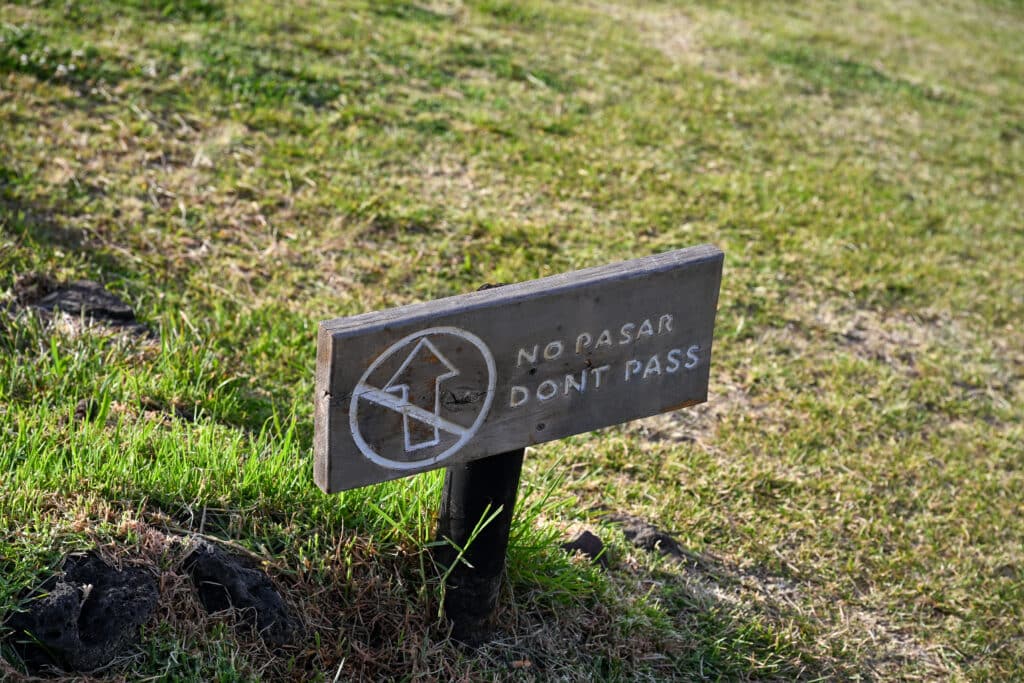
There are rangers patrolling the site who will blow their whistles if you step over the boundaries of the AhuAs the edges of the Ahu are denoted simply by stones, rather than fencing, then you do need to watch your step here. Several people (not us) inadvertently crossed the line and were whistled at; one had even stood on the stones to get an extra 10 inches higher for a photo. Don’t be that person on a trip to Easter Island! 

A small brown wooden sign sits in a patch of grass. White letters tell the viewer Not To Pass.
Keep of the grass and the ceremonial platforms!

Natural Amphitheater

The setting of the Tahai Complex around a natural amphitheater – a curved hill of grass leading down to the cliffs – overlooking the ocean is perfect for watching the sunset.  Pick your stop on the slop, sit back and relax as the sun sets behind the moai set out below you, before slowly slipping behind the statues into the ocean. 

Spirit dogs

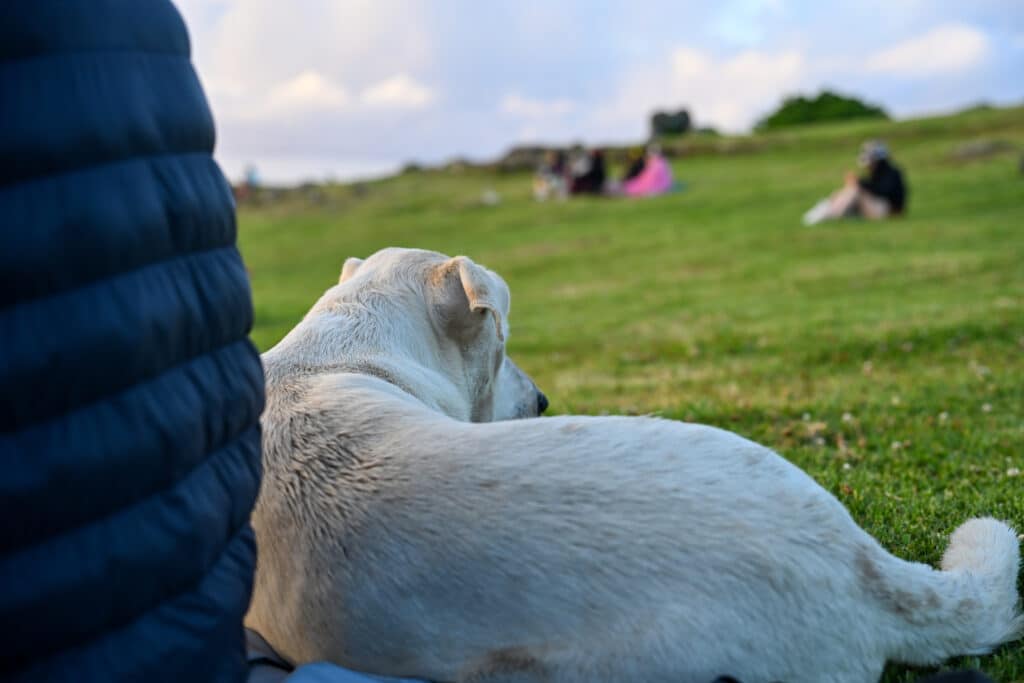
If you’re lucky enough, one of the local dogs will come and sit with you on your trip to Easter Island and the Tahai Complex.  I left Ricardo for 20 minutes whilst I took some photographs, only to return and find that he had a canine friend cuddled up against him.  As soon as I sat down, a second dog came and sat next to me.  They didn’t want anything, just company. 

As we sat quietly watching the sunset, strangely we both felt the presence ‘of others ‘and so started referring to the dogs as our ‘spirit dogs’.   Day One on a trip to Easter Island and Rapa Nui was already getting to me! 

View of the back of a white dog facing up a grassy hillside. The dog is cuddled up against the back of a figure in navy. He is looking towards groups of people sitting on the grass (they are out of focus)
Spirit Dog at the Tahai Complex

Sit back and watch the light show

My advice on a trip to Easter Island would be to go an hour before sunset so that you can walk around the site and have a look at all the artefacts whilst it is still light.  Then, once you have seen everything, pick a good spot and wait for the oranges, yellows and blues to fill the sky and silhouette the moai against the colourful night sky.  Stunning! 

View of a silhouetted row of carved stone figures some of which look to be damaged. Darkened grass field in front as if at sundown. Sunset sky behind - orange and yellow light showing through grey cloudy sky
A cloudy sunset over a silhouetted platform along the bottom of the frame. There are 5 stone statues standing to to the left. Above it yellow glow from the disappearing sun casting orange colour on clouds to the left. Blue and black clouds to the right
Sunset over Ahu Vai Uri, Tahai Complex

Sunrise at Tongariki

Where is Tongariki?

The Tongariki site is a 30minute drive from the town of Hanga RoaIt is on the coast, in front of the Poike volcano and Rano Raraku, the quarry where the moai were carved It is very probable on a trip to Easter Island that you will visit Tongariki on one of your day tours of the island, particularly if you visit Rano RarakuHowever, it doesn’t matter if you visit twice, as visiting at different times of the day offers completely different experiences

What to see at Tongariki

The Travelling Moai

As you enter the site at the National Park office, to the left is A Vere (‘The Travelling Moai’). 

This moai was taken to Japan in 1982 to appear in an exhibition in Osaka, after which he was returned to Rapa Nui. Following this, the Japanese government and a Japanese engineering firm collaborated on the reconstruction of Ahu Tongariki (see below). 

A Vere had another moment of glory in 1986 when it was used in an experiment with ropes to test out the ‘walking moai’ theory. With less than 20 people, and well-attached ropes, the group managed to move A Vere (4 meters tall and weighing 9 tonnes) forward a couple of meters by rocking it side to side.   This led to the acceptance of the walking theory in relation to how the moai were moved from the quarry around the island. 

A large moai (carved stone statue) stands proudly to the left hand side of the frame with a fence around it. It has a small forehead and long nose. A hill leads down to a valley behind with a wide platform filled with stone human form statues to the right. Hill behind. Blue sky above
The Travelling Moai back at home

Ahu Tongariki

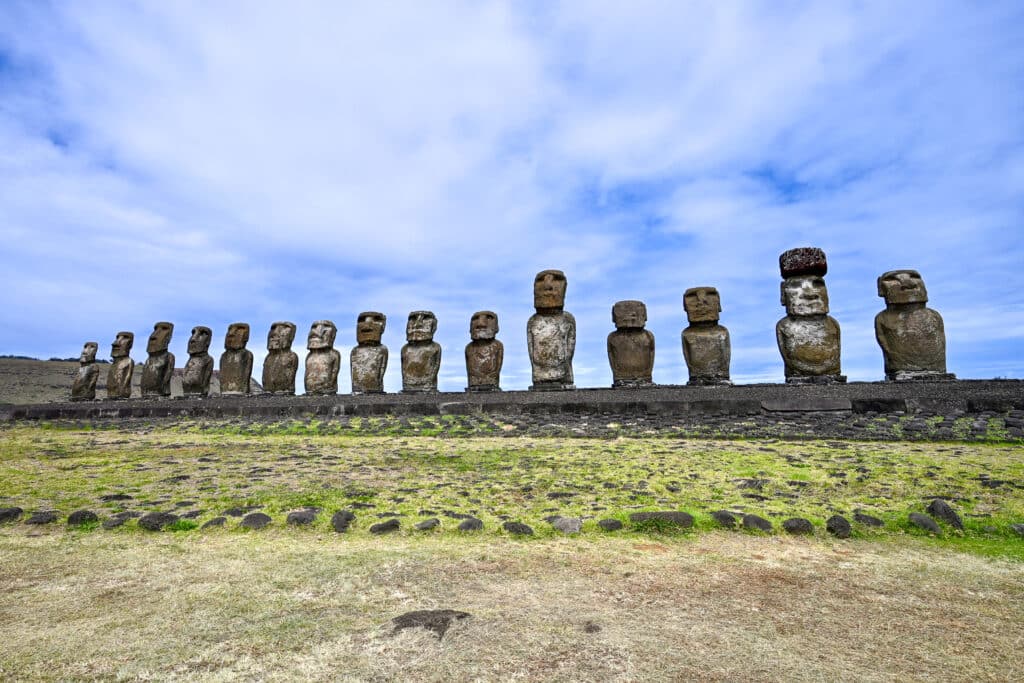
Do not miss Ahu Tongariki on a trip to Easter Island.  It is without doubt the largest and most impressive ceremonial platform on Rapa Nui (Easter Island), with 15 moai standing upright on the Ahu. 

Ahu Tongariki was re-erected by a team working for archaeologist Claudio Christiano in 1994. They used a crane capable of lifting 55 tones, the capacity of which was stretched trying to upright the largest moai at Tongariki which weighed 88 tonnes.  This is fine until you stop to think that the Polynesians didn’t have cranes, or any other mechanical tools, just human muscle. 

Nothing can prepare you for the size and scale of Ahu Tongariki.  At a width of 220 meters, it is awe-inspiring.  I loved the fact that the moai are all different shapes and sizes, just like real people! 

Grassy back with a wide stone platform stretching across the frame supporting 15 human form stone carved statues - different shapes and sizes. One has a red hat. Area in front of the platform remarked with ring of stones. Blue sky with patchy cloud above.
Ahu Tongariki - wide angle lens required!

Elsewhere on the Tongariki site

7 topknots – which could not be re-added back to the moai due to damage to their heads. 

A moai lying on the grass – sadly this one didn’t make it onto the platform, as it must have been broken in transit from the quarry.  

Petroglyphs – viewed from wooden platforms. 

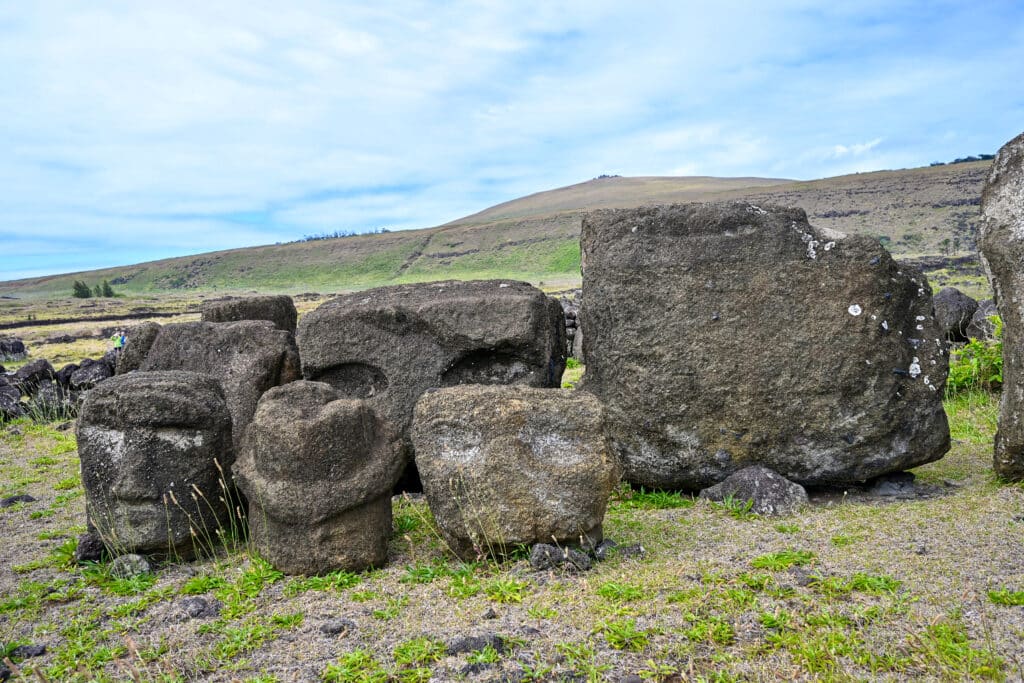
Field with patchy grass and hill behind. Pale blue sky filled with patchy cloud. Rows of carved stone blocks sit on the grass. The first three look like human faces. Larger blocks behind- eye sockets visible.
Old moai carvings lying around the back of Ahu Tongariki

Don’t forget your National Park tickets

Ahu Tongariki is a designated site in the Rapa Nui National Park, so you need your national park tickets with youPack them in your bag the night before, so that you don’t forget them when you alarm clock goes off very early for the sunrise! 

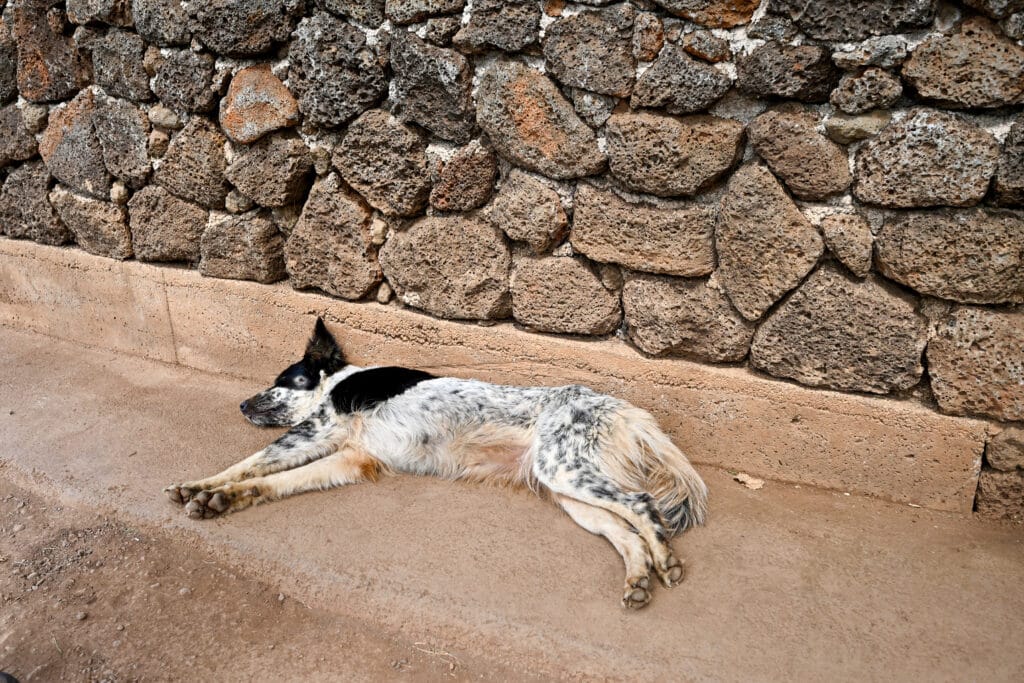
A white dog with black markings is flat out asleep, with legs and paws stretched out in front of him. Black ears and face patches. Lying on the flour but with back against a stone wall.
One of the Rapa Nui National Park employees - asleep on the job!

What to expect from a visit to Ahu Tongariki at sunrise

Visiting for sunrise without a guide

Whilst you do need to be with a guide to enter the walled off area around Ahu Tongariki as it is part of the Rapa Nui National Park, you can watch the sunset from outside the site walls by the side of the road.  You will just be further away but should still have a good view. 

Note – be aware of horses on the road if you are driving along the south coast road in the dark. 

However, on a special trip to Easter Island, you will no doubt want to be as close to the action as possible.  In which case you need to visit the site with a guide. 

Powered by GetYourGuide

On a guided tour to see the sunrise at Ahu Tongariki

If you’re on a guided tour to see the sunrise at Ahu Tongariki, then your guide will tell you the correct time to leave the hotel to arrive in time for the sunrise.  I think we arrived 45 minutes before sunrise when the sky was already shapeshifting with colours. 

Your guide will set you up with camping chairs in their favourite spot to watch the sun rise and hopefully provide the coffee.  Our guide set us up on a raised hillock to the right of the platform. 

View down a grassy bank towards a wide stone platform towards the left of the middle supporting 15 large stone human form statues. A bay and ocean behind. Sun rise sky. A man in red and black plaid shirt sits to the bottom left of frame pouring coffee. A second man sits in the first of two green camping chairs.
Deck chairs and coffee at the ready...

In summertime, the sun rises directly behind the statues, while in winter it rises from behind Poike volcano on the left-hand side, so bear this in mind for your seating depending on the time of year for your trip to Easter Island.   

If it’s cloudy or rainy when you wake up in Hanga Roa, don’t panic as the weather can vary quite a bit across the island – you might still get a good sunrise at Ahu Tongariki and sometimes rain clouds can make the sky look mean, moody and dramatic (in a good way). 

Once again, the ‘spirit dogs’ joined us for our experience.  Our guide explained to us that they are fed by the Park Rangers in turn for chasing horses and cows away from the moai.  So, technically, the dogs are Rapa Nui National Park employees! 

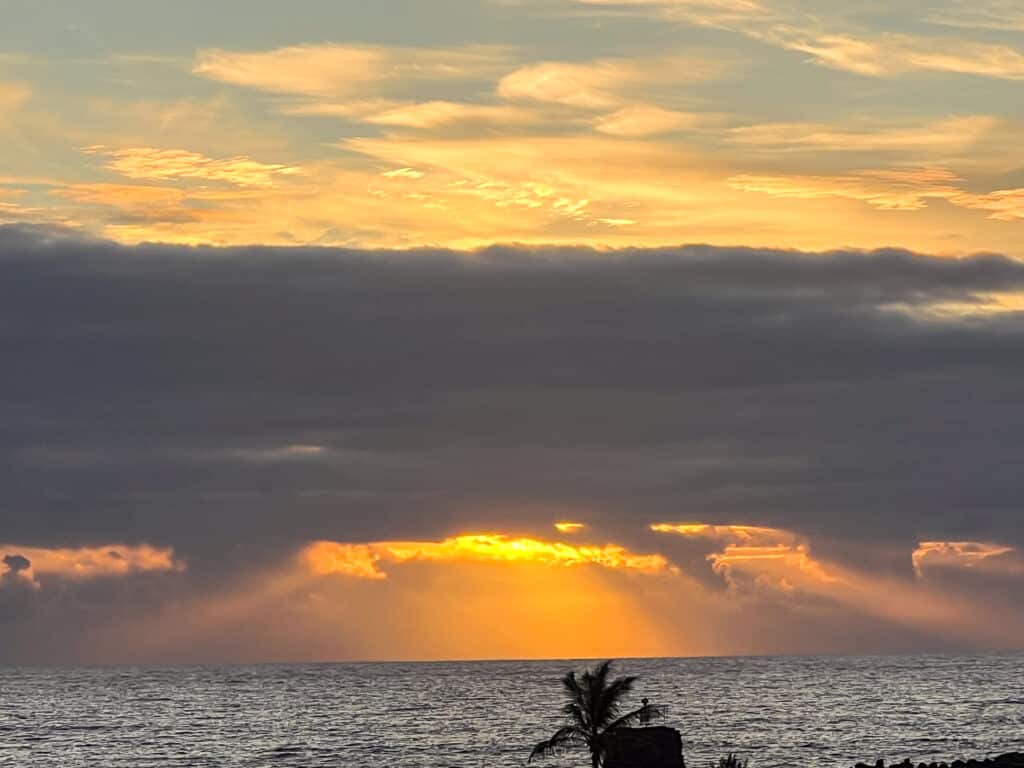
a sky filled with golden sun rise but largely hidden under a horizontal bank of grey cloud. Sun beams escape from the bottom of the cloud over a dark sea. One silhouetted palm tree at the bottom.
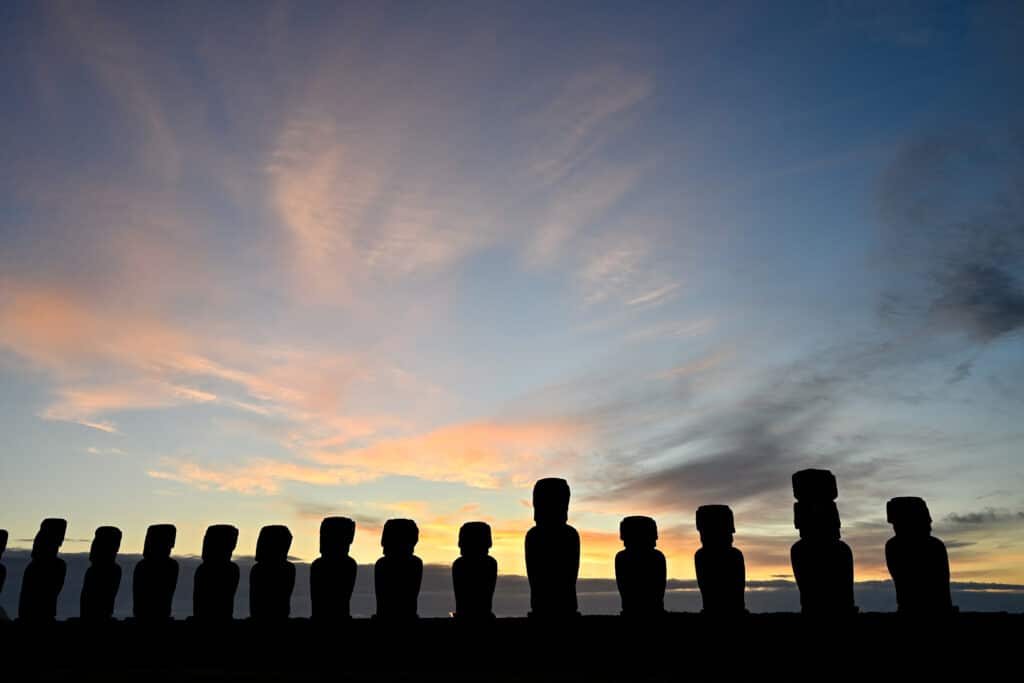
Row of 15 stone statues stretch across the bottom of the frame. they are in silhouette - all different shapes and sizes. A multi coloured sun rise sky behind.
What a way to wake up!

It was difficult to put into words just how special this experience was, watching the colours and the light change, the clouds move, as everything started to wake up – all accompanied by the sound of the ocean waves crashing and birds tweeting. 

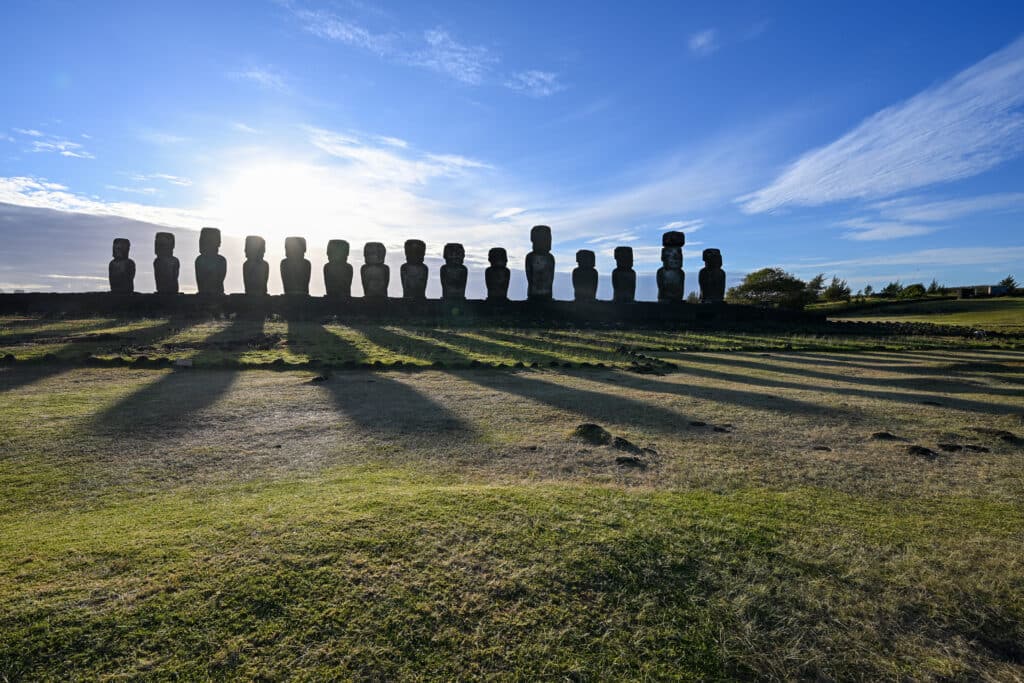
We stayed on at Tongariki for a while, after the sun had come up and after most people had left.  During this time long shadows of the moai cast on the ground looked cool and made for great photos.  So, stick around – don’t rush off or you’ll miss that! 

View across a grassy field to a stone platform running across the horizon with sihouetted stone statues on the platform. Blue sky and sun rise behind. A white dog with brown ears sits looking at the camera directly in the foreground.
Bottom third a grassy field. A wide stone platform stretches across the middle of the frame. 15 stone carved statues stand on the platform - in human form, all different shapes and sizes. Blue sky above with whispy white cloud. Long shadows of the statues are cast on the grass in front as sunrise behind.
Long shadows of the moai on the grass

Final thoughts...

The best introduction you can have to Rapa Nui on a trip to Easter Island is to enjoy sunset at the Tahai Complex, and the best lasting memory of the island can be gained by watching the sunrise at Ahu Tongariki. Anything that happens in-between is a bonus! 

You will feel connected with nature and with something else, more spiritual and powerful, by partaking in these experiences.  It’s difficult to fully explain, so you’ll have to plan a visit to Easter Island yourself to see what I mean….. 

Thank you so much for reading my blog, I hope you found it useful? 

For more stories, itineraries, and advice, check out my Related Posts and sign up to receive my blogs by email. 

If you have a blog-related question, please do ask in the Comments box and I’ll try to help… 

Request please – if you use my photos, then please credit Love Travel Planning on your social media or give me a shout out on Instagram @lovetravelplanning as I am growing my website. Huge thanks. 

 
Enjoy your travels! 

Subscribe to my newsletter!

Stay up to date with my adventures & travels across the world.

Leave a reply

Subscribe to my newsletter!

Stay up to date with my adventures & travels across the world.