The Calgary Stampede gets all the attention, and rightly so, but it is not the only rodeo in Alberta worth building a day around. When the dates for the big one did not line up with our family road trip through the Alberta Badlands and Canadian Prairies, we found ourselves booking tickets for the Strathmore Stampede instead, about forty minutes east of Calgary airport, with very little idea of what a rodeo actually involves.
We are glad we did. Here is everything we wish we had known before we arrived.
The Strathmore Stampede is a four day rodeo and fair held at the start of August at the Strathmore Stampede Grounds, forty minutes from Calgary. Parking is on site with both free and paid options, tickets are sold by session rather than by day, and the afternoon rodeo plus an evening chuckwagon session makes the best single day for a first timer.
Strathmore is a town in Alberta, about forty minutes’ drive east of Calgary International Airport along the Trans-Canada Highway. The Stampede Grounds sit on Wheatland Trail, roughly five minutes from the centre of town.
The Stampede runs over four days at the very start of August, usually taking in a weekend and finishing on a Monday. Dates shift slightly from year to year, so check the official Strathmore Stampede website before you book flights or accommodation around it.
A few things that make the timing worth knowing:
It is a short window: Four days, once a year. Unlike a museum or a viewpoint, you cannot simply turn up another time.
Accommodation fills early: Strathmore is a small town and the Stampede fills it. Book well ahead or stay in Calgary and drive out.
There is a free parade: The Stampede parade runs through downtown Strathmore on Saturday morning and costs nothing to watch.
Championship Monday is different: The final day runs to its own schedule, so check times rather than assuming they match the earlier days.
We came on Saturday, straight off a flight, and it turned out to be an unexpectedly good way to beat jet lag. Nothing keeps you awake quite like a bull running loose in an arena.
Parking is on site, in fields next to the Stampede Grounds, and there is more than one option:
Free general parking: Available in the main field beside the grounds. This is what most visitors use and it is what we used.
Paid parking: Closer options are available at a charge if you would rather not walk far.
VIP parking: A paid, premium option nearest the entrance.
Accessible and senior parking: A free designated area, worth asking about at the gate if anyone in your group would benefit..
Off site overflow: Free parking away from the grounds with transport laid on to bring you in.
Golf buggies shuttle visitors between the car park and the showground, which is both welcome after a long walk across a field and a slightly ridiculous way to arrive. Our teenagers were delighted.
Two practical notes from our visit… There are gopher holes in the parking field, and the organisers have put up signs about them, which we thought was very Canadian. Watch your footing, particularly in longer grass. And arrive earlier than you think you need to, because the walk from the far end of the field to the gate is longer than it looks from the road.
Parking arrangements can change year to year, so confirm the current setup on the Stampede website before you travel.
The Strathmore Stampede is currently the 3rd largest rodeo in Canada, after the Calgary Stampede and Festival Western de St-Tite rodeo in Quebec. Tickets are sold by session rather than by day, which confused us at first and turns out to be the most useful thing to understand about the whole event.
Your options broadly are:
A full event pass: Covering all days of the Stampede.
A day pass: Covering everything happening in one day.
Single session tickets: For one specific performance, such as the afternoon rodeo or the evening chuckwagons.
A small number of tickets are held back for sale on the gate, so if your plans are fluid you can change it. We would not rely on this for a weekend day.
We booked online from the Stampede website before leaving the UK. The tickets arrived by email straight away and the process was straightforward. Prices vary by session and by age, with cheaper tickets for under eighteen, so check current rates on the official site rather than budgeting from anything you read elsewhere.
Buy the afternoon rodeo and the early evening chuckwagon session on the same day. That gives you the full range of what a rodeo is, without committing to four days of it. It is exactly what we did and we did not feel short changed.
We took our seats for the afternoon rodeo with no real idea what we were looking at, so here is the version we wish someone had given us. The rodeo is a series of separate timed or scored events, run one after another, with entertainment filling the gaps. If you’re interested in seeing what happens, we created an Instagram Reel of our time at the Stampede.
The main sessions you will see are:
Bareback riding: The rider must stay on a bucking horse for eight seconds, holding on with one hand and no saddle.
Saddle bronc: The same eight second challenge, this time in a specialised saddle. Considered the classic rodeo event.
Bull riding: The most dangerous of them. One hand, eight seconds, on a bull rather than a horse.
Barrel racing: The women's event, where riders race a cloverleaf pattern around three barrels against the clock.
Team roping: Two riders working together, one roping the steer's head and the other its hind legs.
Tie down and steer wrestling: Timed events testing the working skills that rodeo grew out of.
Between the main events, the entertainment keeps coming. We watched the Calgary Stampede Showriders perform formation displays on horseback, children of about eight to twelve trying to stay on very lively miniature ponies with mixed success, and mutton bustin’, in which much smaller children in crash helmets attempt to ride a sheep. All of them fell off. All of them cried. We have no further comment.
The Strathmore Stampede is very much an agricultural event aiming to bring the agricultural community together, and a key date in the Alberta calendar.
The evening session is where Strathmore does something the other rodeos do not.
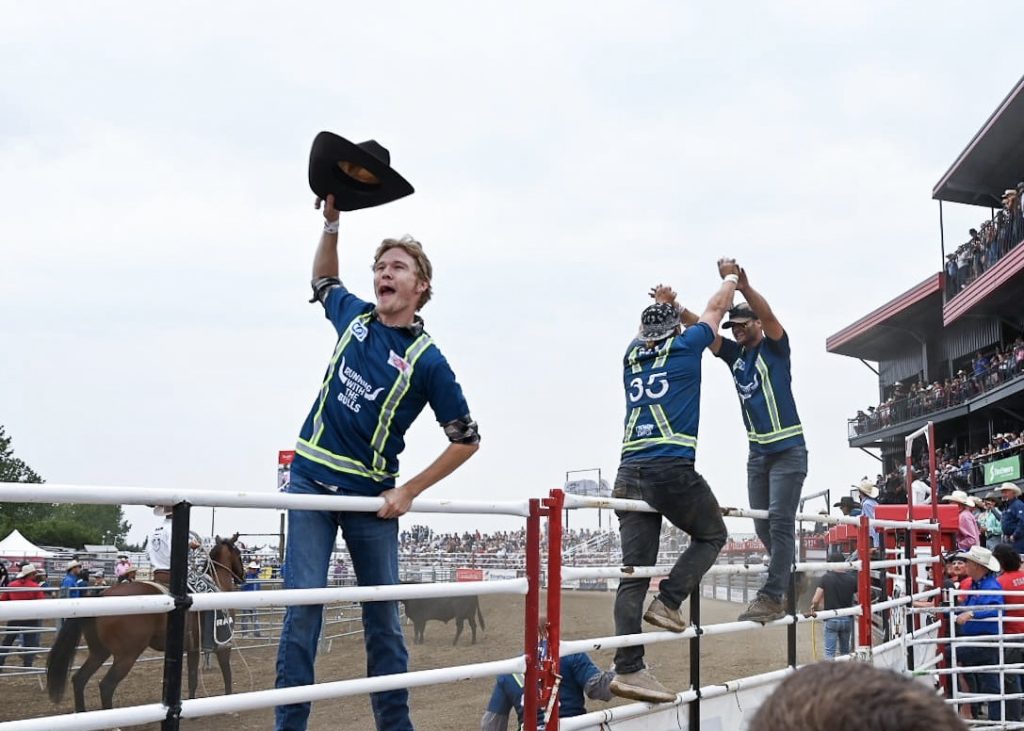
Running with the Bulls has been held here since 2003 and Strathmore is its Canadian home. Around seventy runners register to face three rounds of untamed bulls inside a fenced circular track set up in the infield. The objective, beyond the obvious one of not getting hurt, is to be the bravest and most entertaining runner out there. A panel of judges and the crowd decide the winner, who takes home a cash prize, a belt buckle and the bragging rights.
We could not quite believe what we were watching. At one point we were convinced two runners in front of us had come to serious harm, until they reappeared unhurt on the railings and we realised it was their red handkerchiefs we had seen flying, not anything worse. Anyone can register. Not for us, at any price, but the crowd loves it.
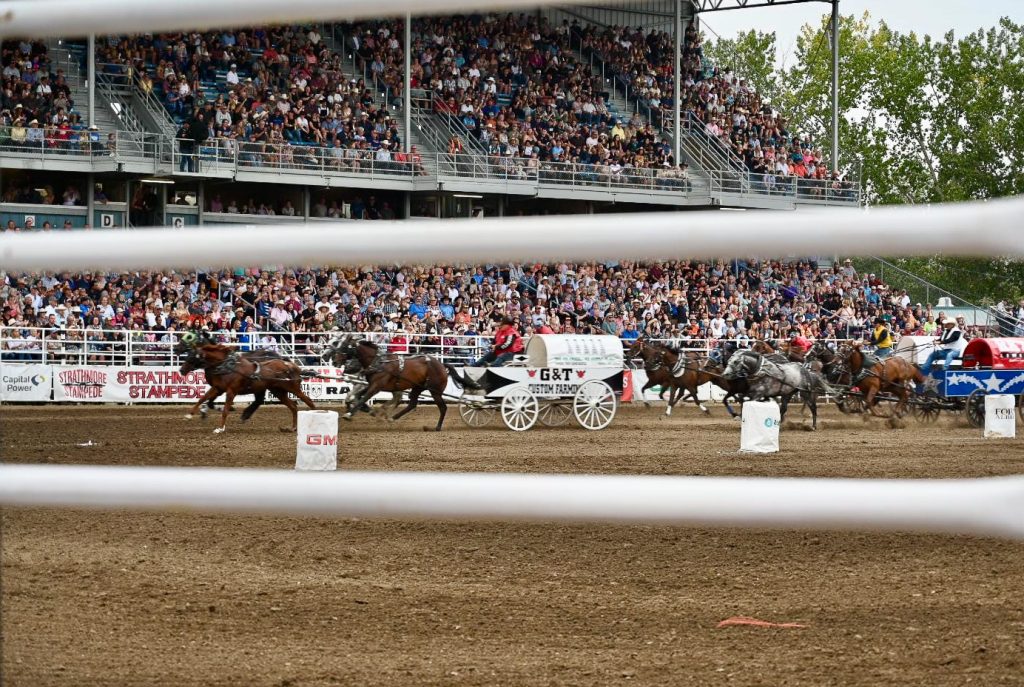
Chuckwagon racing closes the evening and it is the better spectacle of the two. Four horse drawn wagons are loaded, race a figure of eight around barrels in the arena, then charge out onto a longer track behind the stadium to the finish. The horsemanship is remarkable and the noise is extraordinary. There is much less room out there than you would think, and the fact that the wagons do not collide is the whole reason to watch.
The main grandstand is where you want to be for both the rodeo and the chuckwagons. It is open air and largely uncovered, so bring a hat and sun cream for an afternoon session and a layer for the evening, when the prairie cools quickly once the sun drops.
Practical points from our day:
Afternoon sessions typically run early afternoon to late afternoon.
The Running with the Bulls and chuckwagon double bill runs into the evening.
We took a DSLR in with no issue. Bag checks were done at the gate and the atmosphere was relaxed.
Food trucks, a live music stage, merchandise stalls and a mechanical bull all sit outside the grandstand
This varies by year and by venue, so confirm on the official site before you pack.
The area outside the grandstand is worth arriving early for. There are farm animals, agricultural machinery on display and a very large cowboy boot, in case you were in any doubt about where you had ended up.
Wearing yellow at a rodeo is considered bad luck, and it is a superstition taken more seriously than you might expect.
The most widely given explanation is that yellow is the colour of cowardice. The phrase “yellow bellied” was frontier slang for a coward, and no competitor wants that association following them into the arena. A second version holds that the superstition grew from the bright yellow once worn by rodeo bullfighters, the performers known as rodeo clowns, whose job is to draw a bull’s attention away from a fallen rider, which tied the colour to danger.
Either way, you will see very little yellow in the arena. Competitors also avoid fifty dollar bills, carrying loose change while competing, eating chicken beforehand and putting a hat down on a bed. It is a superstitious sport.
Nobody will stop you wearing yellow in the grandstand. But now you know.
Yes, and with one honest caveat.
What we liked most, beyond the arena itself, was the crowd. Locals in cowboy hats, cowboy boots and Wrangler jeans rather than Levi’s, meeting and greeting family and friends across the stands. It felt like a community coming together across every age group rather than a show staged for visitors. Strathmore is smaller and friendlier than Calgary, and for a first rodeo we would argue that is an advantage rather than a compromise.
On the animals, we went in with reservations and we think it is fair to say so. Rodeo is a contested sport and the welfare of the stock is the reason why. Livestock at professional rodeos in Canada is subject to animal welfare rules covering equipment, veterinary presence and handling, and we did not see any animal injured during our time at the Stampede. We are also under no illusion that this is true at every rodeo, every time.
If that sits uncomfortably with you, it is a reasonable thing to weigh up before you buy a ticket. We are glad we went, we would go again, and we would not pretend the question does not exist.
Strathmore has a handful of accommodation options in town, and they book up around the Stampede dates, so reserve early if you want to stay close.
We stayed just outside town at The Gathering Ranch, which we found through Airbnb, about eleven minutes from the showground, sharing the property with the owners and their two dogs. They cooked us a breakfast of steak burritos before we set off the next morning, which is not a bad way to start a road trip.
The alternative, and a sensible one, is to base yourself in Calgary and drive out for the day. Forty minutes each way is nothing, the road is easy, and Calgary gives you far more choice on hotels and restaurants. If you are flying in and out of Calgary anyway, this is the simpler option.
For food on the day, the showground food trucks cover it. We would not plan a restaurant meal around a session.
In closing
The Stampede works best as the opening act of something larger. It is close enough to Calgary airport that you can land, check in and be in the grandstand the same afternoon, which is exactly what we did.
From Strathmore, the obvious next move is east and south. Drumheller and the Alberta Badlands sit about an hour and a half away, and the Cypress Hills, with its ranch stays and its Fort Walsh history, carry the cowboy theme onwards properly. Both slot into a wider loop through Alberta and Saskatchewan.
Let 'er buck!
Thank you so much for reading my blog. For more stories, itineraries, and advice, check out my Related Posts and sign up to receive my blogs by email.
If you have a blog-related question, please do ask in the comments box below and I'll try to help.
A little request: if you use my photos, please credit Love Travel Planning on your social media or give me a shout out on Instagram @lovetravelplanning as I am growing my website. Huge thanks.
Join thousands of travelers looking for inspiration from our FREE Planet Travel newsletter!
Your step-by-step framework for stress-free, unforgettable trips — from first idea to final itinerary.