A trip to Vienna in winter offers a multitude of options for the perfect seasonal city break. Vienna is a very smart and cultured city, so if you like history, art and classical music then you will be spoilt for choice. However, there is much more to Vienna than Mozart and Beethoven. Having visited twice now during the winter season, I have made a good start but still have plenty of the city left to explore. Here are some ideas about what to include on a visit to the City of Music, or the City of Dreams.
Vienna is the perfect place for a winter city break, offering a UNESCO recognised Old Town, smart streets filled with twinkling lights and decorations, buzzing Christmas markets, cosy cafe culture, renowned art galleries, incredible Royal palaces, live music events, and a chance that it might snow. As an aside, it is also a fantastic summer destination, but that’s for a separate blog.
The typical length of time for a city break is 3 days and as the main sights in Vienna are clustered in a relatively compact area, Vienna makes a perfect city break destination. Vienna in winter also works well, as you enjoy the outdoor sights and then warm up in the cosy cafes or museums afterwards.
If you want to travel further afield then there is an efficient tram and metro system, for example, to visit the impressive Schönbrunn Palace.
Whilst Vienna makes a great year-round destination, this blog is about a winter trip so I’ll save the vineyards and River Danube trips for a future blog.
The ideal time to travel to Vienna in Winter is during the Christmas market season which runs roughly from mid-November until the end of December each year. These seasonal markets are one of the main attractions in the city during the darker nights, and Vienna does them very well. If the Christmas markets aren’t a priority, then consider going in January or February, when the chance of snow might be higher.
Vienna is a refined city, full of art, culture, and history (as mentioned above). Vienna in winter makes for a romantic get-away destination for couples.
However, it is also a fun place to visit with friends, due to the very convivial atmosphere at the Christmas markets.
It perhaps lacks the cool factor appreciated by teens, but would be appreciated by young adults, particularly if they like music and the arts.
As mentioned above, the range of activities you can do in Vienna in Winter is huge – way more than you can fit into a short city break, so here are some highlights and ideas to help build the perfect trip, depending on what you like to do.
On the assumption that you will have around 3 days for a winter city break in Vienna, you will quickly find that time evaporates leaving you with a long list of things that you couldn’t fit in. The following blog aims to highlight the elements that you could include, so that you can shape your trip to Vienna in winter to suit your tastes.
But first, some basics…
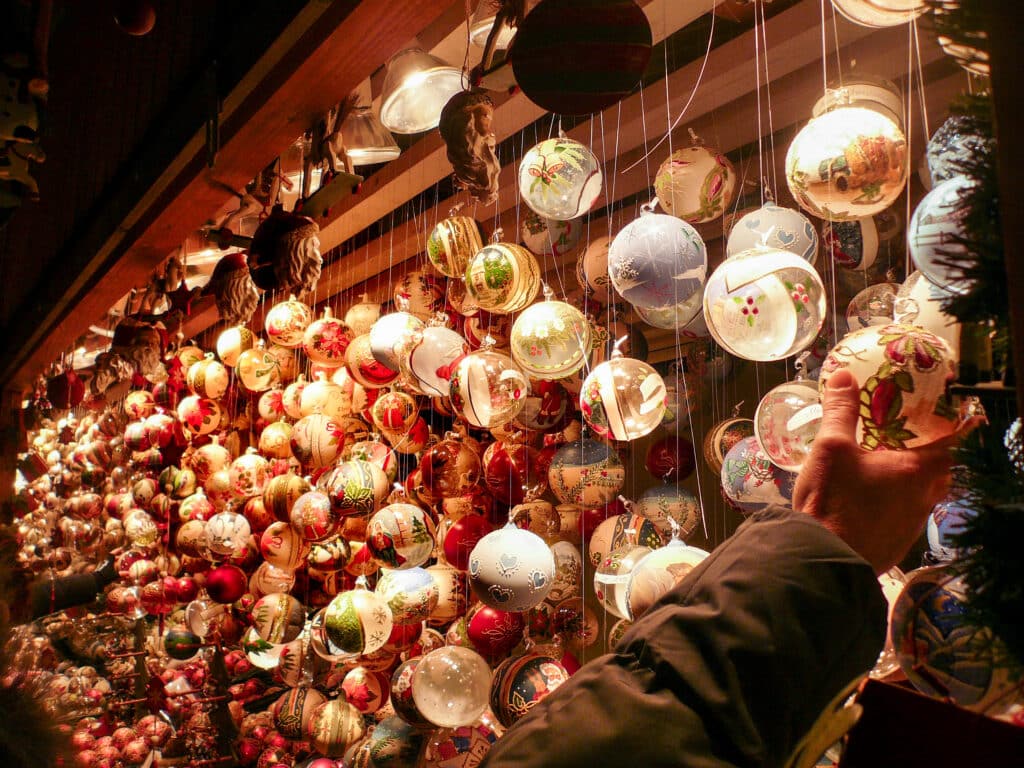
A visit to the Vienna Christmas markets is usually the main event on a trip to Vienna in winter. As the markets take place all over the city, then you don’t need to visit them all; just picking one or two will do. My advice would be to spend time in one Christmas market in the centre of Vienna, and secondly, to make the trip to the Christmas Market at Schönbrunn Palace.
For more information about Christmas market options, check out my blog: Vienna Christmas Markets: Date, Which To visit And What To Expect.
St Stephen’s Cathedral (Stephansdom) sits proudly in the centre of Stephansplatz in Vienna’s Old Town. It is a Gothic masterpiece, and one of the most popular landmarks in the city. For great views over Vienna’s Old Town, climb the 343 steps of the South Tower and earn your Wiener Schnitzel for dinner.
Tiled roof – from the top of the tower, you can gaze down on the incredible roof made of around 230,000 colourful tiles, laid out in the form of the Habsburg coat of arms which depicts a double-headed eagle wearing the emperor’s crown and the Golden Fleece. It was originally built before 1474 but restored after fire damage in WWII.
It was a misty winter day when we climbed the South Tower, but this made for atmospheric views over the Old Town. The roof tiles looked even more colourful given the grey skies above.
North Tower escalator – if you want the view but without climbing the steps, you can take an elevator in the North Tower; this ascends to the bottom of the cupola, the green domed bell house which tops the tower. As well as seeingthe tiled roof of the Cathedral, you will also be able to view the Pummerin Bell, one of the largest free-hanging bells in the world.
Tickets can be purchased from the kiosk at the bottom of the stairs – Cash payments only.
Find out more about visiting Stephansdom in my blog, Vienna Old Town: A Self-Guided Winter Walk Through The Innere Stadt.
Vienna has long been a centre of coffee shop culture. Whilst the origin of its coffee culture is debated, by the 18th century, grand coffee houses were well established as places to meet and relax over conversation or a newspaper. Even Mozart and Beethoven performed in early coffee houses.
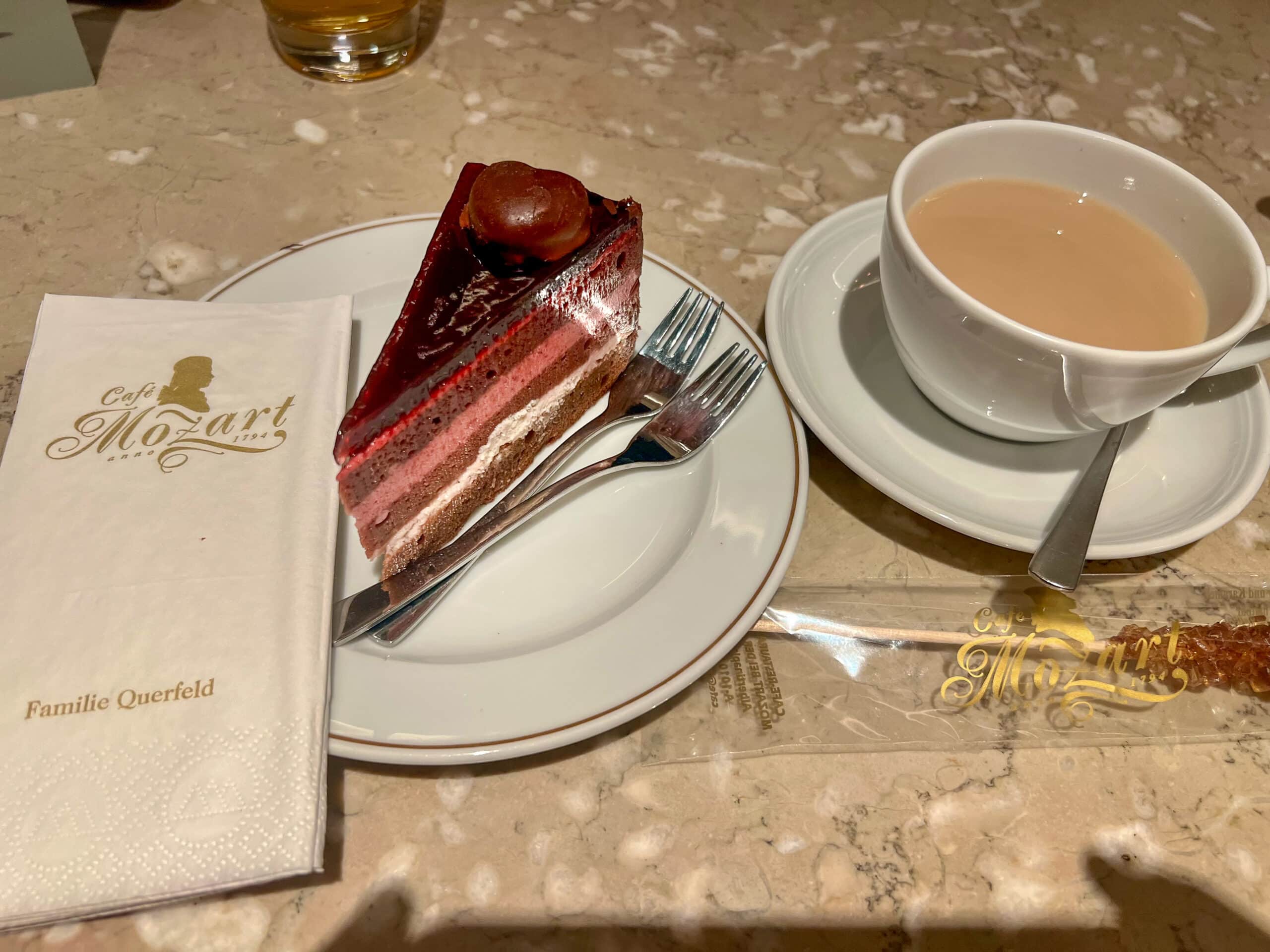
Whichever coffeehouse you decide to visit, take your time – order a Kaffee und Kuchen (coffee and cake) and let the hustle and bustle of the Christmas markets leave you far behind. You will be served a glass of water alongside your coffee, even if you order a Wiener Melange (mild milky coffee like a cappuccino).
We visited the following cafes:
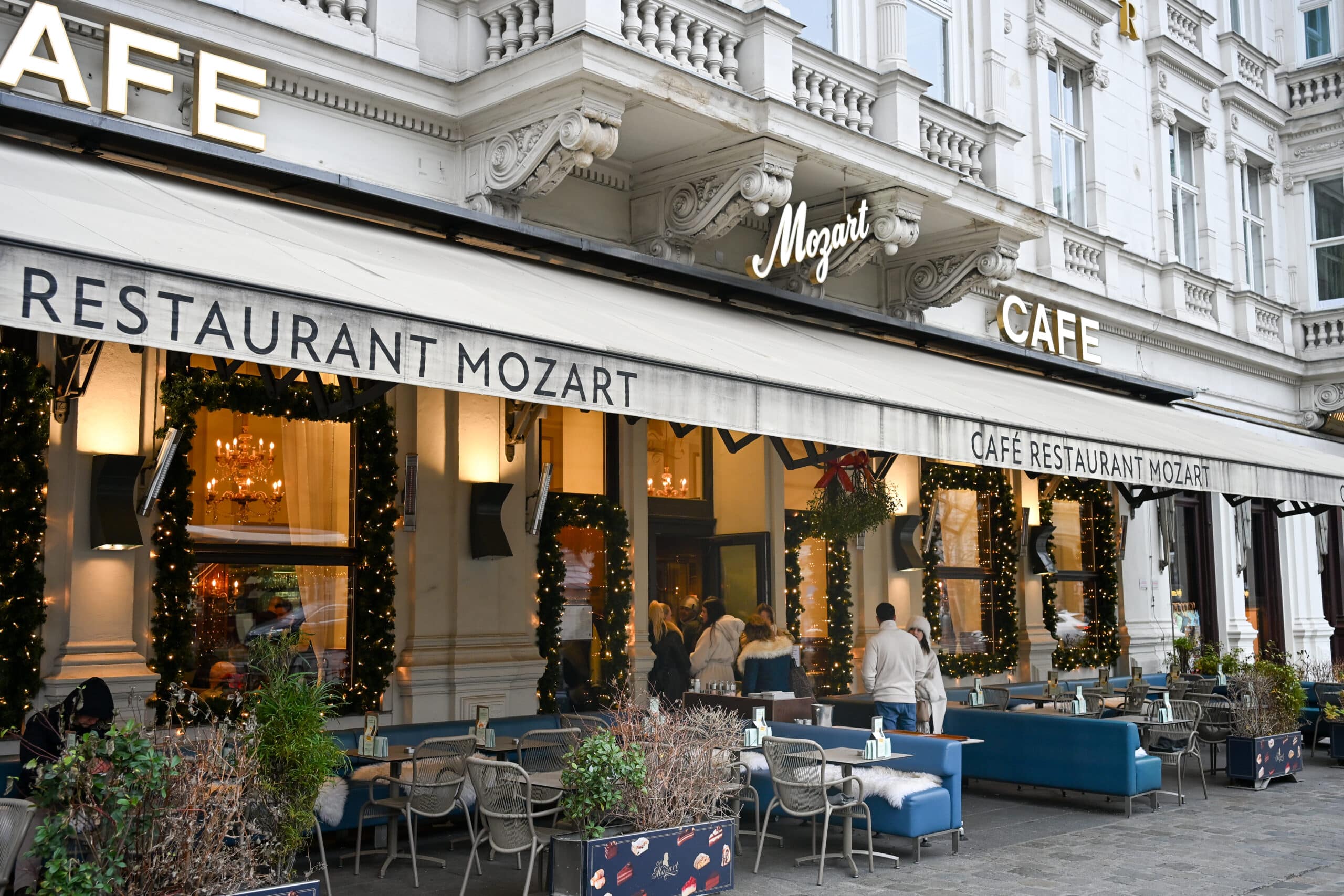
Café Mozart, after a visit to the Vienna Opera House and enjoyed the grand environment with tall ceilings, wood paneled walls and mirrors.
Cafe Hawelka, a family run coffee shop once frequented by artists and writers. This one was less grand, but more atmospheric – you could imagine it filled with smoke in the days when cigars were allowed inside.
Cafe Schwarzenberg – a beautiful coffeehouse with high ceilings, mirrors and chandeliers. It has a display case at the far end of the cafe featuring signed photos from Falco who sang the 1980s song ‘Amadeus’.
For information about other coffee shops such as Café Central and Café Sacher, check out my blog, Vienna Old Town: A Self-Guided Winter Walk Through The Innere Stadt.
Can’t decide which ones to visit? Then consider booking a guided tour of several coffee houses, such as:
You can’t visit Vienna in winter without crossing paths with the Hasburgs – the ruling family for over 650 years. The best way to learn more about the Habsburg dynasty, and the impact they had on this beautiful city, and futher afield, is to book a tour of either the Habsburg Palace (winter residence), or the Schönbrunn Palace (summer palace).
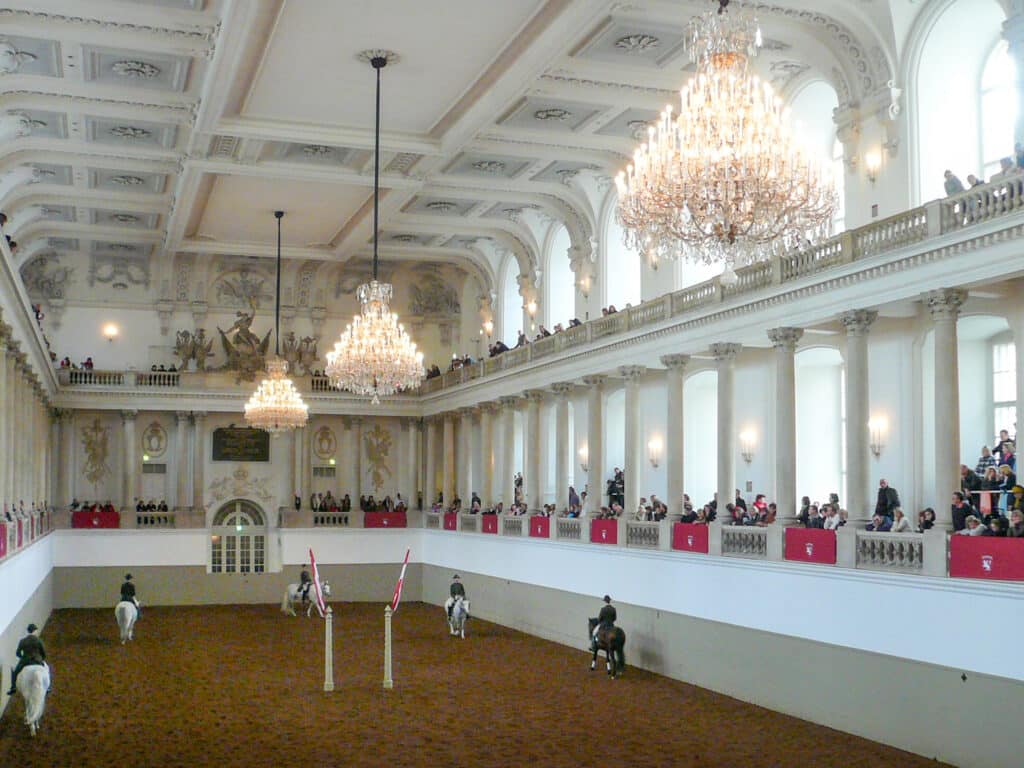
You can visit the Spanish Riding School at the Habsburg Palace and see the famous ‘dancing’ Lippizzaner horses in training (see feature photo).
For more information about a guided tour of the Schönbrunn Palace, check out my blog, Vienna Schönbrunn Palace: Guided Tour, Gardens And Christmas Market.
If you love ice-skating when its cold and wintery, then there are a couple of Vienna Christmas markets which have ice-rinks, namely:
Vienna Ice Dream, Rathausplatz – which runs through the Christmas market season from mid November to the beginning of January.
Schönbrunn Palace Christmas Market – this market has a small ice-rinkk in front of the gorgeous yellow Imperial summer palace as a backdrop.
Both these seasonal ice-rinks have the opportunity to try curling as well as ice-skating.
For fun at the fair, head to Prater Park in Leopoldstadt, Vienna’s 2nd District. Metro – take the U1 or U2 line to the Praterstern station, at the main entrance to Prater Park and closes to the famous Wiener Riesenrad (Giant Ferris Wheel) which featured in the 1949 film The Third Man starring Orson Welles.
Austrian artist, Gustav Klimt (14 July 1862 – 6 February 1918), was a founding member of The Vienna Succession Art Movement. This group of young artists rallied against tradition and formed their own group.
Quote coined by art critic Ludwig Hevesi as the guiding principle for the Vienna Secession movement.““To every age its art, to every art its freedom”
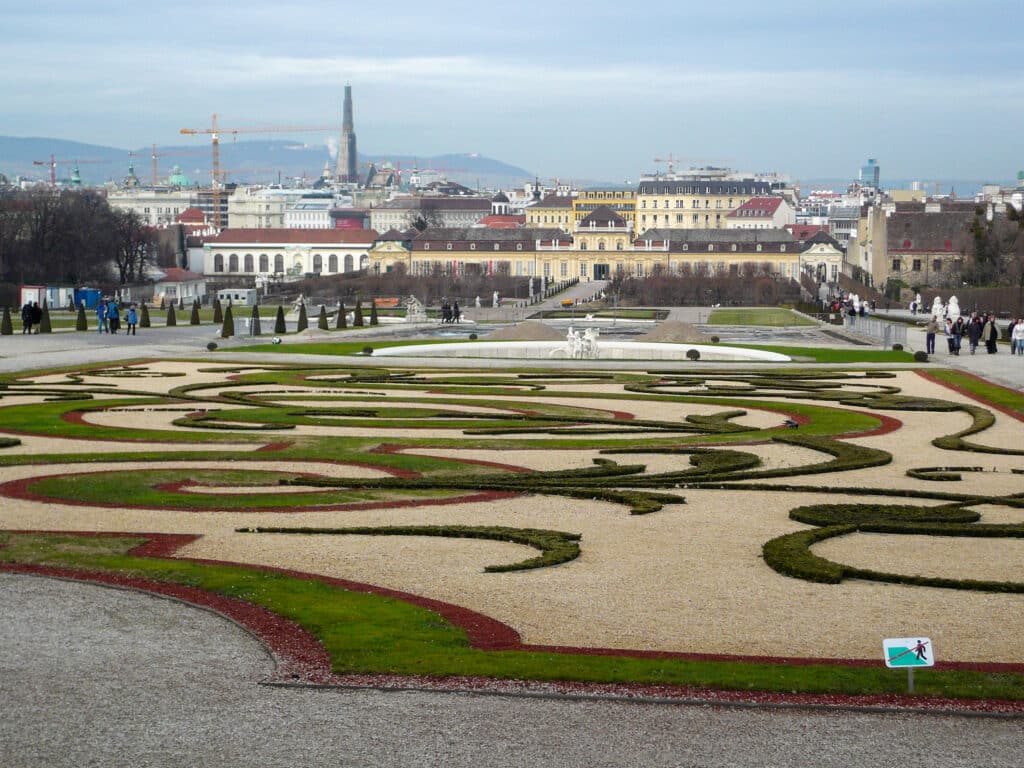
The largest collection of his artwork is on display at the Belvedere Museum, the old summer residence of Prince Eugene of Savoy. In the Upper Belvedere, there are 24 beautiful Gustav Klimt paintings on display, including his most famous artwork, The Kiss (1907) painted in oil and embossed with gold leaf. It’s an absolute stunner!
Klimt’s paintings suit a visit to Vienna in winter very well because they are bright and sparkly like Christmas lights, and if the weather is a bit dull, they are a welcome beacon of light and colour. The work of other Succession Movement artists, such as Egon Schiele are also on display at the Belvedere.
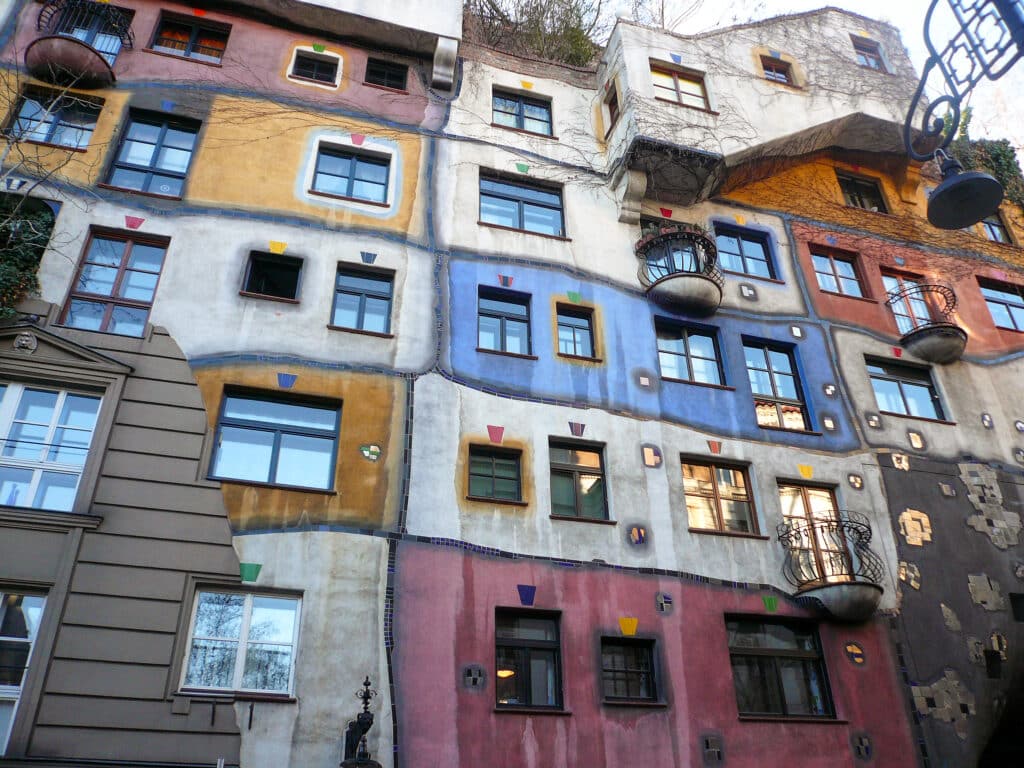
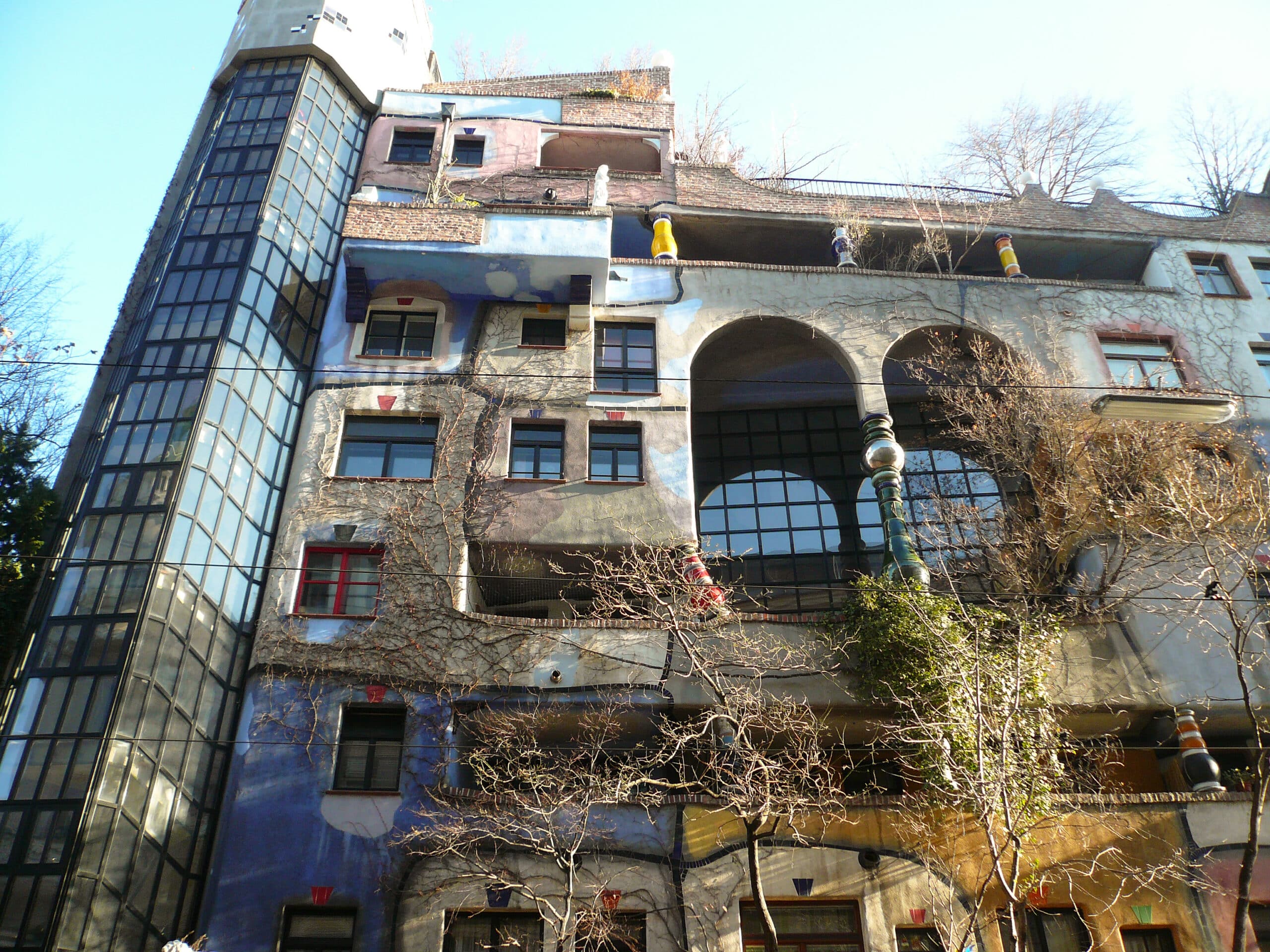
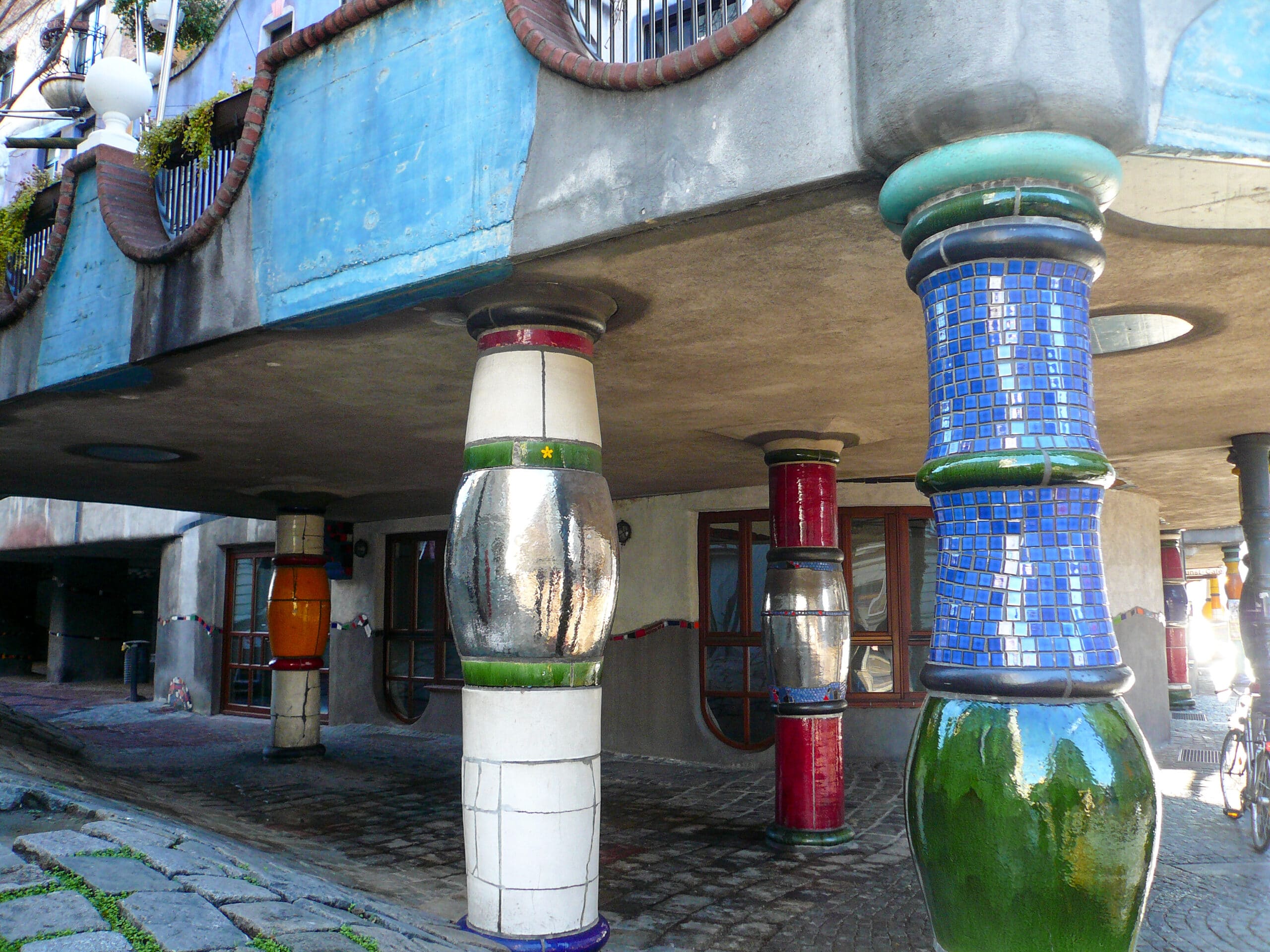
If you love buildings, then try to fit in a visit to the Hunterwasserhaus in the 3rd District (Landstrasse), at the corner of Kegelgasse and Löwengasse. It’s close to the Hetzgasse tram stop.
Designed by Friedensreich Hundertwasser (1928–2000), the Hunterwasserhaus is an expressionist landmark erected between 1983 and 1985. It is a collection of apartments and offices with undulating floors and brightly coloured walls. As his goal was to blend human architecture with nature, there are trees growing inside the building and vegetation on the roof.
As this residential building is occupied, you can only view it from the outside. However, if you want to know more about his work, then you can visit Museum Hunterwasser at the Kunst Haus Wein, just a 6-minute walk away.
Vienna’s nickname of The City of Music comes from its long-standing relationship with classical music – the birthplace of Mozart, Strauss and Beethoven, and home to Brahms. The city is filled with opportunities to listen to a classical music recitalin a beautiful setting. Regular offerings include:
Mozart and Strauss at the Golden Hall of Music
Vivaldi’s Four Seasons at Karlskirche.
The Hofburg Orchestra in Hofburg Park.
Classic ensembles at Peters Church.
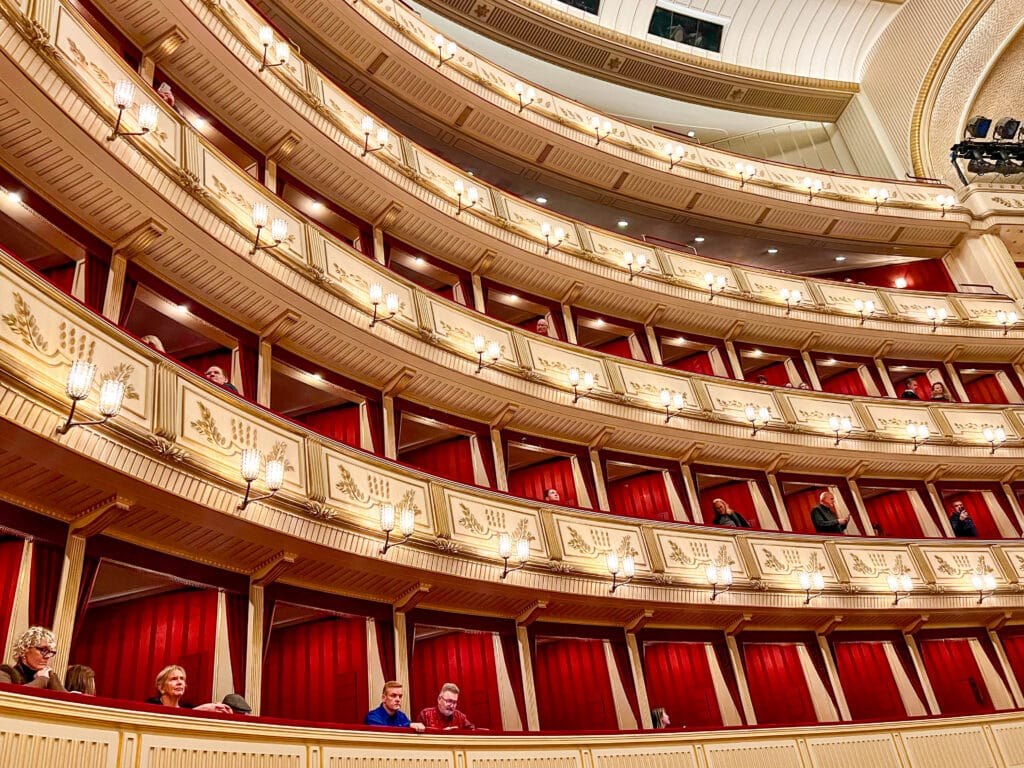
Opera and ballet lovers can catch performances at the Vienna State Opera. We saw the ballet version of Mozart’s Die Fledermaus at the State Opera which was a very special evening. The main auditorium is absolutely stunning, and it felt very festive with the Christmas tree in the main hall. A perfect Vienna in winter activity.
Before your trip to Vienna in winter, watch the 1984 film 'Amadeus' about Mozart to find out more about his life in the city of Vienna.
Whilst Vienna has lots of famous offspring (some of the musical ones are mentioned above), Sigmund Freud is one of the most notable for having developed psychoanalysis (talking therapy). He raised the concept of the unconscious mind and the push and pull of the id, ego and superego. Sometimes referred to as the Father of Modern Psychology. He also worked on Dream Analysis which has lead to the nickname of City of Dreams for his home, Vienna.
To learn more, visit the small but mighty Freud Museum at Burggasse 19, where you can view where he lived and worked, includings his Waiting Room and Treatment Room.
Several high-profile movies were filmed in Vienna, so you can do some film location spotting as you explore Vienna in winter. Here are some of the easier ones to see:
The Third Man – 1949 film noir starring Orson Welles.
The Giant Ferris Wheel at Prater Park.
Molker Bastei - an area full of cobblestone streets and historic doorways. It features in the iconic Third Man scene where Harry Lime (Orson Welles) is first revealed hiding in a dark doorway with a cat.
A Dangerous Method – David Cronenberg’s 2011 film about Sigmund Freud and Karl Jung starring Keira Knightly, Viggo Mortensen and Michael Fassbender.
Cafe Sperl .
Belvedere Palace.
Sigmund Freud’s House (now the Freud Museum).
Before Sunset – 2004 film about a couple who meet on a train and spend one day and night together in Vienna before parting ways. Starring Ethan Hawke and Julie Delpy.
Maria Theresien Platz.
Kleines Cafe in Franziskanerplatz – where the two main characters stop and engage with a fortune teller.
Glühwein– Vienna in winter can be cold, so what better way to warm up than to grab a glass of warm, spiced red wine (gluhwein) from one of the formal Christmas markets or a more informal stall on the main streets of Vienna. We found one on Graben Street before heading for dinner nearby.
Zum Schwarzen Kameel (‘the black camel’) – centrally located near Peterskirche, this restaurant is a great place for dinner on a city break to Vienna in winter. The restaurant is large, with a downstairs bar and brasserie style informal dining room with great buzz and atmosphere. Upstairs is a much quieter Art Nouveau style dining room where you can enjoy more formal menu options. It is extremely popular so you will need to book. We can recommend the Weiner Schnitzel from here.
Note – The Figlmüller restaurant is one of the best places to eat Schnitzel in Vienna. It opened in 1905 and serves paper thin Schnitzel which hang off the plate. It’s on our list for next time!
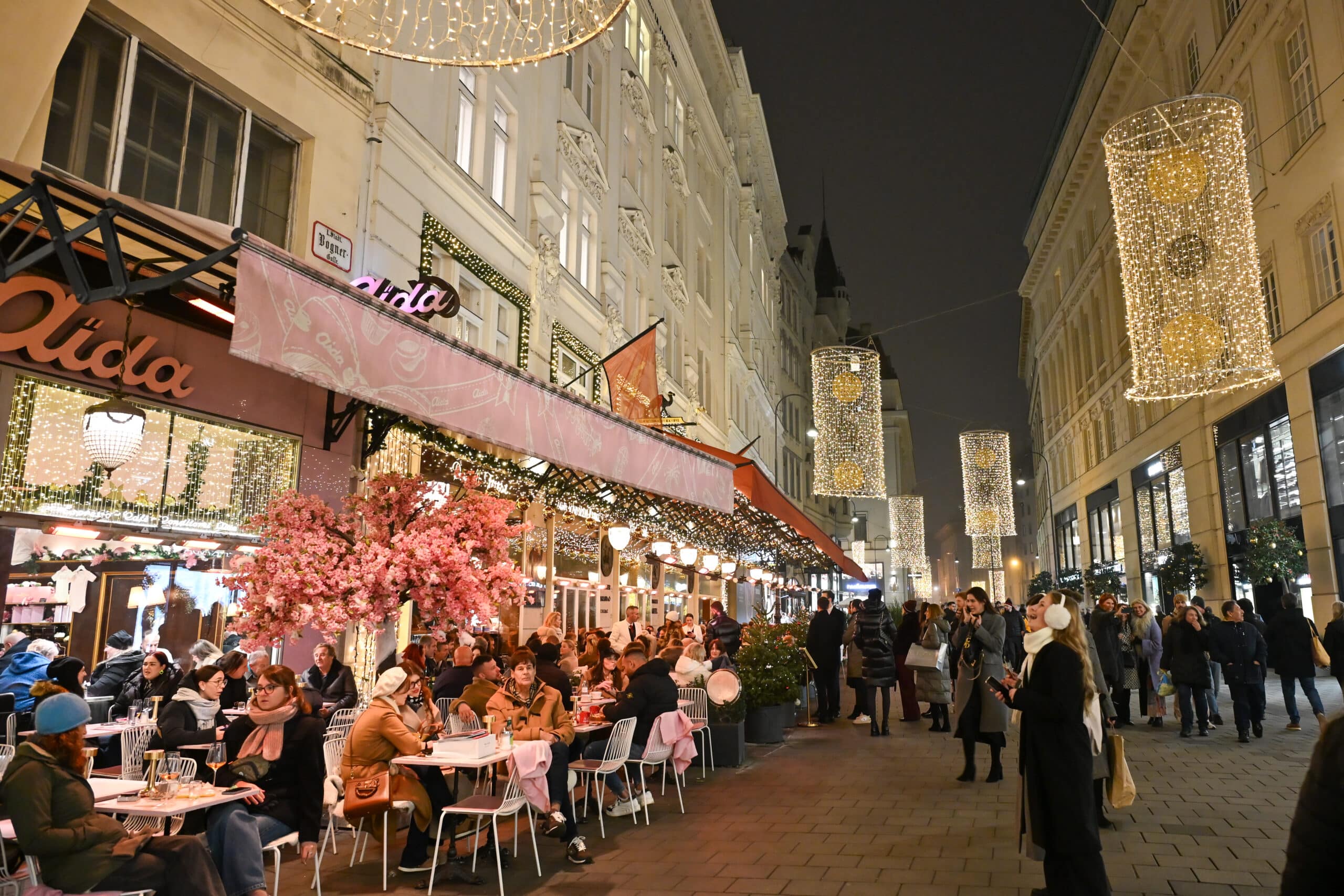
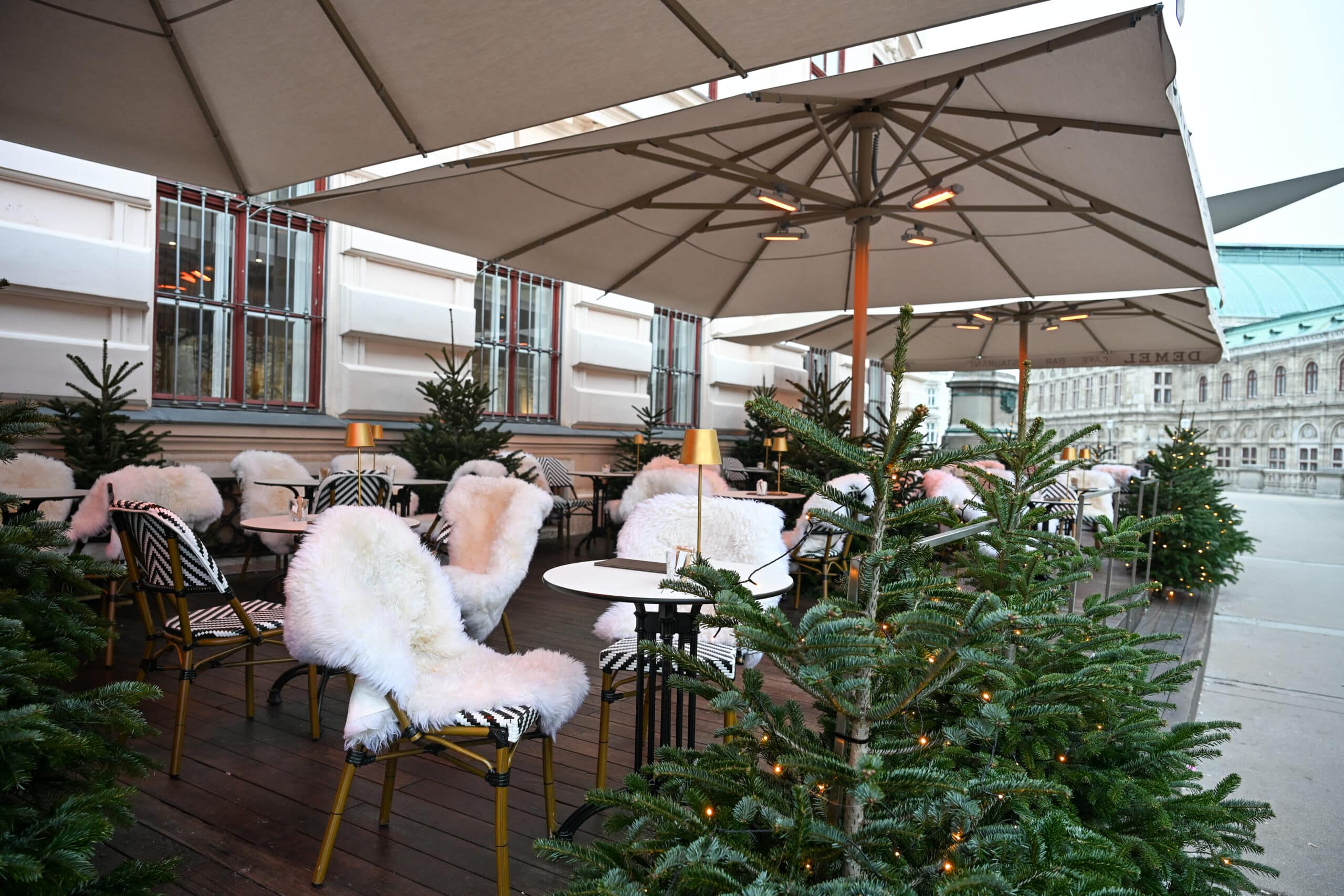
Even in winter, people still eat outside in Vienna if the weather is not too wintery. Many restaurants are set up with heated terraces and patios so the convivial atmosphere can continue through the winter season.
The Christmas markets are the best place to start your Christmas gift shopping in Vienna. However, the main shopping area is fille with high end and High Street options. You can even pick up a real Christmas tree on Graben Street!
For pretty and authentic Austrian biscuits, head to Pirker Lebkuchen on Stephansplatz to pick up nicely packaged gifts.
For a more significant gift, visit Paper Republic to pick up a leather diary with refills and can be customised to your preferences.
Note that many shops in Vienna are shut on a Sunday.
Here’s what your winter city break to Vienna could look like by piecing together some of the elements from above:
| Day | Morning | Afternoon | Evening |
|---|---|---|---|
| Day 1 | Travel to Vienna |
|
|
| Day 2 | See The Kiss at Belvedere Palace or the Albertina Museum |
|
|
| Day 3 | Schonbrunn Palace and Gardens |
|
|
| Day 4 | Freud Museum | Final shopping | Travel home |
Winter in Vienna is a busy time of year, so do your research and book any tours or restaurant tables in advance. There were some of the classic coffeehouses that we couldn’t get into without booking.
Austria follows Schengen Area rules which requires that UK citizens on a full British Passport have:
passport with date of issue less than 10 years before the date you arrive, and
an expiry date at least 3 months after the day you plan to leave the Schengen area.
Visas – As a tourist from the UK, you can travel without a visa to the Schengen area for up to 90 days in any 180-day period.
Remember to check the entry requirements in advance of travel, as this can change from time to time, and may be different for other nationalities.
Health care – To get medically necessary state healthcare in Austria, you need a Global Health Insurance Card (GHIC) or a European Health Insurance Card (EHIC).
There are lots of accommodation options in Vienna, something to suit every taste and budget – from urban lifestyle stays in an Airstream at Hotel Daniel to high end options such as Hotel Bristol or Hotel Sacher opposite the Vienna State Opera House.
We used points to stay at the InterContinental Wien IHG Hotel, on the south side of Stadt Park and opposite the Stadt Park Metro station. Behind the hotel was the Vienna Ice-Skating Club so some of the bedroom views look out over the ice-rink which is lovely in winter.
Whilst most of the key sights centre around Vienna’s Old Town and are walkable, you might occasionally want to venture further afield. If this is the case, Vienna has a very efficient Tram and Metro system, allowing you to move around easily. This can be very welcome if the winter weather is particularly cold or wet.
It is easy to get from the Airport to the city centre on the Express CAT train to Wien Central. It only takes 16 minutes (non-stop) and runs every half an hour. We paid 15 Euros for an Adult Single.
In closing
As you can see from the suggestions above, there is plenty of choice for a city break in Vienna in Winter. In fact, too many options for a short stay. We felt that time seemed to evaporate as we wandered the cobbled streets, ogled the Christmas lights, and browed the Christmas Market stalls - so, try not to pack your itinerary too tightly. Similarly, if you visit one of the gorgeous coffee houses then you don’t want to rush it.
Whatever you decide to do, I’m sure that you will end up feeling very festive by the end of your trip, which presumably is the desired effect.
‘Frohe Weihnachten’ – Merry Christmas!
Thank you so much for reading my blog. For more stories, itineraries, and advice, check out my Related Posts and sign up to receive my blogs by email.
If you have a blog-related question, please do ask in the comments box below and I'll try to help.
A little request: if you use my photos, please credit Love Travel Planning on your social media or give me a shout out on Instagram @lovetravelplanning as I am growing my website. Huge thanks.
Join thousands of travelers looking for inspiration from our FREE Planet Travel newsletter!
Your step-by-step framework for stress-free, unforgettable trips — from first idea to final itinerary.