The Vienna Schönbrunn Palace is Austria’s biggest tourist attraction, welcoming up to 3 million visitors each year. Whilst popular all year round, it is particularly busy during the winter season when the Schönbrunn Palace Christmas Market takes place in the Palace courtyard; ironic really, when you consider that it was built as the summer residence of the Imperial Habsburg family. Here’s your guide to visiting Schönbrunn during the winter season.
⚡ Overview
If you’re wondering whether to visit the Schönbrunn Palace and its Christmas Market, then don’t skip a beat as it is a real gem – the Palace building, it’s history and the extensive gardens filled with fountains, palm houses and even the World’s oldest zoo are truly impressive. The Schönbrunn Palace Christmas Market adds another layer of wonder – located in an incredible setting and full of all the essentials for festive gear and cheer!
Table of Contents
About the Habsburgs
Before we start, it’s good to know a little about the Schönbrunn Palace and who lived there, namely the Habsburgs.
A brief introduction to the Habsburgs
The Habsburgs were the ruling family across (mainly) Central and Eastern Europe for nearly 650 years, from the 13thcentury to 1918. Over this time, as you can imagine, a lot of history passed under the bridge – too much to run through in detail here, but here are some headlines:
Rudolph 1, King of Germany
In the 1270s, Rudolph 1, King of Germany (and a Habsburg) won a battle in which he took control of a land called Austria, including a place called Vienna.
The Habsburg Empire
Over time, Vienna became the centre of the Habsburg ‘Empire’, the area controlled by the family. Rather than being a formal empire, it was more a loose collection of lands which changed over time due to weddings, inheritances, wars and politics.
Formation of a single state
Until 1804, the Habsburg Empire was not a single state, run from a single administration, as each land under the Habsburg umbrella retained some level of authority.
Maria Theresa
Maria Theresa was a key Habsburg figure and the only female leader during this era. Technically she co-ruled with her husband Emperor Francis 1(Franz Stephen); whilst he had the title of Emperor, Marie Theresa was really the one in charge, but without the title of Empress. During her 40-year rule (1740-1780), she had 16 children (including Marie Antoinette) and 56 grandchildren.
Emperor Franz Josef I
Emperor Franz Josef I was the longest ruler of the Habsburgs after his 68-year rule; he was born and died in the palace. Unfortunately, the start of the Great War in 1918 was on his watch. He only had one son with his wife Sisi – Franz Ferdinand, the heir to the throne, was shot by an uncle who hated him. After this it became too difficult to continue the throne line of the Habsburgs and the monarchy ended in 1918, although the family remained large.
The Habsburg Palace (Winter residence)
The Habsburgs built two palaces in Vienna: the Habsburg Palace and the Schönbrunn Palace. The Habsburg Palace, an enormous palace in the centre of Vienna, was built as the winter residence of the ruling family. Today, you can take a guided tour of the Palace to see the State Rooms, apartments, and Royal Silver collection, as well as visit the Sisi Museum.
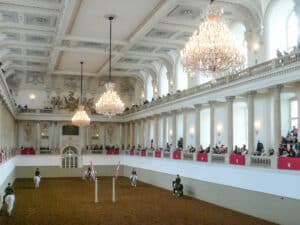
In addition, you could book a guided tour of the Spanish Riding School which is based at the Habsburg Palace; either to see behind the scenes of this 450 Riding School, or to watch a performance of the famous dancing Lipizzaner stallions. Alternatively, try to book a ticket to one of the dressage training sessions to see the ‘dancing’ horses at the palace.
Some form of manor house and hunting ground had existed on the site of the Vienna Schönbrunn Palace since the 16th century; the name Schönbrunn (‘beautiful spring’) having said to have come from a hunting trip when the Emperor of the day, Mattias, discovered a spring here. A fire destroyed the original hunting lodge in 1683 which was rebuilt by Emperor Leopold 1 as a ‘pleasure palace’.
The Schönbrunn Palace (Schloss Schönbrunn) was developed in the 18th century by Marie Theresa as a summer residence. and the Schönbrunn Palace you see today. After this, the palace became the centre of court life and shining star of the Habsburg empire.
This stunning yellow palace is enormous, with 1441 rooms; at the height of its use, the palace had nearly 7,000 people living there. The Palace was a popular workplace as servants believed the Habsburgs were good employers by 19th century standards.
Today, 200 people still live in the palace. Most of these people have old contracts of residency and employment, inherited from their previous family generations.
Schonbrunn 'Summer' Palace
💡
UNESCO World Heritage Status
The Vienna Schönbrunn Palace, Gardens and Schönbrunn Zoo were collectively given UNESCO World Heritage Status in 1996 and so is celebrating 30 years of recognised world heritage status this year (2026).
Tours of the Schönbrunn Palace and Gardens
The best way to learn more about the Habsburg dynasty, and to experience the scale and splendour of the palace first hand, is to is to book a guided tour.
If you book a tour of the Vienna Schönbrunn Palace and Gardens, then you can visit the Schönbrunn Palace Christmas Market before and/or after visiting the Palace. You need to walk through the market to get to the entrance of the palace, so in many ways, there is no escaping the Christmas market!
We took the following tour of the Schönbrunn Palace, booked through Get Your Guide:
We booked the 9.30am tour (2 hours) thinking that it would be a little quieter first thing in the morning, but it was already very busy by the time we got to the palace. We certainly weren’t on the first tour of the day. I would imagine a lot of people had the same strategy as us, to combine a visit to the Schönbrunn Palace Christmas Market with a tour of the Palace and Gardens.
Getting to the Schönbrunn Palace
The Schönbrunn Palace is located in the Heitzing or 13th District, outside the centre of Vienna. We took the U4 Subway Line from Vienna’s Stadtpark station to Schönbrunn which took just 17 minutes and was easy to navigate.
Stadpark Station, Vienna
Fun Fact:
30 mins from the centre of Vienna to the Schonbrunn Palace is not a bad travel time, given that it took the Habsburgs 3 hours to travel between their two Vienna palaces by horse and carriage!
Meeting place for the tour of the Vienna Schönbrunn Palace
The meeting place for our tour of the Vienna Schönbrunn Palace was the Group Centre (Visitor Centre) outside Schönbrunn station. The Visitor Centre is located outside of Palace grounds and has a ticket desk, shop and toilets. After uniting with our guide, we were given headsets before walking towards the Palace entrance with our guide and group.
On arrival at the Schönbrunn Palace
The Star Portal of the Schönbrunn Palace Christmas Market is the first thing that you see on arrival at the Palace – a large and illuminated golden star marking the entrance to the Christmas Market. Be warned – It’s almost impossible to avoid people in your photos when taking a photo of the star with the gorgeous yellow palace in the background!
Walking around the edge of the Schönbrunn Palace Christmas Market to the entrance of the Palace gives you the chance to check out some of your target stalls for later.
Entrance to the Schönbrunn Palace Christmas Market
What to expect inside the Vienna Schönbrunn Palace
Once inside the Schönbrunn Palace foyer, our guide stopped to talk us through a Family Tree displayed near the entrance. To be honest, the carousel of Habsburg names was a little overwhelming as there were so many, but some of the key names began to stick throughout the tour.
The scale of the Vienna Schönbrunn Palace is enormous, and the tour concentrates on the downstairs floor plan which includes the State Rooms and palace apartments where Marie Theresa and Emperor Joseph I resided.
Some of the highlights were the:
The Great Gallery – one of the biggest rooms in the palace at 43 meters by 10 meters, with stunning frescoes on the ceiling. It has great acoustics which were perfect for concerts and music recitals. The Great Gallery was used to impress guests, but the family were clever with their money and only used 1 kilo of gold leaf on decorations crafted from wood, giving the illusion of wealth.
One of the ceiling frescoes by Italian painter, Gregorio Guglielmi (1714–1773), depicts Marie Theresa and her husband on a throne in the centre of the picture, surrounded by characters and items representing all the counties which were part of the Austrian empire at the time (a huge area from Holland and Belgium, across to the Baltics).
Inside the Great Hall
Vieux Lacquer Room – a room covered in black lacquer panels from China. It features a painting of Emperor Franz I Stephen and was one of his key inner Reception rooms where he received visitors and held meetings.
Painting of Emperor Franz I Stephen in the Vieux Lacquer Room
Millions Room (or Mirror Room) – an extravagant room covered in wood panels with unusual carvings, paintings and mirrors on the wall, designed as an exotic illusion for Marie Theresa.
Millions Room (or Mirror Room)
Paintings of gatherings – one of the rooms was covered in paintings of gatherings (parties and music recitals) at the Palace. The Palace still has all the guest lists, and the figures were numbered in the paintings so you could see who they were; Mozart appears in one of the paintings having played his first concert here at the age of 6 years old for Marie Theresa.
Marie Theresa and Franz Stephen’s Apartments (East Wing) – this included Marie’ Theresa’s State bed in the Rich Room, from which she worked for 5 years, all the months that she was pregnant.
The Vienna Schönbrunn Palace is lucky not to have been destroyed during World War II, especially because one bomb fell through the ceiling of the palace but did not explode. The bomb was safely removed and the palace reconstructed as necessary in 1949.
The Schönbrunn Palace Gardens
Your tour will end outside in the Vienna Schönbrunn Palace gardens. As the gardens extend for 1.2 km (east to west), and 1 km (north to south), then you can work up a really good appetite before you head to the Schönbrunn Palace Christmas Market to sample all the treats it has to offer for lunch.
The gardens have been open to the public since 1779 and the Baroque park complex that you see today was developed by Marie Theresa in the 18th century. It holds an incredibly long list of treasures within the grounds, and you could spend the best part of half a day exploring the Gardens alone.
Our tour exited the palace at the gardens around the East Wing which was set up for an Imperial light show with carriages, characters and musical notes, ready to be illuminated when it got dark. I would imagine this would have looked very pretty at night.
From here wandered towards the front of the Schönbrunn Palace, passing the pretty Naiad fountain.
Naiad Fountain
Great Parterre – there are large, manicured gardens directly in front of the Palace called the Great Parterre which were intended to be an expression of the ruler’s status (baroque design) and an extension of the impressive interiors of the house.
Great Parterre, Neptune Fountain and Gloriette
Neptune Fountain – at the far end of the Great Parterre, is the wonderful Neptune Statue, where Neptune is astride a horse and looking back at the palace.
Hill to the Gloriette – From the Neptune fountain you can take a path up the hill to a structure called the Gloriette at the top which overlooks the Palace and has wonderful views. It was built in 1775 and is crowned with an Imperial Eagle sitting on a globe. At one time, the section with glass panels was used as a dining room with views!
Gloriette
As you descend the hill, you could ventureright to find: the Statue of Hercules, the Angel Fountain, the Roman Ruin or the Columbary (circular aviary built in the mid 1700s).
Enjoying the view on the way down the hill
Alternatively, you can head left to find: the Maze, Schönbrunn Zoo (the World’s oldest), statue of Diana the Huntress, and the wonderful glass Palm House erected around 1882, Cactus House and Botanical Garden.
The Palm House
Unbelievably, the list of hidden gems goes on: Orangery, Carriage Museum, Marionette Theatre, and even a swimming pool (Schönbrunn Bad). The gardens are certainly extensive.
💡
Philharmonic Orchestra concerts
Each year free concerts are given at the Vienna Schonbrunn Palace by the Philharmonic Orchestra, which people can book tickets for. Although there are 60,000 guests, the events are popular and tickets sell out.
Given the scale of the gardens, it is therefore no surprise that Vienna Schönbrunn Palace has 60 gardeners to keep these beautiful gardens looking smart. Although this is a blog about visiting Vienna in the wintertime, if you plan to visit or return in Spring then you’ll discover one million flowers in bloom at the Schönbrunn Gardens.
Strolling in the gardens
The Schönbrunn Palace Christmas Market
The Schönbrunn Palace Christmas Market was first held in the Ehrenhof (parade court) in front of the palace in 1994.
It is free to visit, and whilst you can visit the Schönbrunn Palace Christmas Market without entering the Palace, a visit in winter is the perfect opportunity to visit both.
Now that your tour of the palace and gardens is over, you can fully explore the Schönbrunn Palace Christmas Market and peruse the market against the stunning palace backdrop.
A mighty Christmas tree, provided by the Austrian Federation of Forests, stands to the left of the main entrance, which is apparently donated to the Schönbrunn Zoo after the Christmas Market season, for the animals to enjoy.
Schönbrunn Palace Christmas tree
Despite having around 90 market stalls, the Schönbrunn Palace Christmas Market doesn’t feel too large. However, it does has everything that you need for a cosy and festive Advent market experience:
Tempting Market stalls
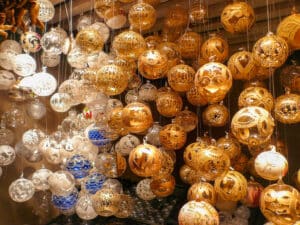
Shopping – stalls decorated with fairy lights and full of winter decorations and handicrafts, such as baubles, candles and paper stars. My best purchase from this market were some lovely, printed stationery cards in presentation boxes, perfect for gifts or a handwritten thank you.
Gift shopping
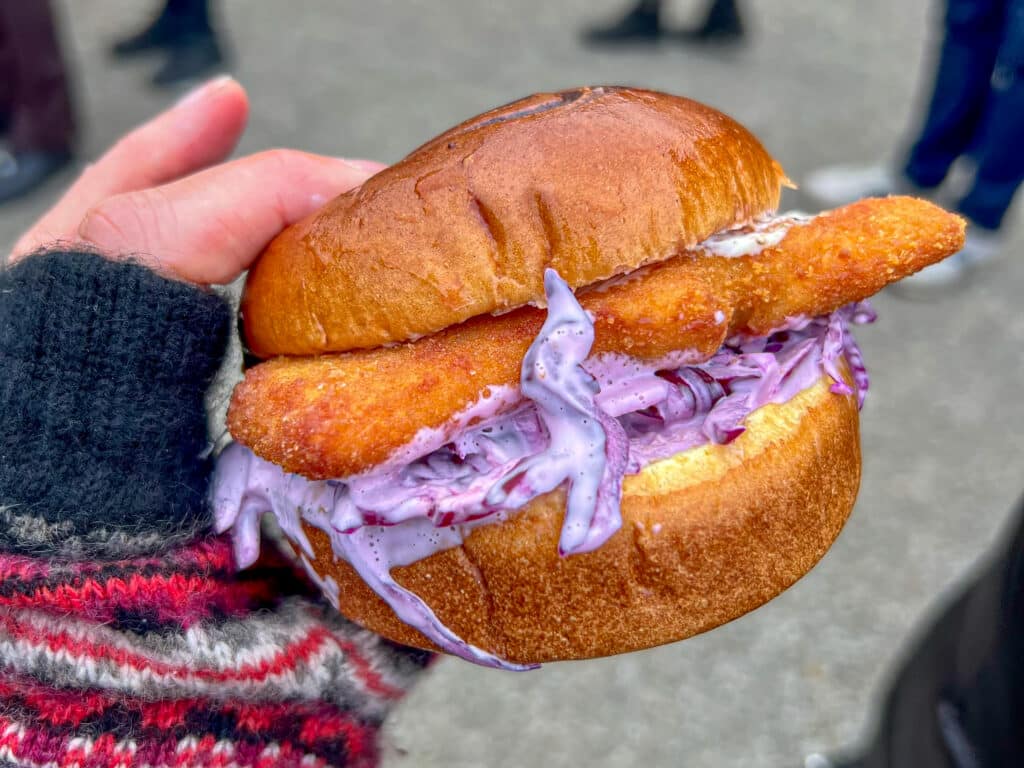
Food – this is the perfect place to pick up local and regional dishes. There is the usual collection of food stalls, plus a Lindt chocolate Christmas world. I had been advised to try the Schnitzel burgers from the Cafe Gerster stall so I tried one for lunch, and can confirm that it was worth the hype. Delicious!
Drinks – the refillable mugs are particularly pretty at the Schönbrunn Palace Christmas Market – white with gold insides, featuring pictures of the palace or Marie Theresa. Perfect for mugs of hot, steaming cider or glühwein, or a hot chocolate topped with cream and sprinkles. There’s something for all tastes.
Activities – for those wanting to burn some calories off after a lunch of bratwurst, giant pretzels and strudel, there’s a small ice-rink at Schönbrunn, and even some curling sessions. Alternatively, you can watch a wood carving or glass blowing demonstration, depending on the programme of activities.
For children – there is a small ice-rink, an old-fashioned Carousel and also a mini ferris wheel at the Schönbrunn Palace Christmas Market, making it one of the best options if you’re visiting as a family. Coupled with ice-skating and a trip to Schönbrunn Zoo, your youngsters will have a great day out here.
Classic!
In closing
Final thoughts
Our visit to the Schönbrunn Palace and its Christmas Market was one of the highlights of our winter trip to Vienna.
Whilst the Schonbrunn Palace are gardens are impressive, the Schonbrunn Christmas Market is the icing on the cake - the perfect size to enjoy all the ingredients of the festive winter day out.
Thank you Marie Theresa for developing such a beautiful palace!
If you have a blog-related question, please do ask in the comments box below and I'll try to help.
📸
A little request: if you use my photos, please credit Love Travel Planning on your social media or give me a shout out on Instagram @lovetravelplanning as I am growing my website. Huge thanks.
Enjoy your travels! ✈️
Get Planet Travel
Join thousands of travelers looking for inspiration from our FREE Planet Travel newsletter!
To provide the best experiences, we use technologies like cookies to store and/or access device information. Consenting to these technologies will allow us to process data such as browsing behaviour or unique IDs on this site. Not consenting or withdrawing consent, may adversely affect certain features and functions.
Functional
Always active
The technical storage or access is strictly necessary for the legitimate purpose of enabling the use of a specific service explicitly requested by the subscriber or user, or for the sole purpose of carrying out the transmission of a communication over an electronic communications network.
Preferences
The technical storage or access is necessary for the legitimate purpose of storing preferences that are not requested by the subscriber or user.
Statistics
The technical storage or access that is used exclusively for statistical purposes.The technical storage or access that is used exclusively for anonymous statistical purposes. Without a subpoena, voluntary compliance on the part of your Internet Service Provider, or additional records from a third party, information stored or retrieved for this purpose alone cannot usually be used to identify you.
Marketing
The technical storage or access is required to create user profiles to send advertising, or to track the user on a website or across several websites for similar marketing purposes.