Port Fairy is where my Limestone Coast road trip got within touching distance of the Great Ocean Road. Two hours from Mount Gambier and across the Victorian border, this historic fishing village sits around 30 km before Allansford, where the road officially begins. It makes a far better overnight stay than pushing on further down the coast.
I arrived on Australia Day, which by this point in the trip had become a running theme. I stayed one night, had some great meals, and then had my onward plans tested by a fire warning. All of which taught me more about Port Fairy, and about travelling this coast.
Port Fairy has a compact, walkable town centre with a working fishing wharf, beaches and a lighthouse island on its doorstep. One night is a great launchpad for the Great Ocean Road which starts at Allansford half an hour up the road.
Port Fairy sits on the Shipwreck Coast, around 30 km west of Allansford, where the Great Ocean Road officially begins for anyone travelling west to east. If you are driving from Adelaide, it is a natural overnight stop after Mount Gambier, and the last night of this itinerary before the Great Ocean Road starts.
The village is quite small, and very walkable, so one overnight works well, though with the beaches, wildlife day trips and food scene, two or three nights would not be hard to fill.
Port Fairy stands on the traditional lands of the Eastern Maar peoples, including the Gunditjmara, who knew Port Fairy as Pyipkil or Ummut and have lived in the region for tens of thousands of years. They were skilled coastal and river people, and their sophisticated stone aquaculture systems survive at nearby Budj Bim, covered in the day trips below.
If Port Fairy is one stop on a longer Limestone Coast and Great Ocean Road trip, one or two nights is the right call, and one worked for me. But, I could just as easily see it as a long weekend destination, as it has the island, the beaches, the food scene and the day trips comfortably filling three days.
My one night in Port Fairy did come with a caveat; because it was Australia Day the town centre was quieter than usual. However, of the three establishments I did go into, Bottega Toscana had great food, and the Caledonian Inn had great locals – who told me that they love living in Port Fairy because there is so much to do, but it is quiet.
Port Fairy reminded me strongly of Robe, another fishing town loved by the people who live in it, popular with those in the know, and a million miles from the crowds of Melbourne. If this sounds like your kind of place, add a second night.
The town runs markets and a packed festival calendar, headlined by the Port Fairy Folk Festival at the end of March, one of Australia’s biggest. If everything lined up, you could enjoy Mad March in Adelaide, travel down the Limestone Coast, and enjoy the Folk Festival in Port Fairy.
Port Fairy spent four decades officially named Belfast (a city we know well). But unlike its Northern Irish namesake, it is not a booming city. But that doesn’t mean that Port Fairy is only good to visit in March; in fact it has a wide range of activities and landmarks to visit year round:
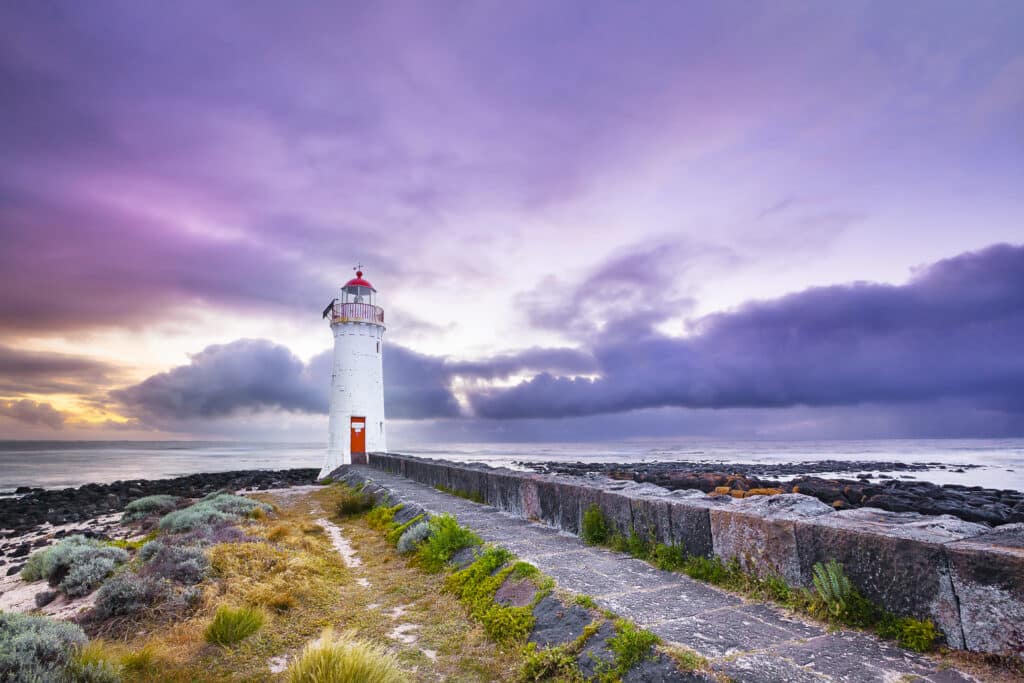
Griffiths Island is a small island at the mouth of the Moyne River, reached by a short pedestrian causeway from Martins Point near the historic wharf. The island takes its name from John Griffiths, who ran a shore based whaling station here from around 1835, the town’s first industry, and today packs walking, wildlife and history into an easy half day or less. The walk can be split into:
The full circuit: Around 2.9 km, taking just under an hour, on winding paths through coastal shrub and dunes with views over the river mouth, harbour and open ocean.
The short version: An out and back to the lighthouse, around 1.25 km each way.
Access: A formed limestone track suits prams in sections, though other paths are sandier and rougher, and tides can affect them.
The Port Fairy Lighthouse was built in 1859 from local bluestone, with views over the Southern Ocean and back towards town, and unlike the Robe Obelisk, you can walk right up to it.
From late September to around mid April, thousands of short-tailed shearwaters, also called muttonbirds, return at dusk from a day’s fishing at sea, having migrated here from Alaska. Make sure you stay on the paths, because their burrows collapse underfoot. There are also more than 80 other bird species present on the island.
Beyond the birds, there is also a small mob of swamp wallabies that graze around the island, alongside echidnas and blue-tongue lizards. If you look out to sea, you may see dolphins, seals and in cooler months, passing whales.
Port Fairy earns its living from the sea:
The wharf and Moyne River: Watch the fishing fleet come and go, and buy fresh seafood landed metres away, including southern rock lobster in season.
Pea Soup Beach: With rock pools to explore at low tide and a reputation for good sunsets.
East Beach and South Beach: Longer stretches for shoreline walks and swimming, with reefs offering natural protection in places.
If you have one or more extra days in Port Fairy, there are plenty of day trips to do:
Tower Hill Wildlife Reserve: Around 15 minutes away, a volcanic crater landscape where emus, koalas, kangaroos and wallabies roam the walking trails.
Budj Bim Cultural Landscape: Around 30 minutes away on Gunditjmara Country, a UNESCO World Heritage site protecting ancient aquaculture systems of eel traps and channels built among the lava flows. Guided cultural tours are strongly recommended for context.
The Crags: A wild coastal lookout with jagged cliffs and views out to Lady Julia Percy Island, best at sunrise.
Lady Julia Percy Island: Boat tours run from Port Fairy to the largest Australian fur seal colony in the Southern Hemisphere, with dolphins and whales possible along the way.
Most of these experiences, along with the historic walks and kayaking in town, are booked directly with local operators or through the Visitor Information Centre rather than the big tour platforms.
Port Fairy was founded as a whaling settlement, before being turned into Victoria’s second busiest port in the 1850s and renamed Belfast. Unfortunately in the 1860s it hit an economic slump and didn’t see the same boom that Melbourne did – and many of its original 19th Century buildings still remain. Because of this the town now has more than 50 National Trust listed buildings, here are the most notable:
The Caledonian Inn (The Stump): 41-43 Bank Street
Merrijig Inn (Former Royal Merrijig Inn)
Former Court House: 30 Gipps Street
Former Customers House: Near the waterfront
Former Lifeboat Station: Griffiths Street area
You can see many of them with a stroll along Bank Street and Sackville Street under the Norfolk Island pines.
If you want more structure, the Visitor Information Centre at Railway Place offers guided historic walking tours, and there are self guided options including a maritime and shipwreck heritage walk taking in Battery Hill, the old Powder Magazine and the Lifeboat Station.
The locals eventually changed the name back to Port Fairy after the economic slump.
As I only had one evening, and one morning in Port Fairy, I only visited two places for food, both of which were delicious.
Dinner was at Bottega Toscana, where the local pasta was very good and, a rare treat, there were no nuts on the menu at all. You should confirm with the kitchen on the day if you suffer from a nut allergy. Then, I had breakfast at The Mill, and the chef here was excellent again with my allergies.
Those two meals were eaten under Australia Day constraints, when only a few kitchens were open. On a normal evening the town offers far more, and my researched shortlist includes:
The Stump at the Caledonian Inn: Classic pub food with a modern twist inside Victoria’s oldest continuously licensed pub, pouring since 1844. I actually had a couple of pints at this pub, and it has a very British pub interior.
Merrijig Kitchen: Refined modern Australian built on local produce, and a long standing town favourite.
Blakes Restaurant: The contemporary seafood option, which feels right in a working fishing town.
Coffin Sally: Lively pizza in a characterful old building, and comfortably the best name on the street.
Book ahead on weekends and during festivals. If you arrive on either, you may need to book an earlier meal as some restaurants will close the kitchen earlier.
I stayed at Seacombe House, which operates as both a motel and a hotel, and it put me within an easy walk of everything above. For a one night stop between the Limestone Coast and the Great Ocean Road, it means you can park the car once and forget about it until morning.
Port Fairy has plenty of alternatives, befitting a town built for visitors:
Drift House: A stylish boutique, with contemporary suites and a strong reputation.
Merrijig Inn: Historic character with one of the town’s best kitchens on site.
The Oak and Anchor Hotel: A beautifully restored heritage hotel in the centre.
Old Market Inn and the central cottages: Great for couples and small groups.
BIG4 Port Fairy Holiday Park: Cabins and sites for families and longer stays.
Here is the part of my visit I did not plan. Over dinner in Port Fairy, I was advised not to continue along the coast to Apollo Bay because fires were burning in the Otway Ranges further east and sections of the road were under warnings. Instead, I drove to Port Campbell, which sat outside the warning area, and reassessed from there.
What I learned is that Port Fairy occupies an unusually useful position when bushfire season flares up…
The town lies west of Allansford and well away from the forested Otways, where the region’s fires tend to concentrate. Open farmland and coastline surround Port Fairy rather than the continuous heavy forest that fuels the big Otways fires, and the town has little history of major bushfire impact.
Grass and scrub fires do occur in the wider farming district on hot, dry, windy days, so stay aware, but this is not one of Victoria’s fire hotspots.
When the Otways close, the western stretch between Warrnambool and Port Campbell, home of the 12 Apostles, is usually the part of the Great Ocean Road that remains accessible.
If the whole coast is off the table, the Princes Highway runs inland from Port Fairy through Warrnambool and Colac to Geelong and Melbourne, staying well clear of the fire country, with around three and a half hours of driving on dual carriageway. The quieter Hamilton Highway makes a second inland option if you prefer back roads.
The VicEmergency app and the VicTraffic app are vital for this road trip, as they will show you where the fires are and what roads are open. Put both on your phone before this trip starts, not after, and check them each morning in summer.
Fill your tank in Port Fairy, or Warrnambool before committing to a rerouted day and carry water.
All of which makes Port Fairy the ideal place to reassess, and the true gateway to the Great Ocean Road. The town has fuel stations, food, accommodation, mobile coverage and a Visitor Information Centre, so you can settle in, check VicEmergency and VicTraffic over breakfast, confirm which sections of the road are open, and choose between the inland run and a particular coastal day via Port Campbell.
Fire warnings can change your itinerary in an instant. Build slack into your plans, listen to local advice, and trust your gut - don’t put yourself at risk.
Thank you so much for reading my blog. For more stories, itineraries, and advice, check out our Related Posts and sign up to receive Lucy's blogs by email.
If you have a blog-related question, please do ask in the comments box below and I'll try to help.
This blog was written by Tom at Smyto Creative.
A little request: if you use my photos, please credit Smyto Creative on your social media or give me a shout out on Instagram @smytocreative as we are growing this website. The rights to the featured image on this post belong to Ben Stevens. Huge thanks.
Join thousands of travelers looking for inspiration from our FREE Planet Travel newsletter!
Your step-by-step framework for stress-free, unforgettable trips — from first idea to final itinerary.