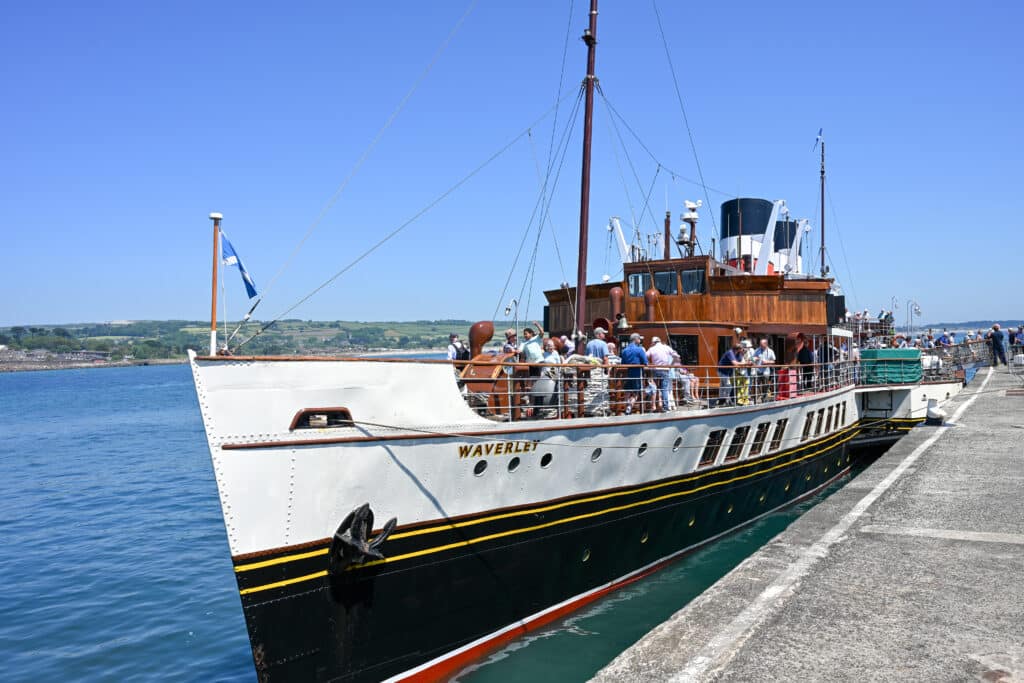
During a recent trip to Whitstable in Kent, we spotted a paddle steamer arriving into port full of passengers dressed up in 1920s outfits. This caught our attention. We discovered that it was PS Waverley, the last sea going passenger-carrying paddle steamer in the World. On this occasion, it was only stopping briefly to drop off and pick up passengers for its Thames Estuary sailing, ending its voyage at London Tower Bridge. The Waverley boat is currently sailing around the UK and so there are lots of options to book a trip on the steamer. Here’s why you should join a voyage.
⚓ Overview
As mentioned above, as the last sea going paddle steamer in the World, the Waverley boat is the last of its kind. So, a voyage on the paddle steamer is currently a unique experience, and one filled with nostalgia and history. At the same time, you can enjoy skirting the beautiful coastline of the UK and visiting somewhere new, whilst someone else does the ‘driving’ (steering).
The Society for Nautical Research describes the Waverley as “one of the real treasures of the maritime world.”
“One of the real treasures of the maritime world"
Society for Nautical Values
Table of Contents
About the Waverley boat
History of PS Waverley
The Waverley boat is named after the Scottish novelist Sir Walter Scott’s historical novel, Waverley, published in 1814, about a young English soldier fighting in the Jacobite uprising with a heady mix of duty, love, loyalty and betrayal.
The Waverley’s full name is PS Waverley, where the PS stands for ‘paddle steamer’.
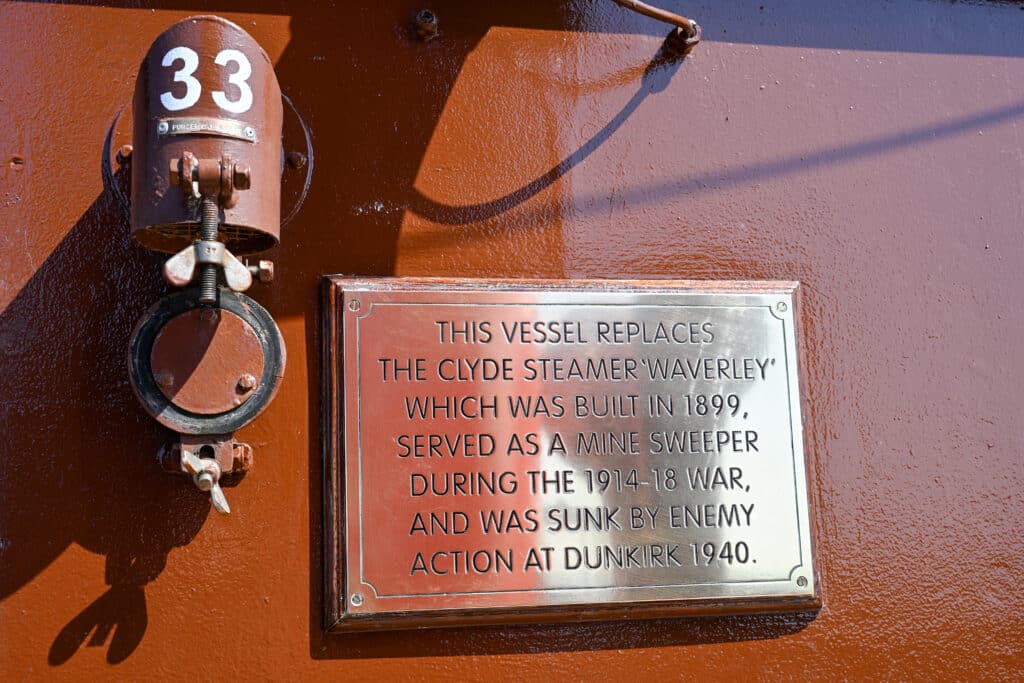
The current Waverley paddle steamer replaces a previous Waverley, built in 1899, which was sunk in the English Channel by enemy action on 29 May 1940 during the Dunkirk evacuation of Allied troops in World War II.
Historical plaque on the promenade deck
The replacement Waverley boat was built for the North British Railway Company, to transport passengers between Glasgow and Arrochar in Argle & Butte, a popular tourist destination. The shipbuilder was A&J Inglis of Pointhouse, Glasgow, with the ship’s keel being laid on 27 December 1945. Due to material shortages after the war, her maiden voyage wasn’t until 16 June 1947.
🔢
Key Stats:
The ship is 239 feet long and can carry 860 passengers with a crew of 19.
Following nationalisation of the railways, the Waverley was part of the British Railways Caledonian Steam Packet Company, Clyde coast fleet, and by 1972 was the last sea-going paddle steamer in the World. In September 1973, the Waverley boat was withdrawn from service and gifted to the Paddle Steamer Preservation Society (PSPS) in 1974 for the token price of £1.00 (sterling).
On 22 May 1975, PS Waverley carried her first passengers under the new owners, with a glorious send off from the Glasgow Police Pipe Band.
As donations grew, the paddle steamer was refurbished to higher safety standards allowing more passengers to travel, so more of the public got to see the Waverley boat as she travelled around the British Isles. Following a £7 million donation from the National Heritage Lottery Fund to overhaul the ship between 2000 and 2003, the Waverley received 2 new boilers and significant works to both the public and crew areas of the ship. Unfortunately, in 2019, the ship boilers needed replacing again; a ‘Save the Waverley’ campaign raised the funds so the ship could sail again in 2020.
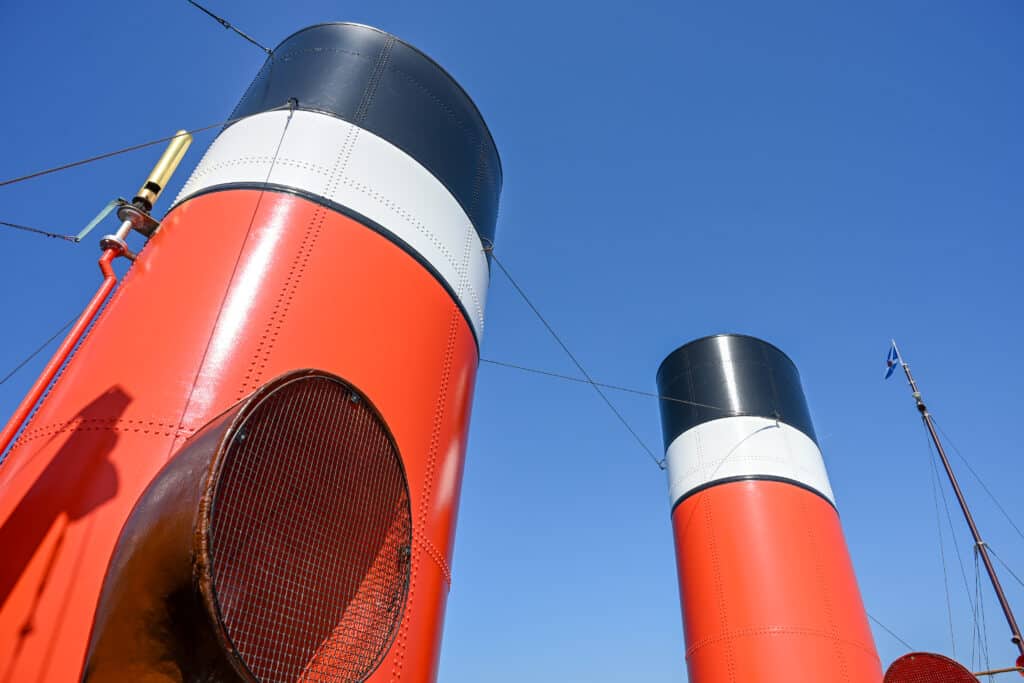
Waverley's colourful funnels
In 2024, the Waverley was given the title of National Flagship of the Year, recognising the breadth and geographic coverage of her sailings, with a record 70 ports and piers reached in that year’s itinerary.
Engineering Facts - for those who want them!
The engines required to turn the paddle side wheels were manufactured by Rankin & Blackmore of Glasgow.
The engine specification is a triple expansion, three crank (24-, 39- and 62-inch cylinder with a 66 inch stoke).
The original boilers were coal fired, double-ended scotch type - these can be found at the Scottish Marine Museum at Irvine, Scotland. Today, they use marine gas oil (2 x Cochran Thermax boilers).
Is the Waverley boat a Charity?
Yes, the Waverley boat is owned by the Waverley Steam Navigation Company Ltd (WSN) on behalf of the Paddle Steamer Preservation Society (PSPS).
The PSPS was founded in 1959 and during this time, it has saved two paddle steamers: PS Kingswear Castle (1924) and the PS Waverley (1947). The Charity’s aim is to:
Keep the paddle steamers operational
To educate the public about the paddle steamers’ historical significance, and
To acquire, preserve and exhibit artifacts connected with paddle steamers.
You can join the charity when on board, or on-line, and in return receive benefits to recognise your support of an organisation tasked with preserving British maritime history for future generations.
🔢
Good news:
The PSPS Charity has raised over £3.7 million since 1974 to keep the Waverley sailing.
Where does the Waverley boat sail to?
Today, the steamer has a sailing programme which circumnavigates the British Isles during the Summer months. It is organised into three broad areas:
Glasgow and the Clyde Coast
South Coast and the Isle of Wight
London and the Thames Estuary
Ports include: Warrenpoint (Northern Ireland), Portishead (Bristol Channel), Falmouth (Cornwall), the Isle of Wight, Whitstable, London Tower Pier and the Isle of Skye.
The Waverley occasionally offers themed events, hence the Great Gatsby style outfits we spotted when the steamer docked in Whitstable– passengers in fake fur coats and dapper evening dress, standing on board with Martinis in hand, waving as the Waverley set sail; it could have been 1926.
Falmouth to Penzance (Half Day cruise)
We booked a half day trip in the morning on PS Waverley from Falmouth to Penzance via Lizard Point in Cornwall. We could have also spent the afternoon on board, cruising past Mousehole, Gwennap Head and Land’s End, before returning to Penzance. There were lots of different options available to experience a trip on the Waverley boat.
The rest of this blog relates to the journey from Falmouth to Penzance as an example of the Waverley experience.
How do you buy tickets for the Waverley boat?
The Waverley is operated by Waverley Excursions, and you can view the programme of cruises, and buy tickets, on its website: https://waverleyexcursions.co.uk/
You will then receive an email confirming your booking. If you book within 7 days of your sailing, you should collect your tickets from the Purser’s office on board the ship (quoting your Booking Reference number on your confirmation email). If you book more than 7 days in advance, then the tickets will be sent to your postal address.
Ticket prices – by way of example, it cost £50.00 per Adult for a 3.5-hour cruise on the Waverley between Falmouth and Penzance (2026 prices).
Important:
Tickets are collected as you disembark the Waverley boat, so make sure that you hang on to them during your voyage.
What to expect onboard PS Waverley
Departure Point
Your booking confirmation email will state the departure point for your particular sailing and give you advice about what time to arrive.
Departing from Falmouth Docks– Falmouth Docks is a secure site, and so you are transported from the Docks Entrance to the ship berth on shuttle buses, even though it is only a short 5-minute journey.
When we arrived at the meeting point, we found a very British queue had already formed at the designated spot. By the time the transfer buses arrived, the queue was snaking around the corner towards Falmouth town. There was a bit of a commotion when several coaches turned up to transport us to the ship.
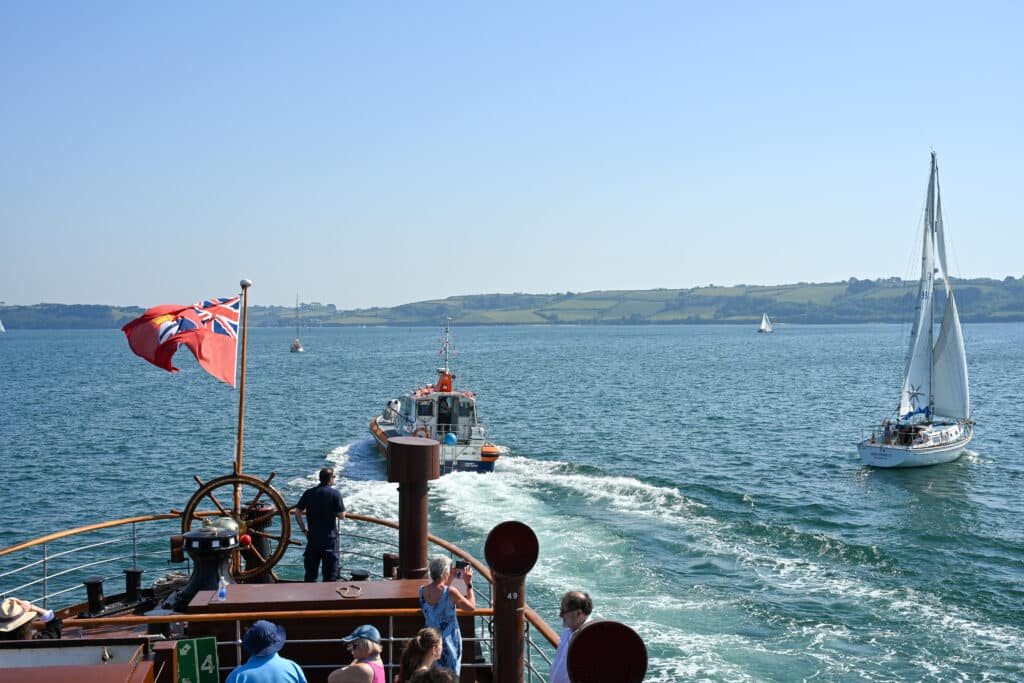
Waverley being led out of Falmouth harbour
Boarding the Waverley boat
Once off the bus and over the gang planks, there was a bit of a scramble to access the seats on the top deck and to bag a seat on port side, facing the coast for the best views on the journey. We needn’t have worried though as there is plenty of seating and people move around once the Waverley boat has set sail.
After the gang planks had been retracted, a tugboat came alongside the Waverley to push us out. Then, the paddle wheels started to turn, and we moved under our own steam into the Falmouth Estuary and then the English Channel.
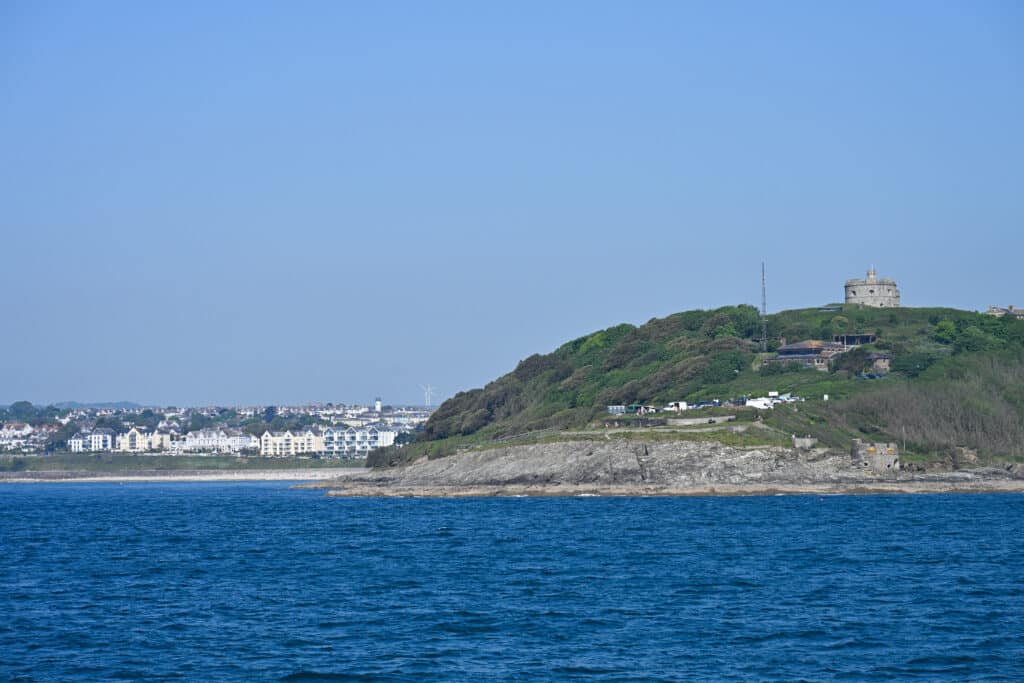
Passing Pendennis Castle at the mouth of Falmouth Harbour
Facilities on the Waverley boat
The Waverley boat has 3 decks and is laid out as follows:
Promenade Deck
With a promenade, seating areas, fore and aft shelters, designated open-air smoking area, and the two large red funnels. It also has the Caledonian Tea Bar serving teas, coffees, light snacks and ice-creams.
.
Main Deck
Up front the main deck has the heated Jennie Deans Lounge, serving drinks with great views on both port and starboard. The Engine Room is in the middle (midships). The souvenir shop and Dining Saloon are at the back (aft). The souvenir shop sells clothing, books, mugs, sweets and postcards. It also has a Victorian post box so that you can send your Waverley stamped postcards home
.
Lower Deck
The Talisman Bar and lounge space, as well as the toilets.
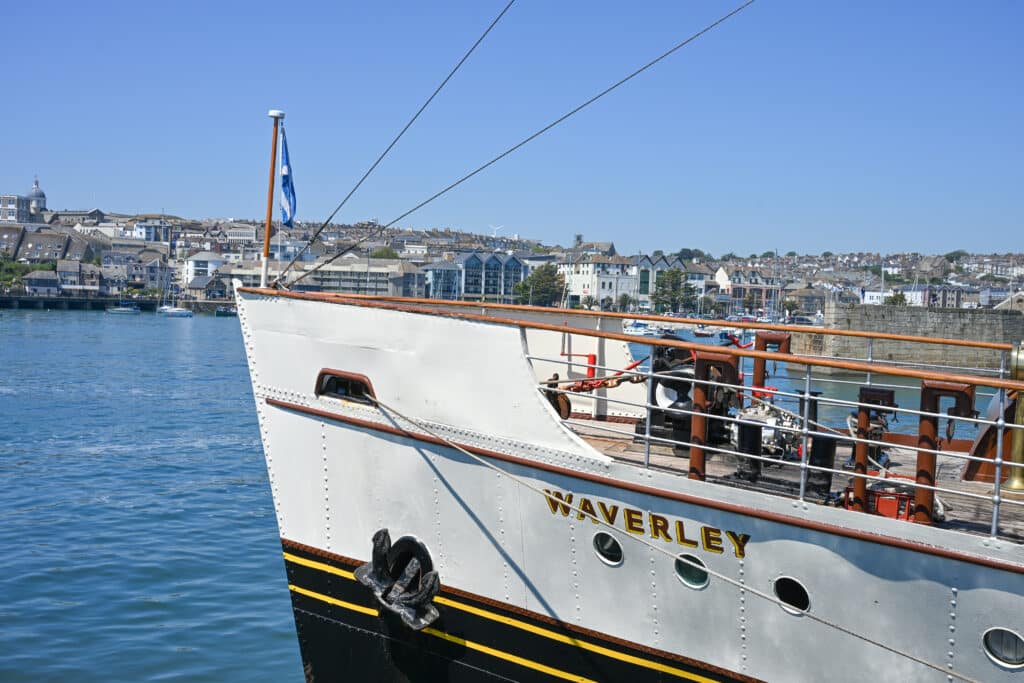
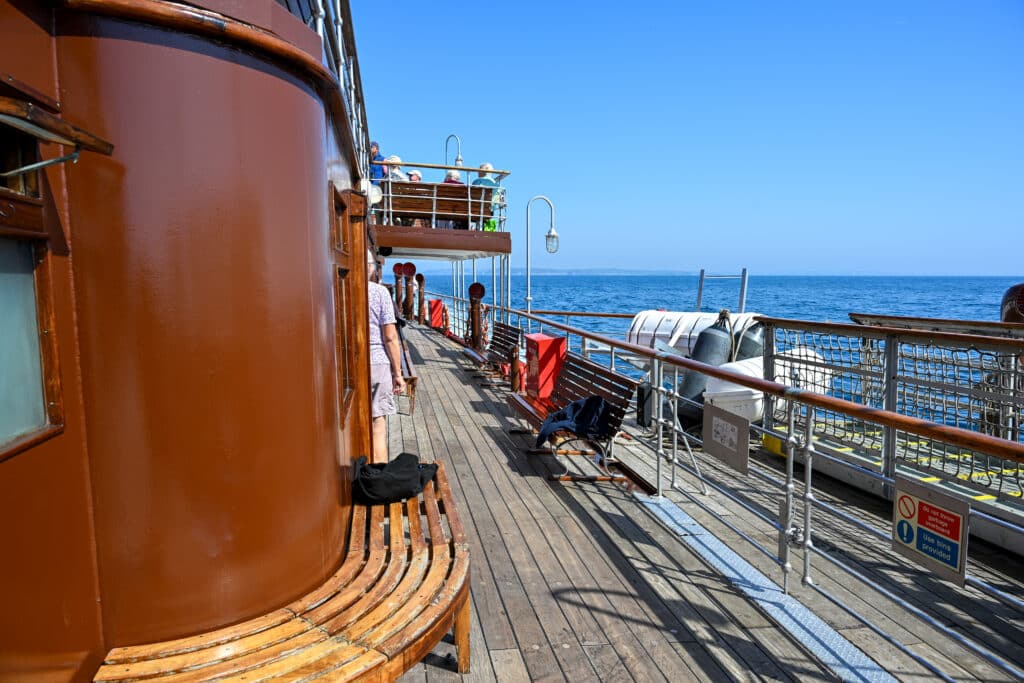
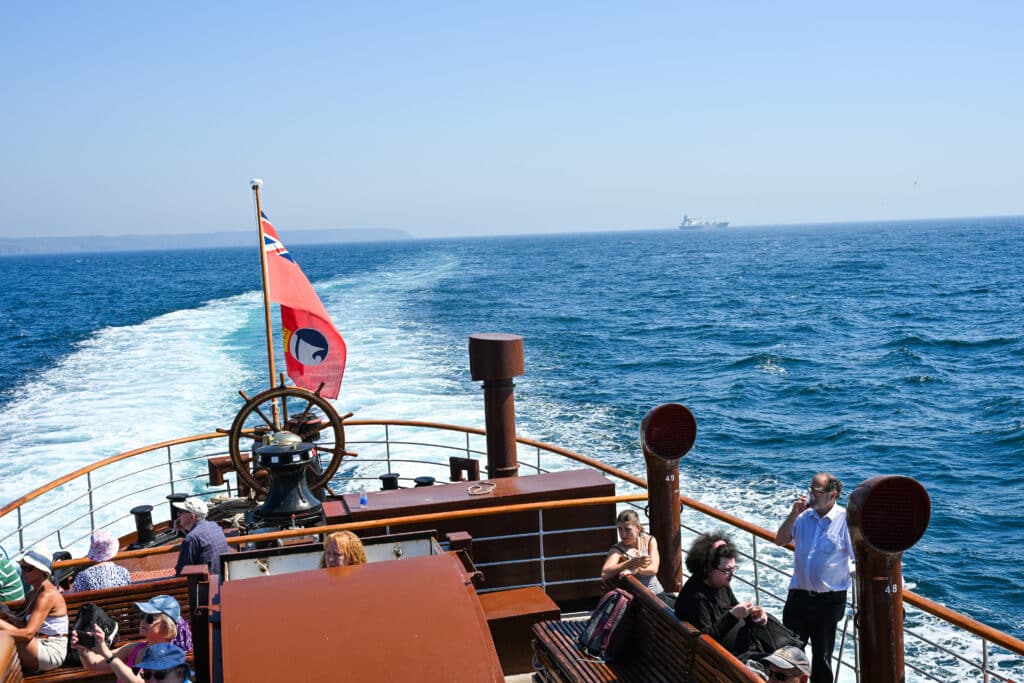
Waverley promenade deck
The Engine Room
You can visit the Engine Room on the Waverley boat, which houses the boilers and pistons to drive the paddle wheels. There are viewing portholes through which you can watch the mighty paddles turning.
I thought the Engine Room was impressive, with immaculately kept machinery operating smoothly, and the smell of hot oil in the air. There were mechanics in overalls looking at gauges, recording numbers in logbooks, but happy to chat to passengers. Clearly, they all loved their work, and you could view the Engine Room from both sides over open railings. It did become a bit mesmerising watching the cranks turn with all the noises, steam and commotion of the ship’s powerhouse.
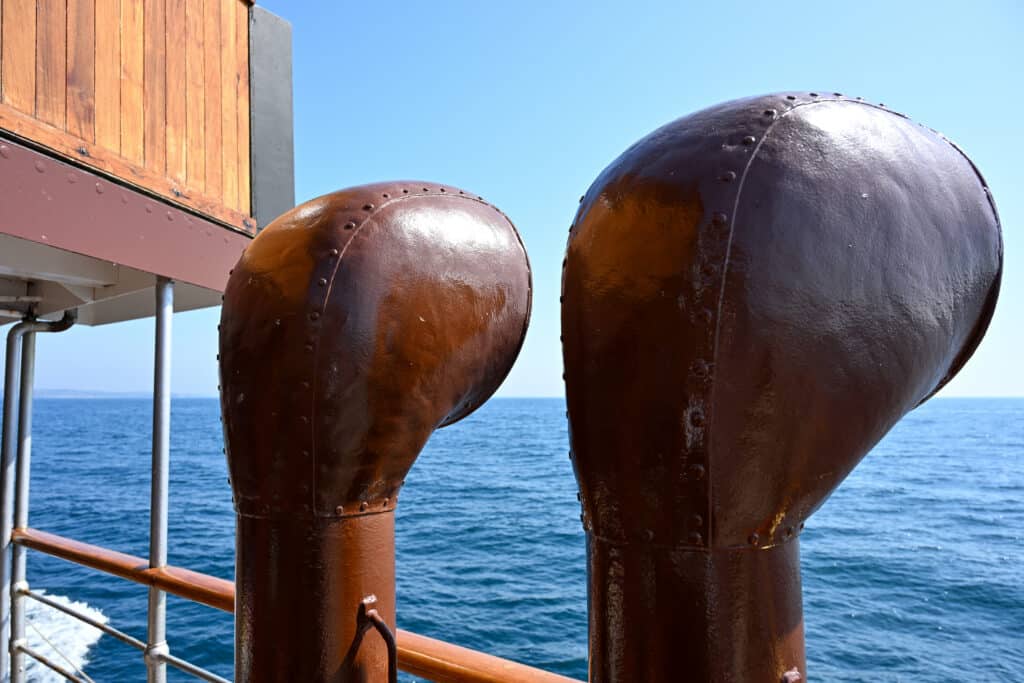
Air vents on the Waverley promenade deck
Passengers and dogs on the Waverley
Passengers – the passengers on the Waverley boat were a mixed bunch; families with small children, couples, groups of overseas tourists, seniors on a day out, and a couple of dogs.
Dogs – we left our dog at home as we didn’t realise that they could travel on some of the Waverley journeys, i.e. those which last no longer than 3.5 hours. Your dog should be booked onto the journey in advance, be well behaved, kept on a lead and not enter the indoor eating and drinking areas during the cruise. Currently the flat fee for a dog’s passage on the Waverley boat is £5.00 (2026 prices).
As the journey continued, the passengers moved around, checking out the different areas of the ship, getting food and chasing the best views, so it all felt very fluid. It was very hot on the day of our voyage, so many went inside to hide from the midday sun, and to buy an ice-cold pint of beer.
Passengers watching the coastline of Cornwall slide past
Travelling at Sea
Our journey from Falmouth to Penzance lasted for around 3.5 hours, so there was a lot of time to explore the steamer. After the captain’s important safety briefing, we went in search of breakfast and purchased take-away hot breakfast rolls (‘square’ sausage sandwiches and Iron Bru – the catering crew were Scottish!). On a colder day we would have enjoyed a full breakfast in the Dining Saloon, where breakfast is served until 11.00am and then lunch options from 12.00noon.
The Waverley at sea
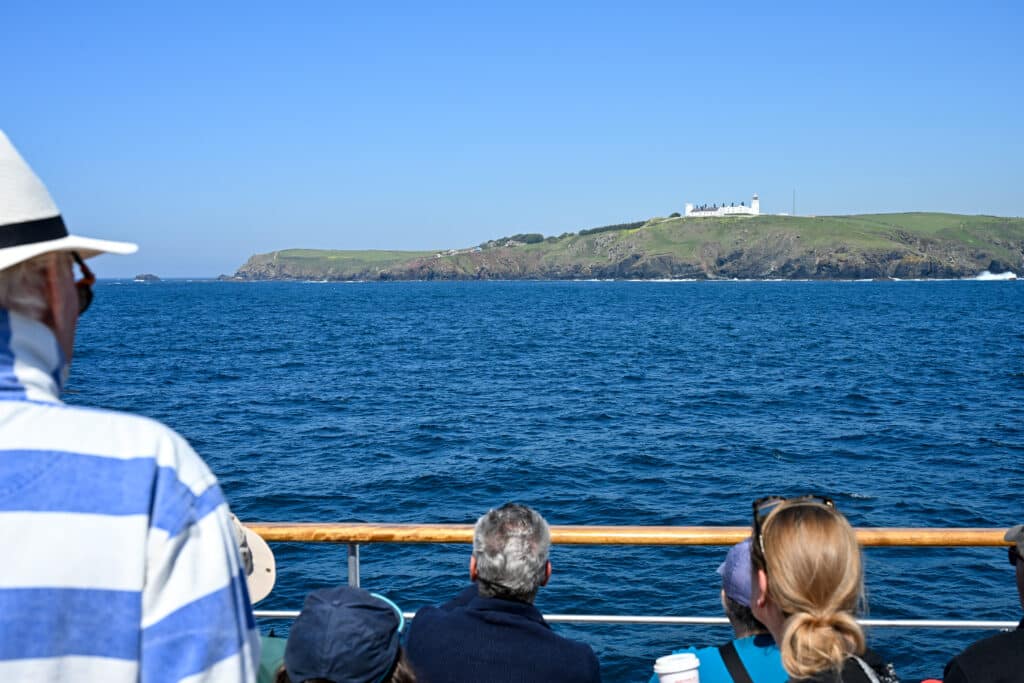
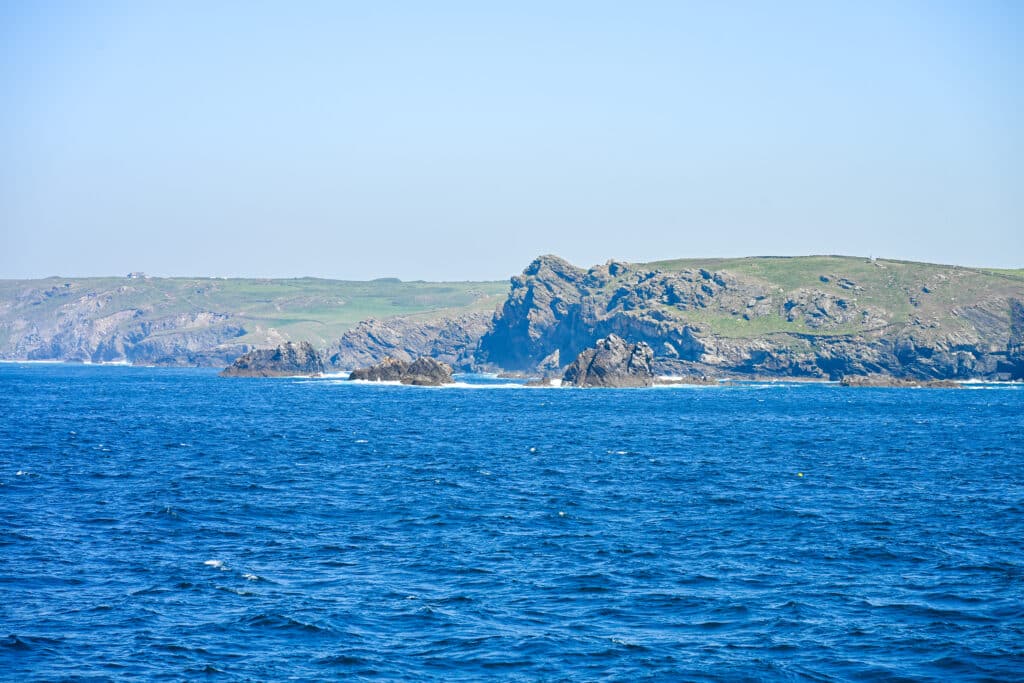
The Waverley boat then cruised along the coastline with the captain pointing out places of interest, such as, Lizard Point, St Michael’s Mount and other ships on the water.
Lizard Point, Cornwall
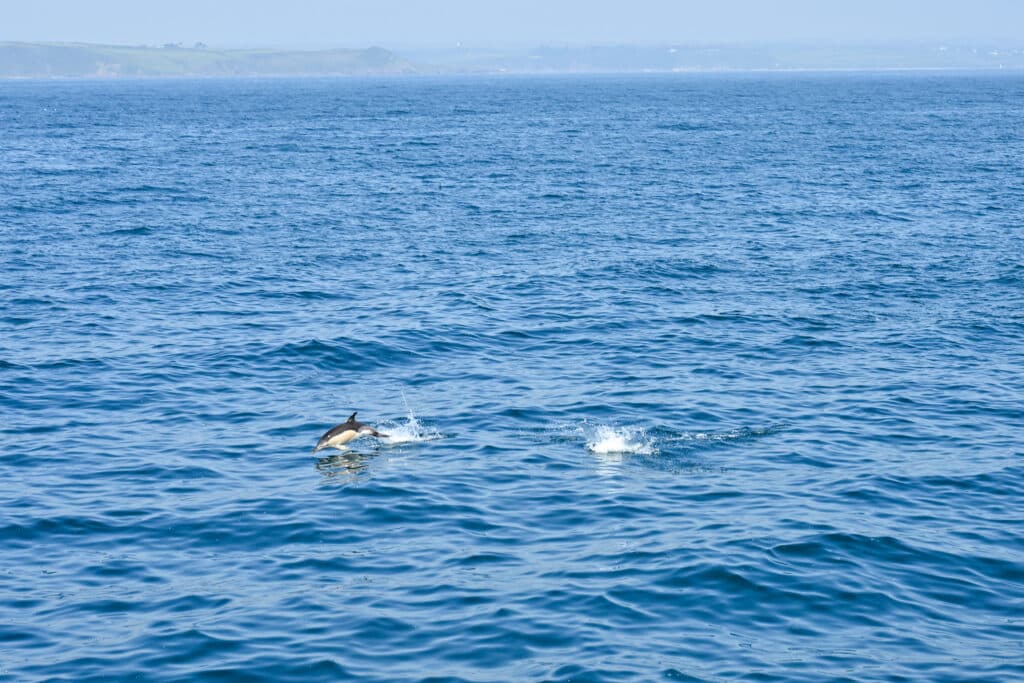
Whilst you’ve got your eyes on the horizon and coastline, don’t forget to check our the water from time to time or you might miss these guys…
Dolphins near Lizard Point
The effect of the weather
Even on the hottest of days, it can be breezy out at seam, so if you want to sit on the deck then bring a jumper. Also, if you’re out on deck, remember to pack sunglasses, sunscreen and a hat.
If the weather turns, there are plenty of covered and heated places on the Waverley to hide from the elements. As you’ll be sailing around the British Isles then prepare for any weather eventuality; a waterproof is always a good idea in the UK.
Keep hold of your belongings whilst out on deck as the wind can quickly whip loose items away!
🔢
Key Stats:
Speed is limited to 16 knots, with a normal service speed of 14.5 knots.
Arriving at Penzance
Eventually, Penzance arrived on the horizon, and we gathered up our belongings whilst the captain pointed out the ships moored in the harbour. As we disembarked, a queue of passengers was lined up along the harbour wall, ready to board the Waverley boat for the next part of its journey along to coast to Lands’ End and back.
Note – we could have purchased an additional ticket for a coach journey back to Falmouth as part of the booking. However, we wanted to have a look Penzance, before making our way back to Falmouth on the train.
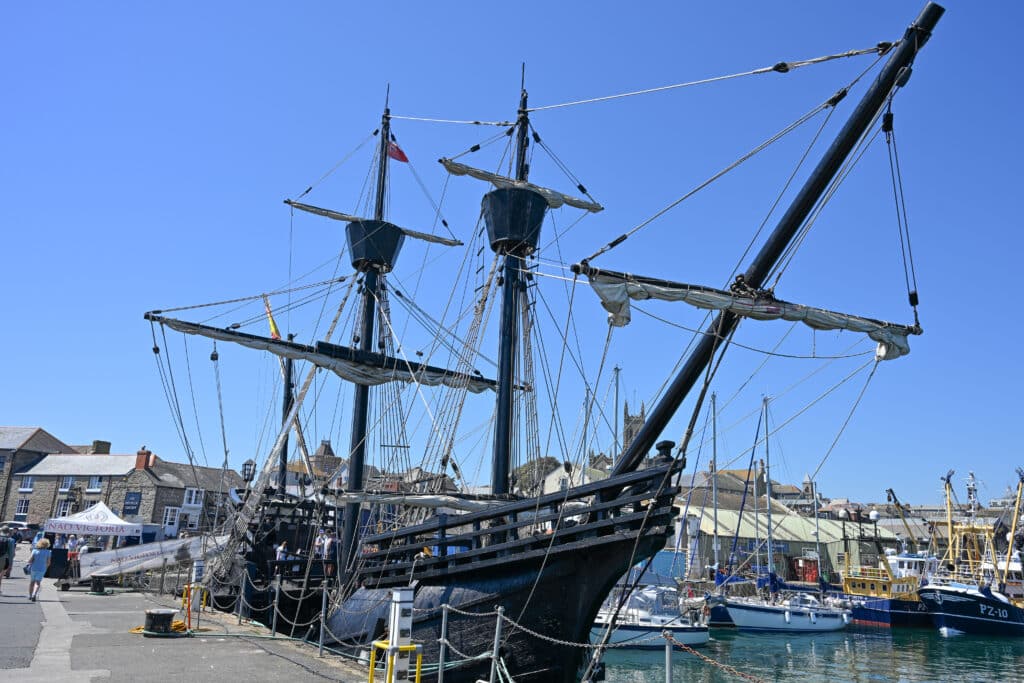
Sailing ship in Penzance harbour
Return journeys:
Remember to check whether Waverley Excusions offers return coach travel from your destination to your starting point, which you can book along with your Waverley boat ticket.
In closing
Reflections on the Waverley
A cruise on the Waverley is a very relaxing and enjoyable experience – time to switch off and let the boat do the work as you slowly make your way around the coastline. It’s an opportunity to experience a piece of history, and potentially to see a part of the British coastline which you might not have experienced before.
Don’t be put off by the word cruise – no one stays onboard – as a cruise on the Waverley is like sailing into the past. PS Waverley is a beautiful boat, with lovely carved wooden decks and seating. You can easily imagine passengers from times gone by boarding the ship for an exciting journey.
I would happily book another trip on this historic steamer should our timetables meet in the future - whatever floats your boat!
If you have a blog-related question, please do ask in the comments box below and I'll try to help.
📸
A little request: if you use my photos, please credit Love Travel Planning on your social media or give me a shout out on Instagram @lovetravelplanning as I am growing my website. Huge thanks.
Enjoy your travels! ✈️
Get Planet Travel
Join thousands of travelers looking for inspiration from our FREE Planet Travel newsletter!
To provide the best experiences, we use technologies like cookies to store and/or access device information. Consenting to these technologies will allow us to process data such as browsing behaviour or unique IDs on this site. Not consenting or withdrawing consent, may adversely affect certain features and functions.
Functional
Always active
The technical storage or access is strictly necessary for the legitimate purpose of enabling the use of a specific service explicitly requested by the subscriber or user, or for the sole purpose of carrying out the transmission of a communication over an electronic communications network.
Preferences
The technical storage or access is necessary for the legitimate purpose of storing preferences that are not requested by the subscriber or user.
Statistics
The technical storage or access that is used exclusively for statistical purposes.The technical storage or access that is used exclusively for anonymous statistical purposes. Without a subpoena, voluntary compliance on the part of your Internet Service Provider, or additional records from a third party, information stored or retrieved for this purpose alone cannot usually be used to identify you.
Marketing
The technical storage or access is required to create user profiles to send advertising, or to track the user on a website or across several websites for similar marketing purposes.