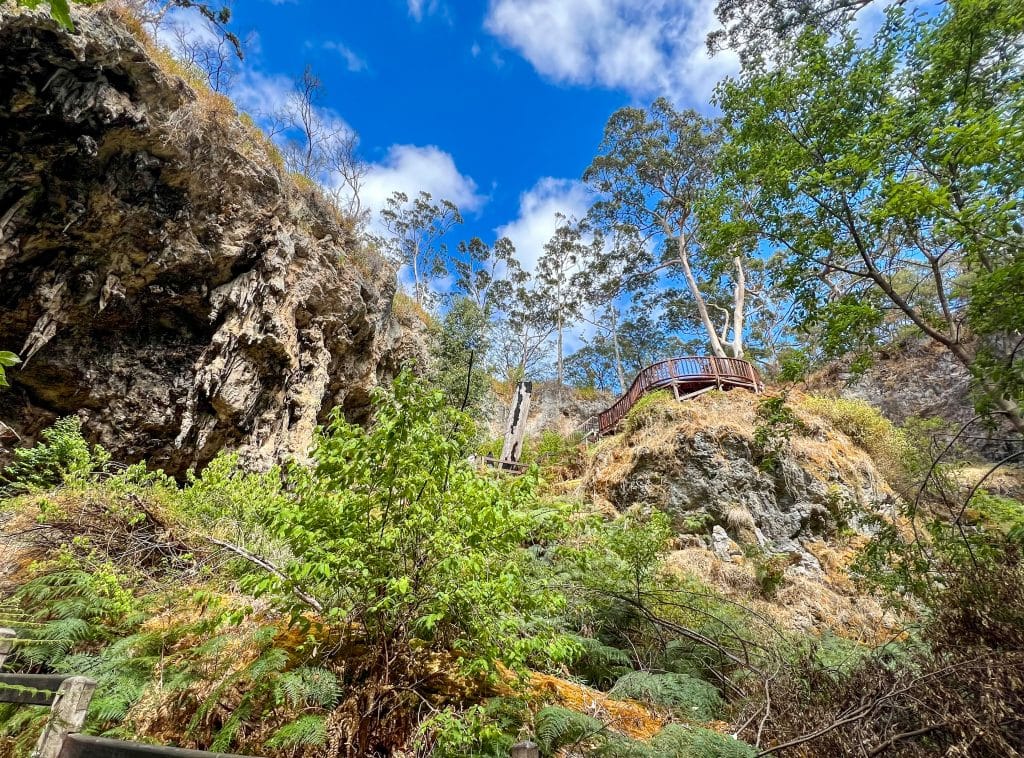
Upwards photo to a blue sky with white puffs of cloud. In the foreground you can see greenery, and also the edges of a cliff or rock face. Wooden stairway on the rocks to the right. Green trees to the right

Things To Do In Margaret River: Beaches, Caves And Surf

I had Margaret River filled in my head as a place you go to drink wine. That is a reasonable summary and also a wildly incomplete one.

The region has around 105 caves underneath it, a surf break good enough to host a world championship event, 135km of coastline, and forests of karri trees tall enough to make you stop the car. We gave it two nights on our first visit, realised our mistake, and came back two years later for another go.

⚡ Overview

The three things to build a day around are the beach at Gnarabup with the coastal walk up to Surfers Point, a drive down Caves Road, and a cave tour. Lake Cave and Jewel Cave are the two we have done and we would recommend either.

Table of Contents

Where is the Margaret River region?

The Margaret River region runs from Cape Naturaliste near Dunsborough in the north down to Cape Leeuwin roughly 100km south, and stretches about 30km inland to take in Busselton. The town of Margaret River sits in the middle and is where most people base themselves, 277km and about three hours south of Perth.

Almost everything in this article is within half an hour of the town, and most of it hangs off one road – Caves Road, running roughly parallel to the coast.

Gnarabup Beach, the closest beach to Margaret River

Gnarabup Beach sits 8km south west of Margaret River town, about ten minutes’ drive, at the southern end of the settlement of Prevelly. It is a 1.6km stretch of sand with a near continuous offshore reef sitting out in front of it, and that reef is the whole reason the beach works. It takes the force out of the swell before it arrives, so while the rest of this coastline is being pounded, Gnarabup stays comparatively calm.

That makes it the sensible choice with children, with nervous swimmers, or with anyone who would rather swim than be thrown around. When we visited, the water was full of teenagers on surfboards and bodyboards, which tells you roughly what the conditions are like.

Brunch at the White Elephant Cafe

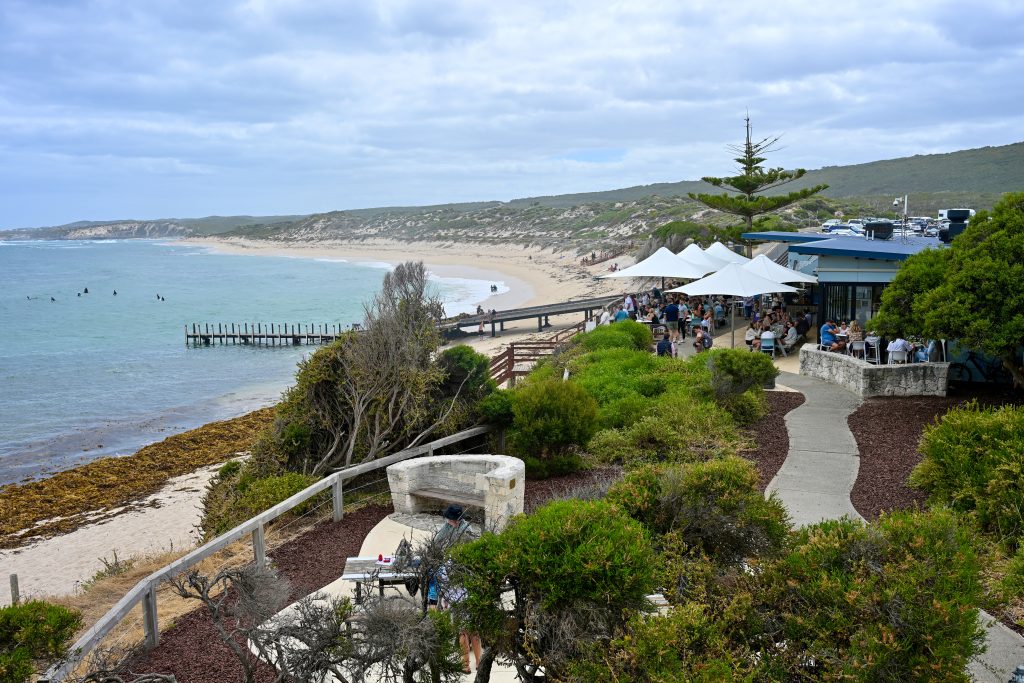
Start with breakfast – The White Elephant Cafe sits right above the sand and is open daily from 7.30am to 3pm, doing healthy, locally sourced breakfast, brunch and lunch. Grab a table and a menu, then order at the counter.

Go early. It gets extremely busy, and the whole point is a table outside on the terrace with the ocean in front of you. It can feel a bit chaotic at peak times, but it is popular for a reason. The cafe is also the local landmark everyone gives directions from, so it is worth knowing where it is even if you do not eat there.

Restaurant buildings overlooking a wide beach with blue water and sky
White Elephant Cafe overlooking the beach

Swimming, snorkelling and surfing at Gnarabup

The sheltered water in front of the cafe is where the swimming happens, and there is a jetty and a pontoon out in the inlet. Locals swim here year round and there are children’s swimming classes in the shallows:

Best time to swim: Mornings, before the south westerly sea breeze gets up in the afternoon.

Surfing: Gnarabup is a decent beginner beach, particularly in winter. The serious surf is further north at Surfers Point.

A real safety note: When shore breaking waves get above about a metre, a rip can form running towards the rocks at the southern end. Watch the water before you go in, and keep an eye on where the current is heading.

Snorkelling: The reef is what makes the water calm, and it is close enough to buy a snorkelling mask for a still morning.

Parking, dogs and driving at Gnarabup

The practical stuff, because this is a small beach with a lot of visitors:

Parking

There is a large car park off Reef Drive with accessible toilets, showers and a boat ramp. It fills up. Beach parking around Prevelly and Gnarabup has been an active local issue and the Shire has run public consultations on it, so in peak season arrive early or park further back and walk.

No. This is a car park and walk-on beach, not a four wheel drive one. If beach driving is what you are after, Kilcarnup north of the river mouth is the one in this area, and you need a proper four wheel drive rather than a soft roader.

Parts of the beach are a dog exercise area and parts are not, and the boundaries are specific. Broadly, the northern end and Gnarabup Back Beach have off-lead access, while the stretch running south from Reef Drive towards Gas Bay does not.

The published boundaries differ slightly between the tourism listings and the Shire’s own rules, so check the Shire of Augusta Margaret River dog exercise areas page before you let a dog off the lead. Elsewhere in the shire, dogs must be on a lead in public.

Walk the coast path to Surfers Point

This is the best hour we spent in Margaret River and it is free.

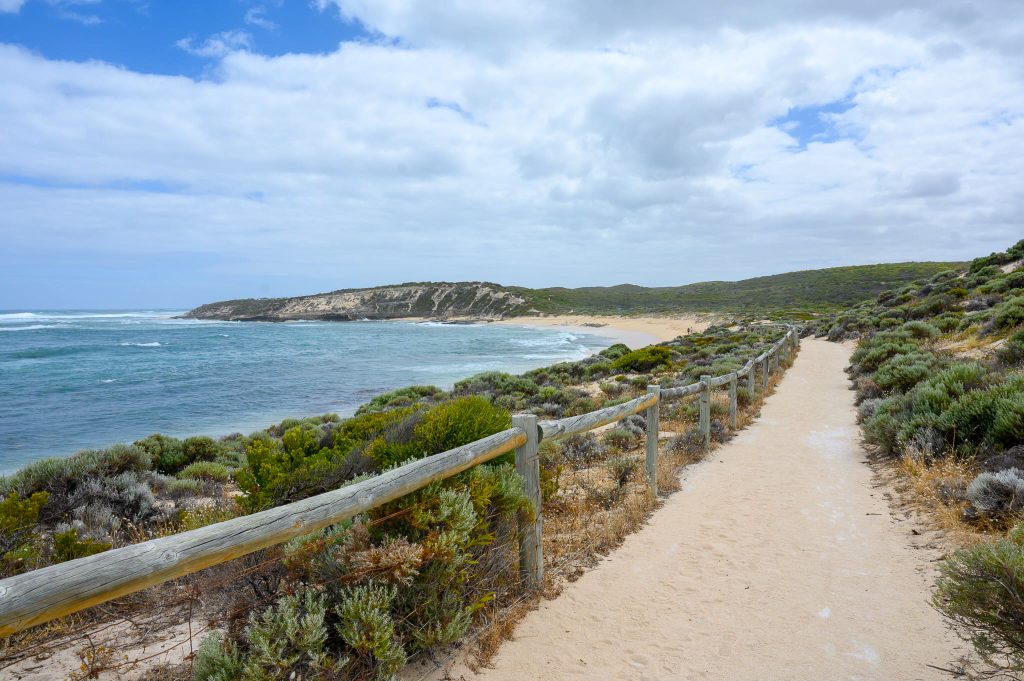
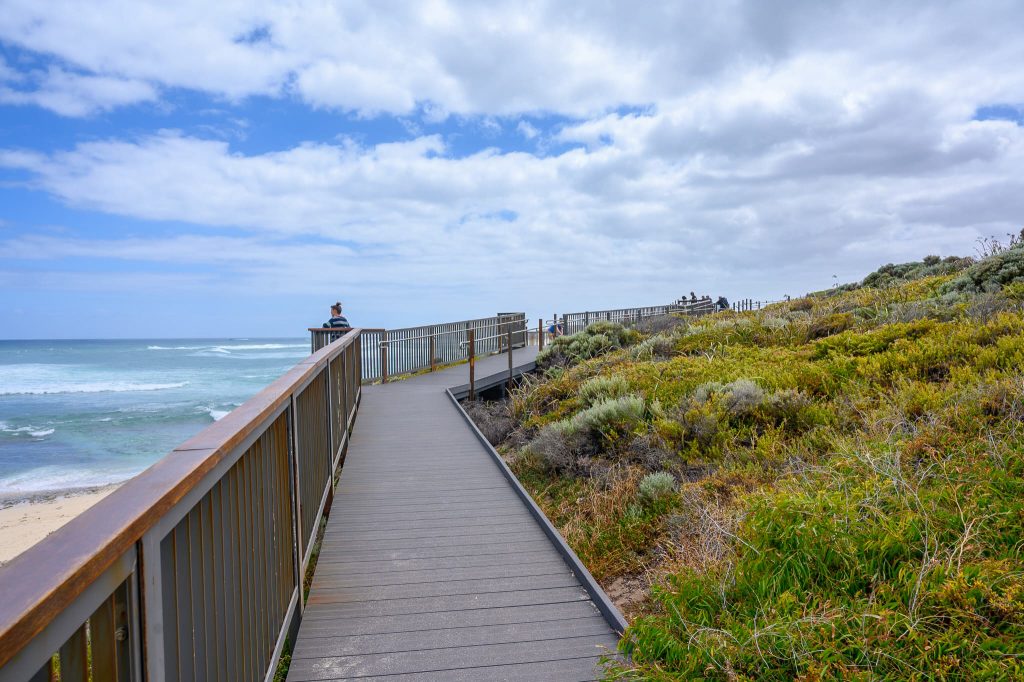
From Gnarabup Beach a coastal pathway runs north to Surfers Point, 1.5km and around 40 minutes each way. The views, the colours and the coastal shrub are lovely the whole way, and it never feels like a slog.

View along a path to the right hand side, wooden barrier to the left and shrubland beyond. Turquoise sea to the left. Cloudy blue sky above
Between Gnarabup and Surfers Point, WA

What makes it more interesting is that this path is a section of the Cape to Cape Track, the roughly 123km walking trail that runs the full length of the Leeuwin-Naturaliste Ridge between the lighthouses at Cape Naturaliste and Cape Leeuwin. Walking it end to end takes around six days. Plenty of people never do that and instead pick it off in day and half-day sections over months or years, using the access points along the way. This is one of the easiest of those sections, and you can do it after brunch in your normal clothes.

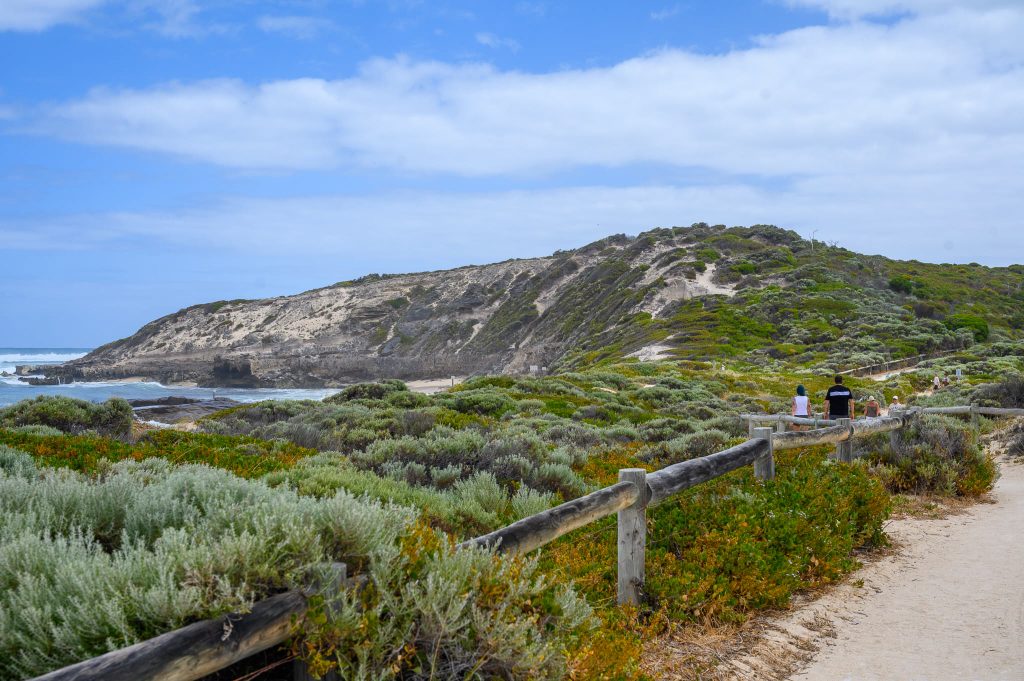
View from a path across scrubland to a headland. Ocean to the left. Cloudy blue sky above
Looking at Surfer's Point from the Cape to Cape path

What to do when you get to Surfers Point

Surfers Point at Prevelly is the serious end of the region’s coastline, and it is worth the walk even if you have no intention of getting in the water.

View along a boardwalk leading to the middle of the horizon. Grass land to the right. Turquoise ocean to the left. Cloudy sky above
Images provided by @SmytoCreative (Instagram)

Every April it hosts the Western Australia Margaret River Pro, a stop on the World Surf League Championship Tour. In 2026 the competition window ran from 16 to 26 April, and it is the second stop on the year’s schedule. The heats run at Main Break and at The Box, and spectators can watch from Surfers Point live and free, with surfing between roughly 7am and 5pm on competition days.

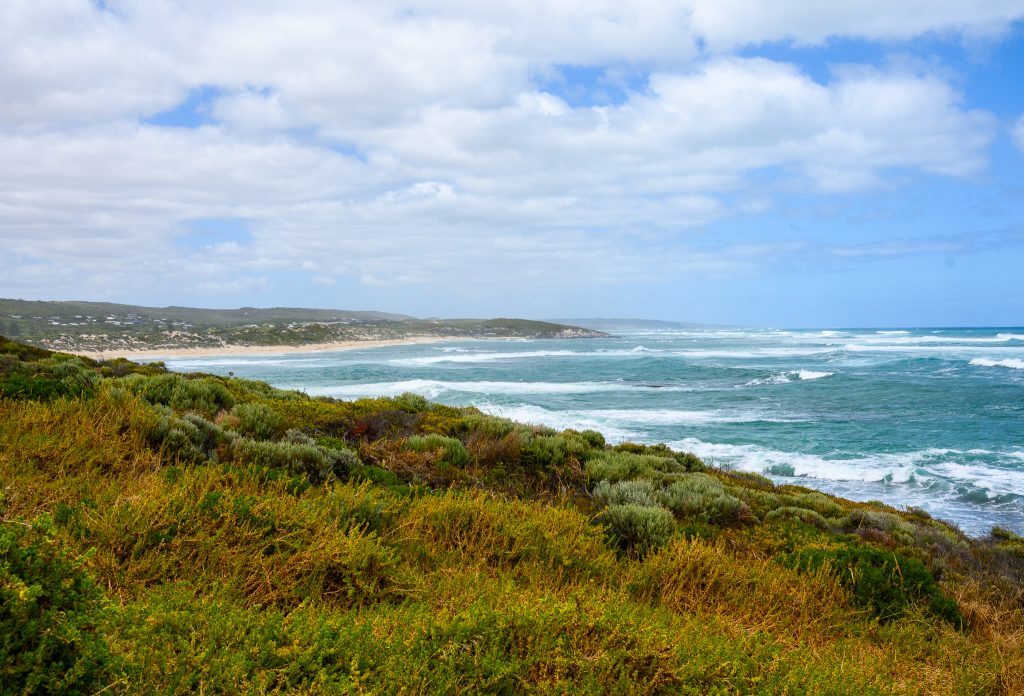
View across scrubland to turquoise ocean waves on the right hand side at the horizon. Cloudy blue sky above
Between Gnarabup and Surfers Point, WA

Even outside the competition you will usually find experienced surfers out at Main Break, and watching them from dry land is entertaining in its own right. There are information displays at Surfers Point about the surfing and the event, then benches where you can sit and watch the rollers come in from a safe distance.

One planning note:

If you are in the region during the Pro, book accommodation and restaurants a long way ahead. It is one of the two busiest periods of the year alongside Easter.

Learn to surf at Redgate Beach

The region has around 135km of coastline and it ranges from legendary breaks that will hurt you to beaches that are fine for a first lesson.

If you fancy trying it, the Margaret River Surf School runs out of Redgate Beach, just south of Gnarabup. Beginner group lessons are also bookable on GetYourGuide at around 2 hours from $43, which is a low commitment way to find out whether you enjoy it.

Powered by GetYourGuide

Drive Caves Road

You start among vineyards on both sides, with fields that quite often contain kangaroos and emus going about their day as though nobody is watching. Then the fields give way to Karri forest and the road turns into a green tunnel. The Boranup Forest section is the one to slow down for.

There are around 105 caves under the Margaret River region, of which seven are currently open to the public, and Caves Road is how you reach them. They fall into two groups:

The developed caves:

Ngilgi at Yallingup, Mammoth, Lake Cave and Jewel Cave at Augusta. These have visitor centres, walkways and either guided or audio tours.

Calgardup, Giants and Moondyne, run by the Parks and Wildlife Service. Helmets, headlamps and in Moondyne’s case overalls. Giants Cave does not admit children under six.

Pick one – They are each an hour or more with the walk in and out, and each has its own character. Two in a day is possible but you will start comparing rather than enjoying.

A note on the multi-cave pass

If you do want more than one, the Capes Foundation multi-cave pass covers Lake, Mammoth, Jewel and Ngilgi at a discount over seven days. Worth asking about at the first cave you visit rather than buying single tickets each time.

Which of the Margaret River caves should you visit?

Lake Cave if you want the most spectacular one and do not mind 325 steps. Jewel Cave if you want the easiest walking or the best story. Mammoth Cave if you would rather go at your own pace with an audio guide. Ngilgi Cave if you are staying up towards Yallingup and want the Wadandi cultural interpretation.

Lake Cave, for the reflections

We picked Lake Cave on our first visit. You reach it by walking down 325 steps on a wooden staircase into a huge sinkhole, past karri trees growing up out of it. The descent alone is worth the ticket.

Dark scene where some rocks formations are illuminated in red and yellow, and reflected in a shiny surface below
Lake Cave reflections

Then Lake Cave opens up – stalactites hanging over an underground lake, with reflections that double everything. When we visited, the water was at its highest level in decades and the effect was extraordinary. There are thousands of straws hanging from the roof, and a suspended table of calcite that appears to hover above the water without touching it. The gap underneath shows you where the old cave floor used to be.

Near the end our guide ran a light show, illuminating the cave in different colours, which was pretty. But the best thing in Lake Cave is Nature’s Window, the perfect circle of sky and karri canopy above you as you climb back out.

Practical details:

Tours are fully guided and take about an hour, running every 40 minutes from around 9.20am to 4pm daily. Adult tickets are around $26, seniors $24, children aged 4 to 16 around $13, and under threes free. It is about 20 minutes south of Margaret River at Forest Grove. The 325 steps down and back up need a reasonable level of fitness, and tour groups are capped, so book ahead in peak season.


Jewel Cave, for the Tasmanian tiger

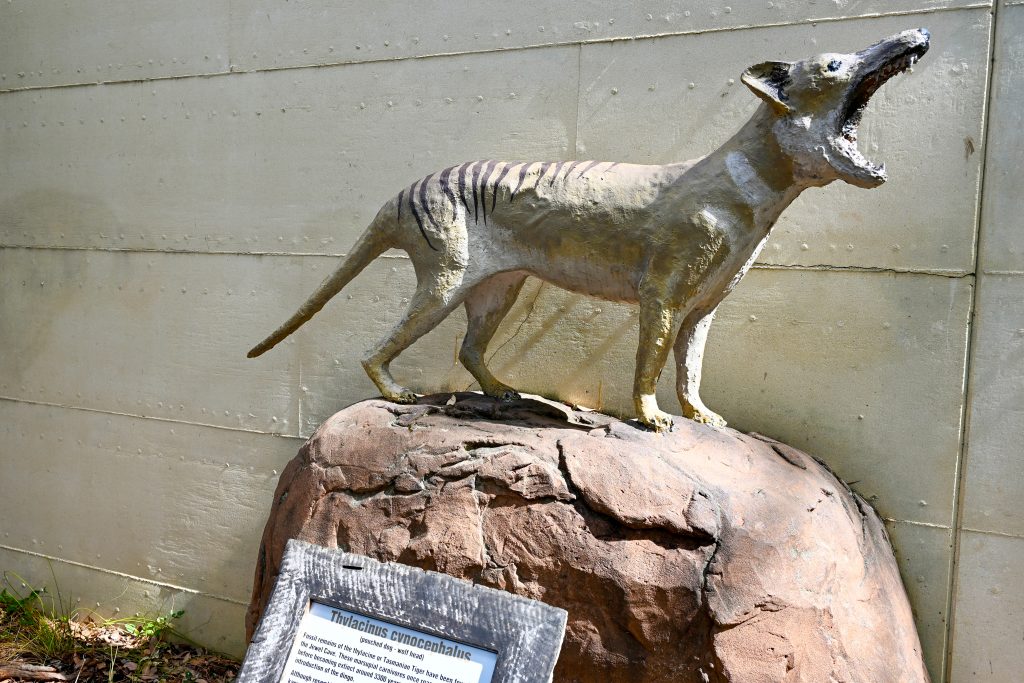
On our second trip we chose Jewel Cave at Augusta, mostly out of curiosity. Bones of a Tasmanian tiger, the thylacine, were found in it.

Statue of a dog like creature outside a concrete building
Tasmanian Tiger model

The thylacine looked like a dog or a wolf but was actually an Australian marsupial, and the last known one died in captivity in a zoo in 1939. Seeing the model and hearing how the bones ended up down there is a strange piece of natural history to encounter underground. Fun Fact – Colossal Biosciences, a company who recently bought back a pair of dire wolves, is also attempting to bring back the thylacine.

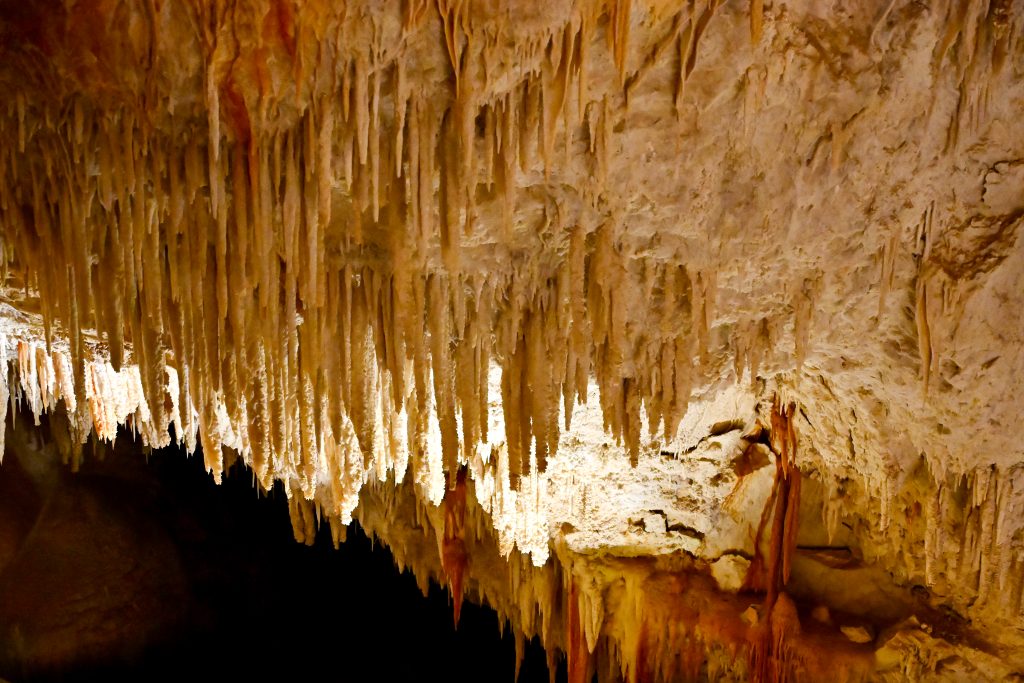
Row of stalactites hanging from the ceiling of a cave
Stalactites in Jewel Cave

The cave itself is a series of very large chambers. From the information centre a set of stairs brings you into the first one, which you cross on an elevated gangway to a big viewing platform. More stairs take you down to the base and through to the other chambers. There are stalactites, stalagmites, thousands of straws, an enormous frozen waterfall and a 23 tonne crystal formation known as The King.

Practical details:

Fully guided one hour tours leave every hour from around 9.30am to 3.30pm. There are fewer steps than at Lake Cave or Ngilgi, which makes it the easier choice if stairs are a consideration. Augusta is further south than Lake Cave, so allow for the extra driving.

Mammoth Cave, for going at your own pace

We have not done this one, but it is the one we would pick next, and it is the one to choose if guided tours are not your thing.

Mammoth Cave works on a self-guided audio player, so there are no time slots and no group to keep up with. You turn up, collect the audio guide and go at whatever speed suits you. It is also the cave for anyone interested in prehistory, because it holds fossils of Australian megafauna, the giant marsupials that lived here tens of thousands of years ago, and the interpretation leans into that.

Worth knowing:

There are hundreds of steep steps on the way out. It is not the easy option despite being self-guided.

Ngilgi Cave, for the cultural interpretation

Ngilgi Cave sits at Yallingup, up towards the northern end of the region, so it suits you if you are staying around Dunsborough rather than Margaret River town.

It runs on a semi-guided format; a talk of about fifteen minutes to start, then you explore at your own pace. The descent takes you down into what is more amphitheatre than chamber. 

What sets Ngilgi apart is the Ancient Lands Pathways interpretation, which covers the Wadandi people’s connection to this Country, so you come away with more than geology. Guided experiences run every half hour from around 9.30am to 4pm.

The adventure caves: Calgardup, Giants and Moondyne

The other three are run by the Parks and Wildlife Service rather than the Capes Foundation, and they are a different proposition entirely. Helmets, headlamps and no handrails.

Calgardup Cave: Self-guided with torches and headlamps provided. Around 27 metres deep and 300 metres long, and the gentlest introduction to the adventure.

Giants Cave: Around 86 metres deep and a proper scramble. Children under six are not admitted.

Moondyne Cave: The full experience, with miners' lights, helmet and overalls provided, on a guided cave awareness tour departing from the Jewel Cave preservation centre. It was discovered in 1881 and is deliberately left undeveloped.

We did neither the adventure caves nor Mammoth and Ngilgi, so this comes from research and from what the guides told us rather than our own boots. If you have teenagers who found Lake Cave too civilised, this is where to send them next.

Things to do in Margaret River with families

We did this trip with two teenagers, 16 and 19 at the time, and came back two years later with them again. Margaret River suits that age group unusually well, because almost everything is outdoors and none of it requires them to look interested in wine.

Gnarabup Beach: Sheltered, safe for swimmers, and full of teenagers on bodyboards. The easiest half day on this list.

A surf lesson at Redgate: Beginner group lessons run around two hours and are cheap enough to be worth the risk that they hate it. They will not.

A cave tour: Lake Cave in particular. The 325 step descent into a sinkhole does what no amount of scenery does, which is make a teenager put their phone away.

The coast path to Surfers Point: Forty minutes each way, flat, with actual professional surfers to watch at the end of it.

The Margaret River Chocolate Company: A reliable way to buy goodwill before a winery afternoon.

The town itself: Ours disappeared into the surf shops on the main street and emerged with several bags of things they cannot get at home.

What we would skip with younger children:

The adventure caves at Giants, which does not admit under sixes, and the longer Cape to Cape sections. Everything else on this page works from about eight upwards.

What else is worth the drive

We did not get to all of these, and the ones we missed came up repeatedly in our research afterwards. Consider this the list for a longer stay than we managed:

Busselton Jetty: The longest timber-piled jetty in the southern hemisphere, with a train along it and an underwater observatory at the end. Around 50 minutes north of Margaret River.

Cape Leeuwin Lighthouse: Mainland Australia's tallest lighthouse, standing where the Southern and Indian Oceans meet, at Augusta. Easy to combine with Jewel Cave.

Canal Rocks and Sugarloaf Rock: Two coastal rock formations up near Yallingup and Cape Naturaliste. Sugarloaf Rock is the sunset one.

Hamelin Bay: Where stingrays come into the shallows and glide past your legs. We stopped here on the drive from Margaret River to Denmark and it was a highlight.

Whale watching: Humpbacks, southern rights, minke and blue whales pass the coast between roughly June and December, with cruises from Busselton, Augusta and Dunsborough from around $68.

Canoeing on the Margaret River itself: Guided tours run at around 4.5 hours from $85, including a wild food lunch.

Famously, Margaret River is very well known for its vineyards. If this is something on your bucket list, then we have just the blog for you.

Margaret River itinerary: How long do you need?

A two day Margaret River itinerary covers the town, one cave and a morning at the beach, which is roughly what we managed on the first trip and it felt rushed.

A three day Margaret River itinerary is the one we would actually recommend. Day one for the town and the beach, day two for Caves Road and a cave, day three for the wineries and a long lunch. That is the version where nothing gets cut.

Four or more and you can add the drive up to Busselton and Yallingup, a second cave, and start walking sections of the Cape to Cape rather than just looking at it.

If you are passing through on a road trip from Perth then you may have to keep moving, and even a short stop gives you a good sense of the place. Just be aware that you will spend the drive out planning when you can come back. We did, and then we actually did it.

It is too beautiful to rush, and the whole region has a therapeutic quality to it, all trees and ocean and very good food. Somewhere to disappear for a few days.

Love Travel Planning
Thank you for reading

I hope you found it useful

Thank you so much for reading my blog. For more stories, itineraries, and advice, check out my Related Posts and sign up to receive my blogs by email.

If you have a blog-related question, please do ask in the comments box below and I'll try to help.

📸

A little request: if you use my photos, please credit Love Travel Planning on your social media or give me a shout out on Instagram @lovetravelplanning as I am growing my website. Huge thanks.

Enjoy your travels! ✈️
Get Planet Travel

Join thousands of travelers looking for inspiration from our FREE Planet Travel newsletter!

Thanks! Check your inbox to confirm.

Leave a reply

FREE GUIDE

The Platinum Travel Planning Roadmap

Your step-by-step framework for stress-free, unforgettable trips — from first idea to final itinerary.

FREE GUIDE

The Platinum Travel Planning Roadmap

Your step-by-step framework for stress-free, unforgettable trips — from first idea to final itinerary.

Get Planet Travel

Join thousands of travelers looking for inspiration from our FREE Planet Travel newsletter!

Thanks! Check your inbox to confirm.