Rome is a wonderful city to visit with your children. Not all history is interesting to young people, but stories of bloody gladiatorial battles, twins raised by a wolf, emperors and chariot races might just get them hooked. Because Rome is best explored on foot, I’d suggest visiting Rome with teenagers once they’re happy to walk a decent distance, and then letting the city work its magic on them.
We’ve been twice with two of our kids, in late May and early June two years running. The first trip went so well that they asked to go back the following year, which I’m taking as a good review.
Rome is brilliant with teens if you mix one big sight a day with something hands-on (Gladiator School, bikes in Villa Borghese, a gelato crawl), go out early, and build in a long break in the heat of the afternoon.
Yes, but the way you plan it changes with their age.
They love the gory stories, the dressing up and anything with a challenge attached. A tour designed for children brings the Colosseum to life, and Gladiator School is a highlight. Keep the museum time short.
They’re happy with a normal tour or exploring at their own pace, and they enjoy the style of the city as much as the history. People watching in Piazza Navona, browsing the shops around the Spanish Steps and a late dinner in Trastevere all go down well.
Whatever their age, Rome involves a lot of walking, and in late spring it’s already hot. We stayed a little outside the centre at a hotel with a pool, so we could head out early, come back after lunch to cool off, and go out again for dinner. With teens, that afternoon break made all the difference to everyone’s mood.
This is how I’d shape a long weekend in Rome with teenagers, using our own walking routes as the backbone and swapping in the activities our kids enjoyed most. Each day sticks to one area, and each has a detailed walk if you want the full route.
Gladiator School in the morning, then a family tour of the Colosseum in the afternoon. Our guide to visiting the Colosseum and exploring Monti covers tickets and the neighbourhood next door.
Follow our Centro Storico walk from Campo de’ Fiori to Castel Sant’Angelo, with stops for the cats at Largo di Torre Argentina, Bernini’s elephant and a climb to the top of Castel Sant’Angelo.
Trevi Fountain as early as you can manage, then up the Spanish Steps to Villa Borghese to hire bikes. The full route is in our walk from the Trevi Fountain to Villa Borghese.
The Roman Forum and Palatine Hill, the turtle fountain in the old Jewish Ghetto, a hand in the Mouth of Truth, then dinner in Trastevere. Our Ancient Rome and Trastevere walk has the route.
If you have longer, our Vatican City guide explains how to make the Vatican Museums manageable, and our walk through Testaccio and Ostiense is a quieter day for a return trip. For the bigger picture, including when to go and getting there, see our Rome city break planner.
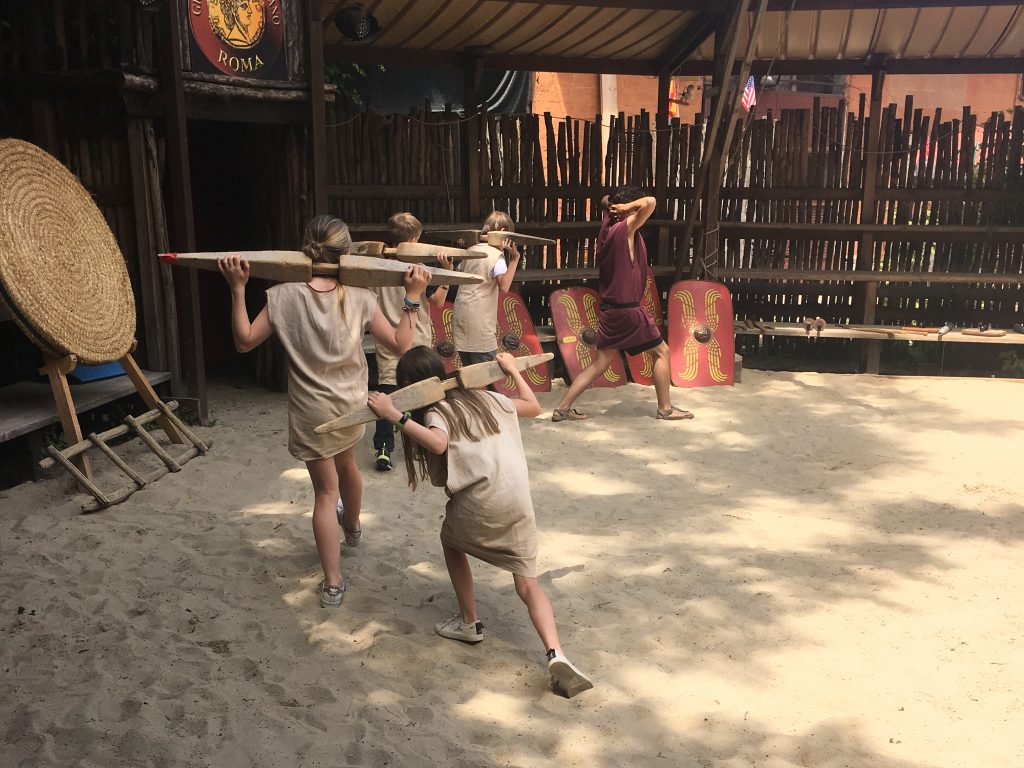
Invest some time at the start of your visit to Rome with teenagers by training to be a gladiator at Gladiator School, run by the Gruppo Storico Romano. To be honest, it probably suits younger teens better than older ones. Over a couple of hours you:
Learn the history: Start in the small on-site museum, with masks, shields and armour to look at.
Get kitted out: Dress up in gladiator tunics so you look the part.
Train properly: Warm up, then learn the key sword fighting positions and tricks of the trade, with wooden swords.
Fight it out: Take part in a mock battle in the arena to see who the emperor and the crowd decide to spare.
Graduate: Leave with your gladiator credentials, ready for the Colosseum.
You’ll need to book ahead. It isn’t cheap, so we just booked our kids in, although there were parents joining in and clearly having fun. We booked our session through GetYourGuide.
The school is on the Via Appia Antica, so the easiest way there is a short taxi ride. You’ll be travelling along the Appian Way, one of the most important roads of ancient Rome, which ran all the way to Brindisi on the heel of Italy. One tip: take insect repellent, as you will get bitten if the conditions are right (or wrong!).
Once your kids have graduated from Gladiator School, it’s time to see the Colosseum and hear what really happened to the gladiators, most of whom were slaves, in this mighty amphitheatre.
For younger teens, the best way to visit the Colosseum is on a tour aimed at children. Our guide was lovely, encouraged us all to wear gold leaf headdresses, and pitched her stories so they were fun and age appropriate, which kept the kids interested from start to finish. We booked our family tour through GetYourGuide.
Older teens might prefer a standard tour, or to explore under their own steam. If you go it alone, check what audio guide options are available when you book. Either way, the stories will stay with them: battles with wild animals, the arena said to have been flooded for mock sea battles, and the heroes and villains of the gladiator days.
Our Colosseum and Monti guide has the practical detail on tickets and timing.
After the excitement of Gladiator School and the Colosseum, this is a low-key stop, but it was one our kids really enjoyed. Largo di Torre Argentina is a sunken square of ruins holding four temples from the Roman Republic, some dating back to the 4th century BC. They lay hidden until demolition work uncovered them in the late 1920s.
There’s a story to grab teenagers here too. Julius Caesar is thought to have been murdered in 44 BC in the Curia of Pompey, whose remains are part of this site.
Today, though, the square is better known as home to a colony of cats, cared for by volunteers who run a cat sanctuary on the site. Spend a quiet 20 minutes trying to spot them asleep in the shade or stretched out on the old stones. It’s on our Centro Storico walk, so it’s easy to fit in.
Castel Sant’Angelo is a fortress on the banks of the River Tiber, and it has everything a teenager could want from a castle. You reach it across Ponte Sant’Angelo, the Bridge of Angels, lined with angel statues designed by Bernini.
It started life in the 2nd century AD as a mausoleum for the Emperor Hadrian, then became a papal fortress and a prison. Inside there are dungeons, and a fortified corridor that runs all the way to the Vatican as an escape route for the Pope if danger was approaching. There are cannons, cannonballs and catapults dotted around the walls, and the papal apartments are full of painted rooms, statues and artwork.
When you reach the top you’re rewarded with superb views over the Bridge of Angels to St Peter’s Basilica. When we went there was a café near the top, which is a good spot for a drink beneath the huge bronze statue of the Archangel Michael. Visiting the castle was a surprise for me. We went because of the kids, but it turned out to be one of my favourite things we did in Rome.
Booking skip the line tickets ahead saves time at the entrance.
Villa Borghese is a large urban park covering around 80 hectares, on land that was once a vineyard. It’s a peaceful escape from the busy streets, and a perfect spot for a picnic or for exploring on bikes.
There are a few places to hire bikes inside the park, including near the Terrazza del Pincio. We rented a four-person bike with a blue sunshade, which was fun for the kids and a good way to cover a lot of the park without anyone complaining about their feet.
If you come in from Piazza del Popolo, head right first to the Terrazza del Pincio for a fabulous view over the piazza and the rooftops beyond. Our walk from the Trevi Fountain to Villa Borghese finishes here, with ideas for lunch and the Borghese Gallery if anyone still has the energy for art.
Don’t miss the Trevi Fountain, with its powerful water cascading over a beautifully carved façade. Go as early as possible to beat the crowds, then get your kids to throw a coin over their shoulder and make a wish. Legend says:
One coin: You'll return to Rome.
Two coins: You'll fall in love with an Italian.
Three coins: You'll return, fall in love and get married.
They might be a bit young for some of those, so maybe stick to the one coin!
To manage the huge crowds, Rome has introduced a small charge for the area down by the fountain basin during the day. The upper part of the piazza is still free. Check the official Trevi Fountain ticketing information before you go, as the times and arrangements may change.
Some of the most fun moments in Rome come from odd little details rather than big sights. Turning these into a treasure hunt is a good way to keep teens interested as you walk.
In Piazza della Minerva, just behind the Pantheon, you’ll find a carved elephant carrying an Egyptian obelisk on its back, designed by Bernini. The Grand Hotel de la Minerve on the piazza had a rooftop bar overlooking the Pantheon when we visited, if you need a drink.
The Pantheon itself is right there, so you could pop in if the kids aren’t flagging. There’s now an entry charge and the queues can be long, so decide whether it’s worth it for your crew.
In Piazza Mattei, in the old Jewish Ghetto, look for the Fontana delle Tartarughe. Four bronze youths seem to be lifting little turtles up into the fountain’s top bowl, and once you’ve spotted them it’s hard not to smile. The Ghetto has a sobering history worth sharing with older kids: from 1555 until 1870, Rome’s Jewish community was confined behind its walls.
If you’re passing, stop at the Bocca della Verità, the Mouth of Truth, in the portico of the church of Santa Maria in Cosmedin near the Circus Maximus. If the queue isn’t too long, line up to put your hand in the stone mouth and make a statement. Legend says that if you’re lying, it will bite your hand off.
Sometimes it’s the small things that keep kids entertained in a new place. In Rome, ours loved:
The water fountains: Filling water bottles from the old fountains around the city, or drinking straight from them.
The traffic police: Watching officers in the middle of busy junctions directing the traffic.
Fiat 500 spotting: Counting the little Fiat 500s (we call them Bob!).
A gelato league table: Trying a different gelato everywhere you go and keeping score of the best.
Carbonara: Eating your body weight in spaghetti carbonara, a true Roman classic.
In closing
There's so much more I could have included, because Rome is packed with things to discover. But these are the ideas that worked best for us on a visit to Rome with teenagers, and the ones I'd recommend to any family.
If you're planning your trip now, our Rome city break planner brings all our walks together. I hope your kids enjoy a magical few days in Rome. Ours loved it so much they asked to go back the following year.
Buon viaggio!
Thank you so much for reading my blog. For more stories, itineraries, and advice, check out my Related Posts and sign up to receive my blogs by email.
If you have a blog-related question, please do ask in the comments box below and I'll try to help.
A little request: if you use my photos, please credit Love Travel Planning on your social media or give me a shout out on Instagram @lovetravelplanning as I am growing my website. Huge thanks.
Join thousands of travelers looking for inspiration from our FREE Planet Travel newsletter!
Your step-by-step framework for stress-free, unforgettable trips — from first idea to final itinerary.