Rated 4.5 out of 5
Seated sculpture overlooking the countryside at Yorkshire Sculpture Park, with the distant Emley Moor transmitting mast visible on the horizon under cloudy skies

Yorkshire Sculpture Park: A Walking Route Around The Outer Park

Yorkshire Sculpture Park (YSP) spreads across 500 acres of 18th century parkland near Wakefield, with around 90 sculptures dotted through its fields, woods and lakes. YSP describes itself as the largest sculpture park in Europe, and once you’re out exploring the landscape, it’s easy to believe.

It’s one of the Modern Wonders on our Wonders of Yorkshire trail, and it was the main stop on a day out that also visited Castle Hill and Emley Moor Mast.

I visited here on a Wednesday afternoon in late October and spent around two and a half hours walking a loop through the outer areas of the park. It wasn’t nearly enough time. I left having seen only part of it, and I’m already planning to go back.

⚡ Overview

My loop took around two and half hours, including stops. To spend longer with the sculptures and see more beyond the loop, plan on four hours or more, and walk the outer areas if you want art and countryside in equal measure.

Table of Contents

Tickets & parking at Yorkshire Sculpture Park

You need a ticket to enter, whether you arrive by car, bike, bus or on foot, and car parking is included. I didn’t book ahead. I drove up the main drive and paid at a staffed booth on the way in, then parked at the Visitor Centre car park.

Yorkshire Sculpture Park recommends booking online, especially at weekends, bank holidays and school holidays, when tickets are limited and can sell out. Check the YSP visit page for the latest ticket and opening information.

The gates close an hour earlier in winter than in summer, and Yorkshire Sculpture Park is closed on Mondays, except during Wakefield school holidays and on bank holidays. Check the opening times before you go. Arriving after lunch, I found an afternoon simply wasn’t enough time.

Visitor centre and shop entrance at Yorkshire Sculpture Park, with autumn trees, a paved path and information board under cloudy skies

My walking route through YSP’s outer park

Rather than sticking to the main paths around the lakes, I walked a clockwise loop through the outer areas of the park, planned with the YSP map. It’s mostly field walking with some surfaced paths and lanes. The car park was about half full, but out on the loop, I didn’t see a single person.

I’ve created the exact route I followed on AllTrails, so you can follow it step by step:

Start & finish: The Visitor Centre, next to the main car park.

Distance: 6.79km.

Time: About two and a half hours, including stops to look at the sculptures.

Terrain: Mostly fields, with some surfaced paths and lanes. Expect mud after rain.

Steps & climbs: A long flight of steps from the lakes, then a climb to the ridge of Oxley Bank.

Livestock: Highland cows near Longside, other cattle in some fields, sheep and goats in the Country Park.

Dogs: Pet dogs aren’t allowed around the Upper Lake, which this route passes, so dog walkers need to follow YSP’s signposted alternative for that stretch.

From the Visitor Centre down to the lakes

I started at the Visitor Centre, where there are toilets, then headed down across the open fields of the Country Park into the valley.

On the way down, I passed two of Damien Hirst’s bronzes; Charity is a giant version of an old charity collecting box, a girl in calliper holding a teddy bear and a box asking you to “please give generously”. A little further down is The Virgin Mother, a 10-metre bronze of a pregnant woman with one side opened to show the anatomy underneath. It’s even stranger in person than in photos.

Damien Hirst’s Charity sculpture, a large figure of a girl in a blue dress holding a teddy bear and donation box, standing in the parkland at Yorkshire Sculpture Park under cloudy skies
Damien Hirst’s The Virgin Mother, a large standing female figure sculpture, in an open field at Yorkshire Sculpture Park with autumn trees and a reservoir beyond under cloudy skies

At the bottom, I crossed the lakes beside the cascade, where the water spills over a weir from one lake to the next. If you look to your right, you will be able to see Emley Moor Mast poking over the trees.

Damien Hirst’s The Virgin Mother sculpture standing on the bank above a weir and river at Yorkshire Sculpture Park, with autumn trees under cloudy skies
Emley Moor transmitting mast visible in the distance across a reservoir, framed by autumn trees under heavy cloud

Seventy-one Steps and Oxley Bank

From the lakes, the trail climbs through the woods on David Nash’s Seventy-one Steps, charred oak steps set in coal. It’s a steep climb, but a lovely one in autumn, with the beech leaves turning gold around you. At the top, the woods open out onto the ridge of Oxley Bank.

David Nash’s Seventy-one Steps, charred oak steps climbing through autumn woodland at Yorkshire Sculpture Park, with fallen leaves covering the path and surrounding trees

The Seated Figure and the view to Emley Moor

The highlight of my walk was a giant figure of a man sitting on a chair on the ridge of Oxley Bank, looking out over the valley. It’s Sean Henry’s Seated Figure, three metres tall.

From where he sits, he looks straight across towards Emley Moor Mast, which I’d stopped at earlier in the day. It was almost as if he was looking at the route I’d just taken.

Dirt path leading up a grassy slope to Sean Henry’s Seated Figure sculpture at Yorkshire Sculpture Park, with a bench and autumn trees under cloudy skies

Longside and the Highland cows

Following the signs for the Longside Gallery, the path drops back into the woods, past Andy Goldsworthy’s Outclosure, a circular drystone fold among the trees. Near the Longside Gallery, I passed a herd of relaxed Highland cattle, although I wasn’t in their field. Not much later, I walked through a field of younger cattle, who also weren’t bothered by me at all.

Andy Goldsworthy’s Outclosure, a circular stone wall structure in the woodland at Yorkshire Sculpture Park, surrounded by trees and autumn leaf litter
Highland cattle grazing in a field at Yorkshire Sculpture Park, with trees and a building in the background under cloudy skies

The Upper Lake and the Shell Grotto

From Longside, the path follows the Upper Lake, with wildlife boards along the way and the water glinting through the trees. 

Thomas J Price’s Network, a life-sized bronze statue of a man in a black puffer jacket looking at his phone, standing beside a gravel path at Yorkshire Sculpture Park under cloudy skies

Further round, I came to the little ivy-covered stone hut by the Upper Lake. This is the Shell Grotto. One of the follies from the old Bretton estate, rather than a modern artwork.

Ivy-covered stone entrance to the Shell Grotto at Yorkshire Sculpture Park, a historic folly set in the woodland

The Yorkshire Sculpture Park heritage page says it may even have housed a hermit to entertain guests. Step inside and look up. The ceiling is a swirl of rough stone, and arched windows frame the lake.

Close view of the shell-encrusted stone interior of the Shell Grotto at Yorkshire Sculpture Park
View through the stone entrance of the Shell Grotto looking out over the lake at Yorkshire Sculpture Park

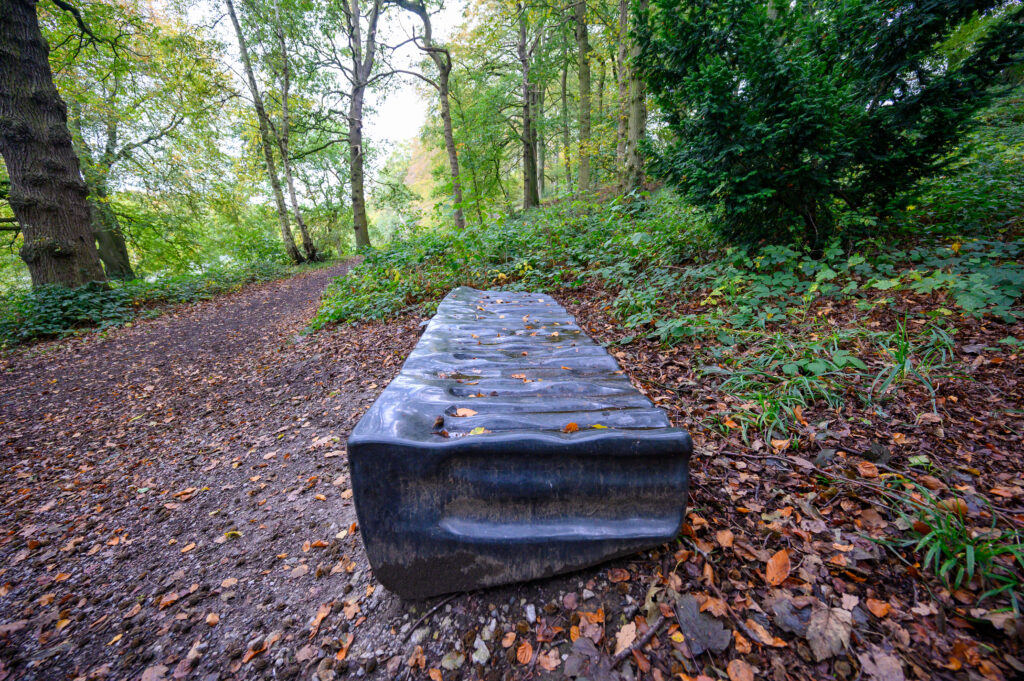
Just past the grotto, Willem Boshoff’s Flagstone looks out over the water. It’s a block of black granite carved to ripple like a flag in the wind, and it doubles as a seat.

Dark sculptural form beside a woodland path at Yorkshire Sculpture Park, surrounded by autumn leaves and trees

A little further on, there’s a wooden bird hide looking out over the water, and the ruins of the old boathouse. The hide is a good spot to sit for a few minutes and watch the birds go about their daily business – when I visited, all I could hear was the birds and the sound of rain drops on the roof…bliss!

View across a lake at Yorkshire Sculpture Park framed by wooden beams of a shelter, with trees and islands under cloudy skies

The Greek Temple & a giant bronze head

Beyond the boathouse, the path follows the Cut, the old water channels on the far side of the Upper Lake. Just after them is Tania Kovats’s RAVINE, which looks like a black rock split in two and doubles as a bench.

From there, a woodland walk leads past an old obelisk to the Greek Temple, a folly from the estate’s days as a pleasure ground. In front of the temple stands Matthew Darbyshire’s Untitled (David), a version of Michelangelo’s David that looks as if it’s been built from stacked slices.

Matt Darbyshire’s Untitled (David) sculpture, a black layered figure, standing near the Greek Temple at Yorkshire Sculpture Park under autumn trees

Deeper in the woods, I found the large sculpted head I’d glimpsed through the trees. It’s Daniel Arsham’s Unearthed Bronze Eroded Melpomene, a huge classical head half sunk into the fallen leaves, with parts of it looking worn away, as if it’s just been dug up. Bharti Kher’s bronze The fallow is nearby too.

Daniel Arsham’s Unearthed Bronze Eroded Melpomene, a large bronze head sculpture lying on the ground in the woodland at Yorkshire Sculpture Park amid autumn leaves

Back through the gardens and Country Park

From the woods, I crossed the Cut Bridge at the end of the lake and headed back towards Bretton Hall. This stretch is packed with sculpture. Sol Le Witt’s stepped 123454321, Sean Scully’s stacked stone blocks, Wall Dale Cubed, Barry Flanagan’s leaping hare, and Large Nijinski on Anvil Point, are all close together.

Sean Scully’s Wall Dale Cubed, large stone wall sculptures in the parkland at Yorkshire Sculpture Park, with an information board in the foreground under autumn trees
Barry Flanagan’s Large Nijinsky Hare on Anvil Point, a dark bronze leaping hare atop a tall anvil form, standing in the parkland at Yorkshire Sculpture Park with autumn trees and further sculptures under cloudy skies

The last stretch back up to the Visitor Centre crosses the Country Park, home to the park’s Henry Moore bronzes, with sheep grazing between sculptures.

Vanessa da Silva’s Muamba Posy, colourful abstract organic sculptures in the distant parkland at Yorkshire Sculpture Park, with sheep grazing in the foreground under cloudy skies

What else to look out for:

James Turrell’s Deer Shelter Skyspace: A chamber inside an old deer shelter that frames the sky through its roof.

Barbara Hepworth’s The Family of Man: Nine large bronzes on a hillside, each a stage of life.

The indoor galleries: Changing exhibitions, so check what’s on before you go.

Works move around and some are on loan, so check Art Outdoors on the YSP website or pick up a map on arrival.

Visiting Yorkshire Sculpture Park with dogs

Dogs are welcome in most of the parkland and woods, but Yorkshire Sculpture Park asks you to keep them on a short lead at all times, not just near livestock. Pet dogs aren’t allowed around the Upper Lake or Menagerie Wood, to protect the livestock and wildlife there, and there’s a signposted route around that area.

I passed a herd of horned goats through one of the woodland areas, and I’m sure they would have been far more intimidating for Linus (our dog), than Linus to the goats!

Luckily, I didn’t have Linus this time. If you bring your dogs, make sure you read YSP’s dog guidance before you go, and ask at the Visitor Centre for a dog-friendly route.

Accessibility at Yorkshire Sculpture Park

My outer loop isn’t suitable for wheelchairs or mobility scooters, as it’s mostly field walking, with mud and a long flight of steps.

YSP lends a small number of off-road mobility scooters free of charge, and recommends reserving one before you visit, as they’re popular. Staff at the Visitor Centre can suggest accessible routes for you. Most of the main paths are compacted stone, but there are some steep gradients, especially in the Country Park, and wet weather can make outdoor areas very muddy.

See YSP’s accessibility page for the details.

Lake with reed beds and autumn trees at Yorkshire Sculpture Park under cloudy skies

Tips for visiting Yorkshire Sculpture Park

Give yourself time

My loop took around two and a half hours. Plan on four hours or more to linger with the art, and longer with lunch or the indoor galleries.

Check the day and closing time

YSP is closed on most Mondays outside school holidays, and the gates close earlier in winter, so start early if you want to walk the full loop.

Wear boots

The outer loop is mostly fields, and parts were muddy even on a dry autumn day.

Have lunch at the park

There’s a cafe at YSP. I grabbed a meal deal on the way, but an earlier start would have meant a proper lunch.

Respect the livestock

Give cattle space and close gates behind you.

Why Yorkshire Sculpture Park is a Modern Wonder of Yorkshire

The Modern Wonders of Yorkshire are the places created in the last century or so that changed how the country looks and lives. The landscape at Bretton is much older, but what Yorkshire Sculpture Park has done with it earns its place on the trail.

In 1977, Sir Peter Murray, then a lecturer at Bretton Hall College, started YSP with a £1,000 grant and no staff. The idea was to take modern sculpture out of the gallery and put it in the landscape where people could encounter it on a walk. Nearly 50 years later, the park has worked with more than 1,000 artists from over 40 countries.

Other than it being in Yorkshire, there is also a strong Yorkshire connection, too. Barbara Hepworth was born in Wakefield, and Henry Moore in Castleford, and you can see work by both here. YSP is the only place in Europe where Hepworth’s The Family of Man is displayed in full.

Named Art Fund Museum of the Year in 2014, Yorkshire Sculpture Park has helped make Yorkshire a place people travel to for sculpture, alongside The Hepworth Wakefield and the Henry Moore Institute in Leeds.

For me, though, it was coming across a seated figure on a quiet ridge, then realising he was looking towards Emley Moor Mast, where I’d just been. The old estate, the surrounding countryside and the sculptures all become part of the same walk. That’s what makes it a Modern Wonder of Yorkshire.

Make a day of it

Yorkshire Sculpture Park is the main stop of a day out with two other Wonders of Yorkshire. Emley Moor Mast is about 15 minutes away by car, and Castle Hill is a little further on, above Huddersfield. Start with whichever of YSP or Castle Hill is furthest from home, stop at the mast in the middle, and finish at the other.

Yorkshire Sculpture Park also sits right on the border with South Yorkshire, and Wentworth Woodhouse, one of our New Age Wonders. It is only around half an hour south down the M1, so it’s another great pairing if you’re in the neck of the woods for a weekend.

Final thoughts

Is Yorkshire Sculpture Park worth visiting?

Yes. I loved my time exploring Yorkshire Sculpture Park and will definitely be returning. I especially enjoyed venturing out beyond the main paths, and still coming across sculptures. With even half the car park full, I didn’t see a single person on the outskirts of the park.

Next time, I’ll start earlier and head for the Skyspace, the Hepworths and the galleries.

See you back at the Seated Figure!

Love Travel Planning
Thank you for reading

I hope you found it useful

Thank you so much for reading my blog. For more stories, itineraries, and advice, check out our Related Posts and sign up to receive Lucy's blogs by email.

If you have a blog-related question, please do ask in the comments box below and I'll try to help.

T
Guest writer

This blog was written by Tom at Smyto Creative.

📸

A little request: if you use my photos, please credit Smyto Creative on your social media or give me a shout out on Instagram @smytocreative as we are growing this website. Huge thanks.

Enjoy your travels! ✈️
Get Planet Travel

Join thousands of travelers looking for inspiration from our FREE Planet Travel newsletter!

Thanks! Check your inbox to confirm.

FREE GUIDE

The Platinum Travel Planning Roadmap

Your step-by-step framework for stress-free, unforgettable trips — from first idea to final itinerary.


FREE GUIDE

The Platinum Travel Planning Roadmap

Your step-by-step framework for stress-free, unforgettable trips — from first idea to final itinerary.

Get Planet Travel

Join thousands of travelers looking for inspiration from our FREE Planet Travel newsletter!

Thanks! Check your inbox to confirm.