
★★★★★ Rated 4.5 out of 5

★★★★★ Rated 4.5 out of 5
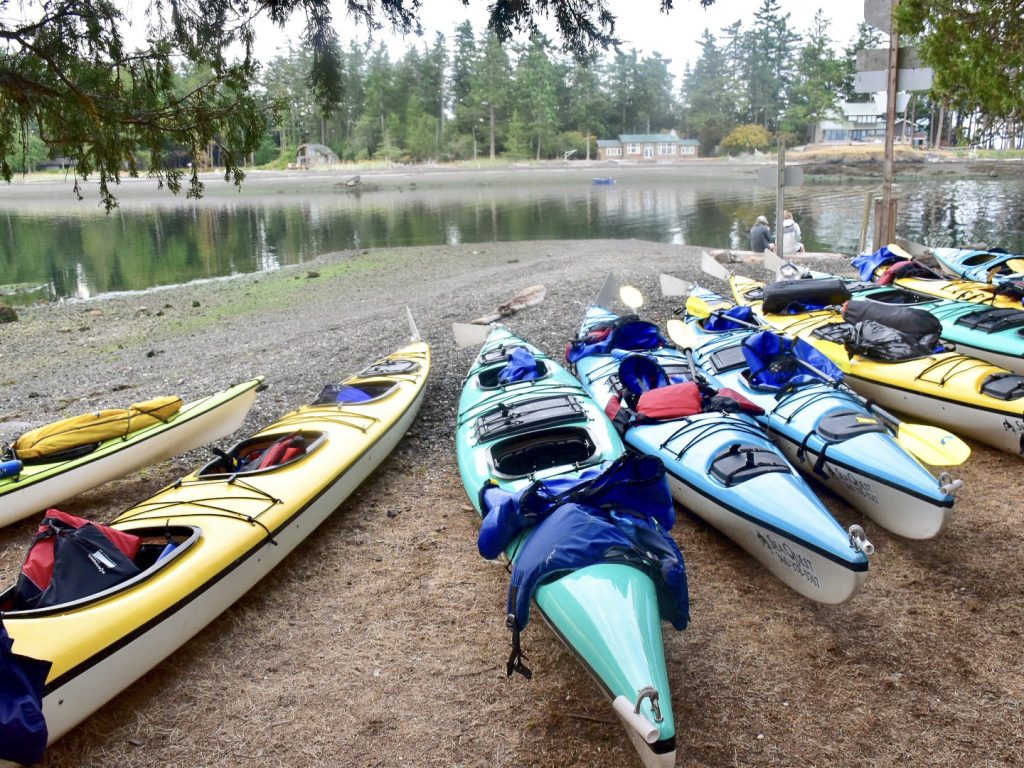
As part of our Pacific Northwest road trip, we booked a sea kayaking tour in search of orcas who roam the Salish sea routes of the San Juan Islands, USA. The promotional materials for the kayak tours show wonderful photographs of majestic orcas swimming past and breaching near enthralled kayakers on these trips, but they also make it clear that orca sightings are obviously not guaranteed. So, what’s it like on a sea kayaking tour in the San Juan Islands, USA, and does it matter if the orcas don’t show up?
Geoparks offer rewarding, low-crowd alternatives to traditional UNESCO sites – rewarding for their dramatic landscapes, stories of Earth history, and genuine local engagement. A free downloadable list of all Geoparks is provided for trip planning.
There are three ways, and they suit different people…
The quietest and the most physical. You are at water level, you cover ground slowly, and if orcas do pass you it is at eye height rather than from a deck three metres up. Trips run from a half day to five days. This is what we did, and the rest of this article is about it.
Faster, warmer and far more likely to reach the whales, because the skippers are in radio contact with each other and can reposition. If seeing an orca matters more to you than the experience of being on the water, book a boat. San Juan Safaris and San Juan Island Outfitters both put a share of every fare into their joint conservation fund.
Lime Kiln Point State Park on the west side of San Juan Island is known locally as Whale Watch Park, and orcas hunt along that shoreline. It costs nothing, you can sit there all afternoon, and people do.
May to September, following the Chinook salmon run. The Southern Resident pods have had some very poor years — we picked 2019, which was one of the worst on record — but recent seasons have been much better.
We booked our multiday kayaking trip with Sea Quest Kayak Tours which involved two days on the water and one night of wild camping on one of the San Juan Islands, USA. Sea Quest Kayak Tours offer longer trips, but two days was all that we could spare on our road trip itinerary.
I would thoroughly recommend Sea Quest Kayak Tours for such a trip. All their communications were excellent, and the tour leaders are experienced sea kayak guides with specialisms in biology or environmental science, so you are in both safe and interesting hands.
*Please note, we are not affiliated or sponsored by Sea Quest Kayak Tour, we genuinely had such a blast with them, even if we didn’t see any orcas!
We met our guides at Friday Harbor port where we loaded all our bags and equipment onto a trailer ready for transportation to the departure beach. In total we were a group of 16 people on the tour – 1 Aussie, 4 English and the rest Americans – plus 2 tour guides. Our girls (aged 12 and 15) were the youngest in the party, but there were 2 older teens in the group.
When we were all present and correct, we boarded a Scooby Doo transfer bus and drove across San Juan to Smallpox Bay on the west side of the island, where we divided up our provisions and loaded the kayaks, spreading out the weight of the food and tents.
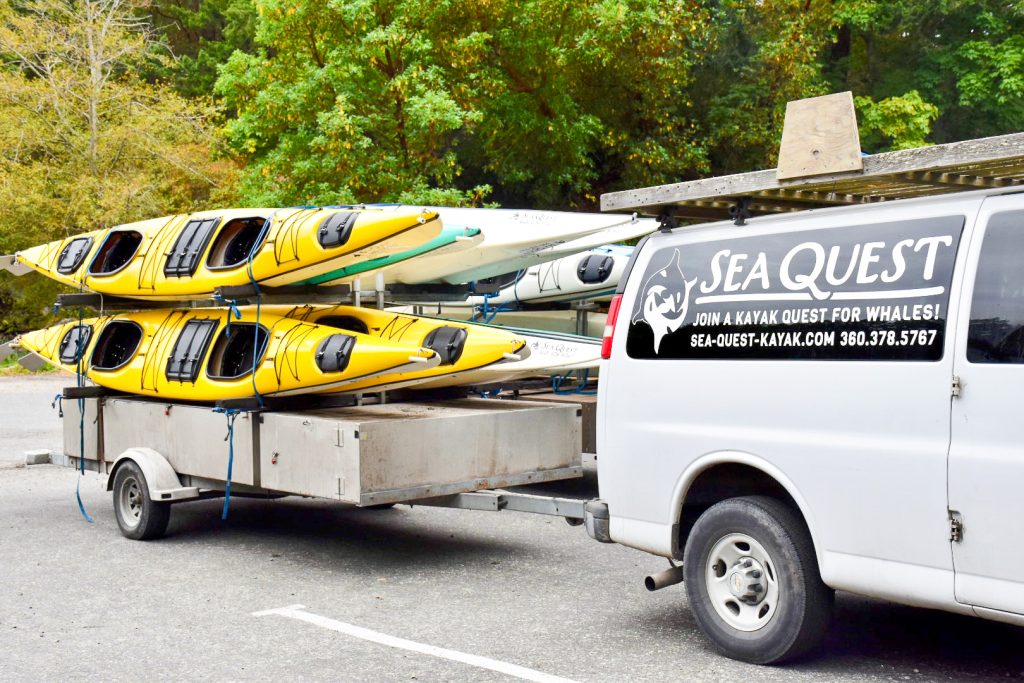
I must admit to feeling nervous at this point – nervous about what was in store for us, how difficult it would be, and whether we would be fit enough!
We used top-quality sea kayaks for the trip which were over 20 feet long and steady in the water. Double kayaks tend to be more stable than the solo versions, particularly when filled with all your equipment and food supplies. Our elder daughter paddled a double kayak with one of the tour guides, and our youngest daughter shared a triple cockpit kayak with Mum and Dad.
All the kayaks required a waterproof skirt to be fixed on to the board of the kayak to prevent water splashing inside, but if you have ever tried attaching these you will know that it’s harder than it looks and took some time to master. Challenge number one!
The conditions on the first day of our sea kayaking trip were a little damp, but thankfully not too windy. The previous week had enjoyed gorgeous weather in the area, more fitting with San Juan’s claim to having the ‘driest microclimate along the Washington Coast’ due to the protective position of the Olympic Mountains nearby.
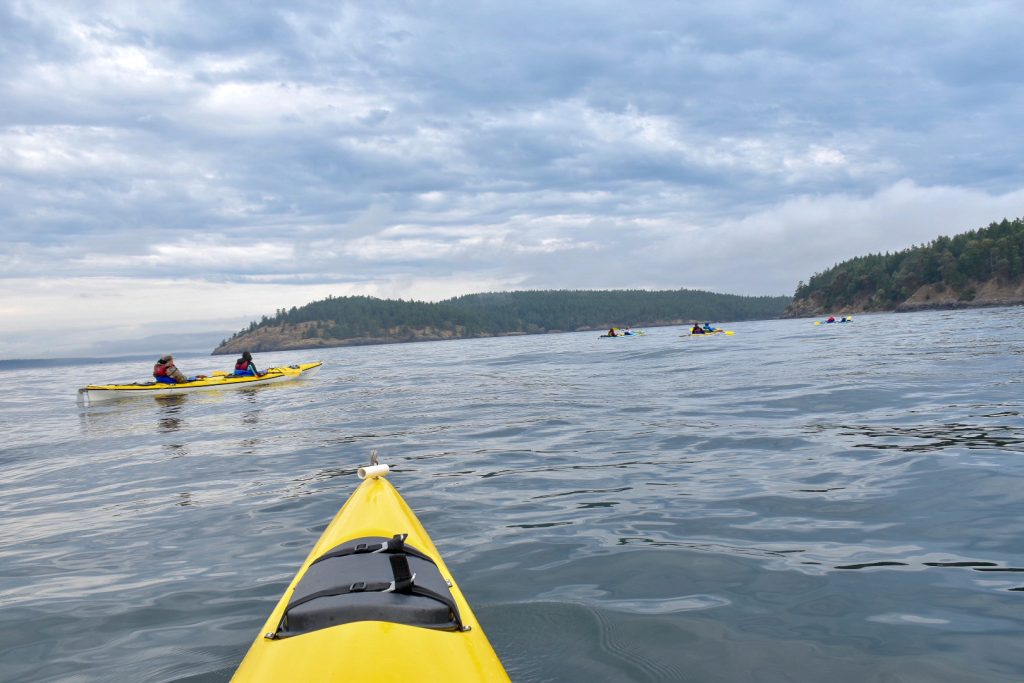
We kayaked north up the west side of San Juan Island and enjoyed the ease of kayaking with the current, before stopping at a pebble beach for a lunch of hummus bagels and fresh cherries. There were Lion Jellyfish on the beach, which can sting even if they are on the ground, so we had to be careful where we stepped.
Swimming for the brave. Only one of the group was brave enough for a swim, and it was a very quick one, as the waters are so cold – apparently it would only take 20 minutes for someone to get into trouble in the chilly waters here.
After lunch we continued kayaking north and around Henry’s Island and hit a large area of Bull Kelp in the water – strong enough for the Salish people to have used it as a line to haul in halibut due to its remarkable tensile strength. Bull Kelp is also nutritious and tasty to eat, which we sampled straight from the water. Actually, it was quite tasty.
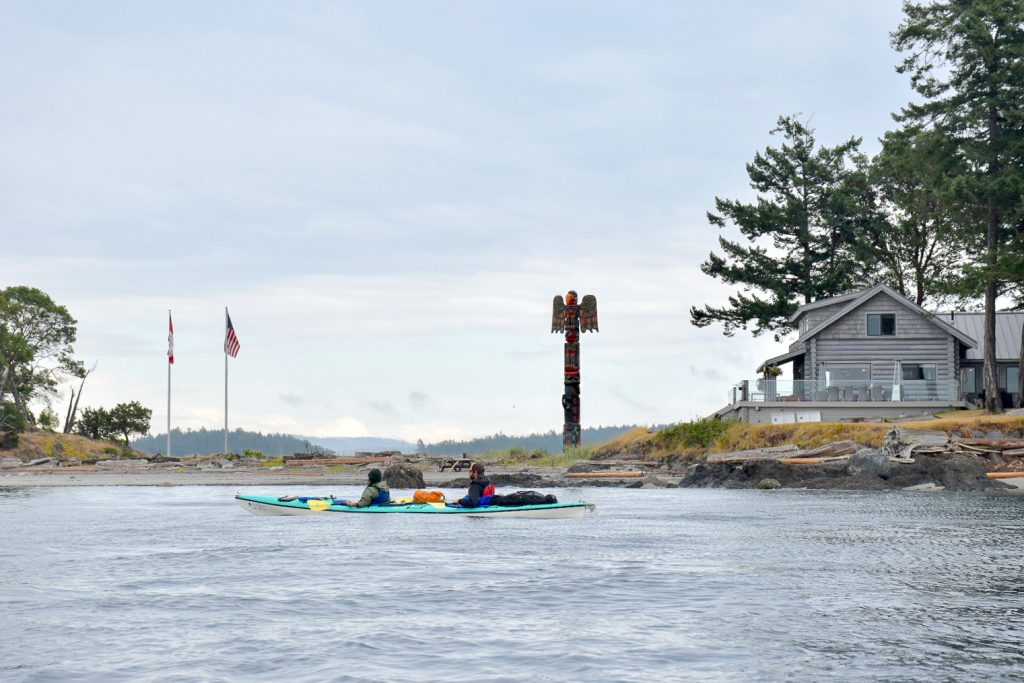
I particularly enjoyed the next section of our sea kayaking trip as we paddled by some gorgeous houses along the coast – these houses cost millions as they are west facing so enjoy the sunsets and views of passing whales on the migration routes. Most of the houses have boat launches, huge windows overlooking the view, tree houses and hot tubs outside, which all made for great rubbernecking from the water!
There were also plenty of madrone trees along the coast which I had never seen before – peeling like onions, resulting in blotchy, multi-coloured bark, some of which were bright orange.
Towards the end of the day’s journey, we spotted a house on a small island with a totem pole in the garden, flying both the US and Canadian flags as the house straddles the border between the two countries. We were paddling through international waters although we only made land in the USA.
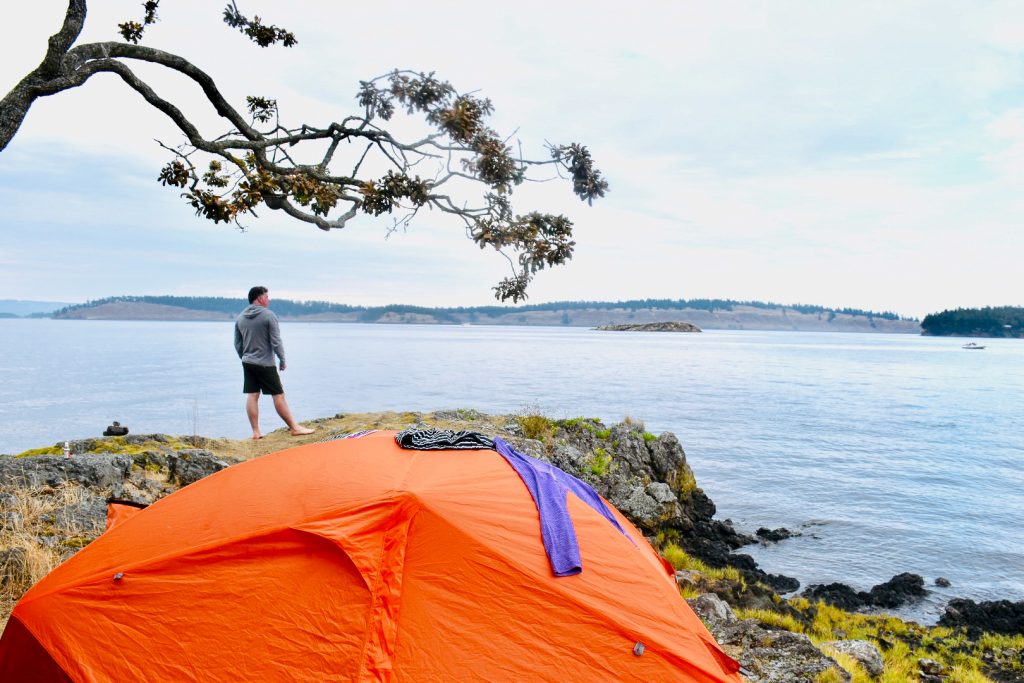
Eventually we arrived at our reserved campsite on tiny Posey Island, USA, for the night. We pitched our two-man tents overlooking the water and then rested our tired arms. Posey Island is on the flight path of the float planes heading into Roche Harbor, so we enjoyed watching the little planes taking off and landing around us. After a while we were joined by some curious harbour seals who played in the water in front of our tent which was a highlight.
The tour guides set out dinner on a long table for a communal camp meal of burritos, when we could get to know our fellow paddlers a little better. For those able to stay awake long enough, S’mores were made around an evening campfire, and someone produced a guitar for a sing-along – I’m not sure where the guitar had been hidden on the kayaks!
Somewhere amongst all of that there was a terrific sunset capping off an all-round memorable day, despite not having spotted any orcas.
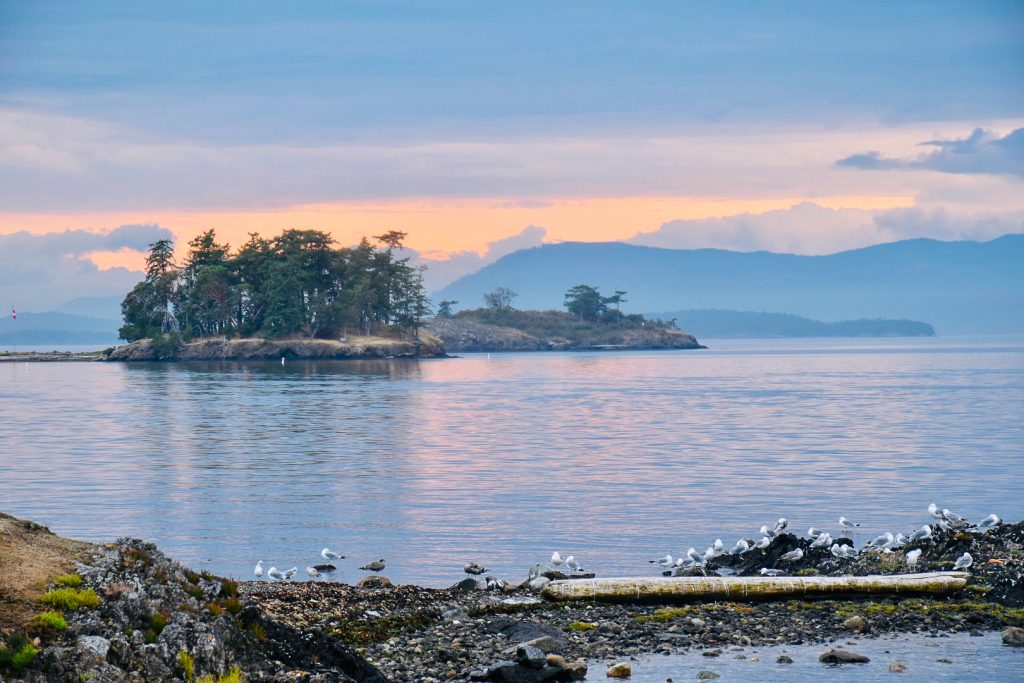
Camp was awoken by the sound of Gershwin’s Summertime being played on the guitar as the sun rose – what a wonderful alarm call. Then, when we surfaced from our tent, our two harbour seal friends were sitting on the rocks opposite our tent watching us. Hello guys!
After a breakfast of scrambled eggs on toast, cleverly using leftover veggies from last night’s burritos, we needed to strike camp and repack the kayaks ready to hit the water again (leaving no trace of our stay behind). As our guide liked to say, “Let’s roll on and off and keep on rolling!”
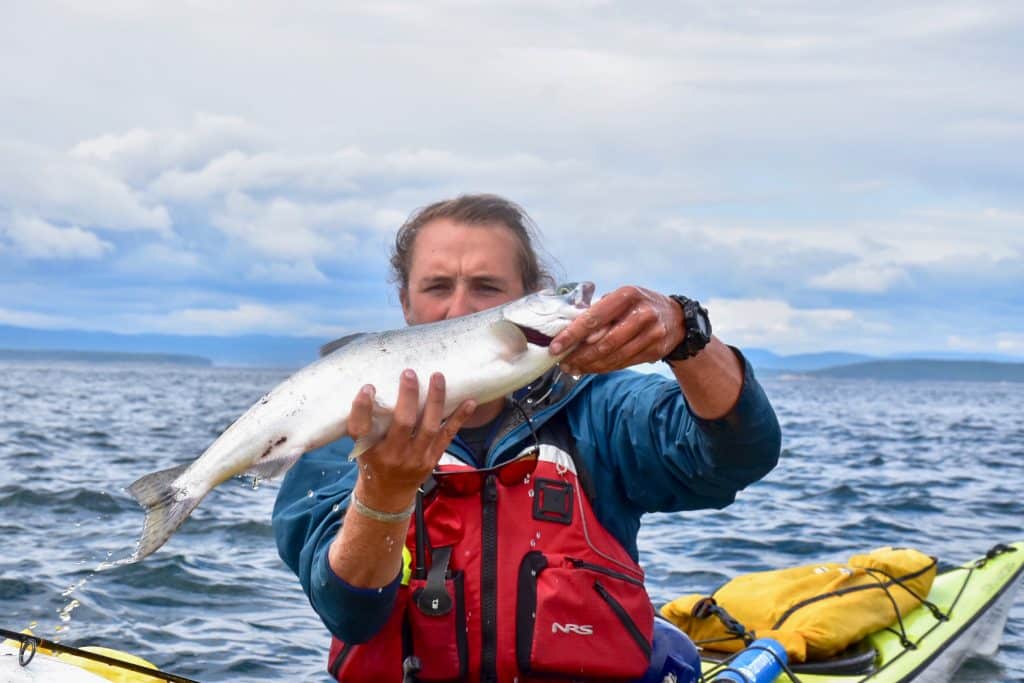
Before long we were kayaking through a school of jumping salmon and one of the guides, who had been running a fishing line from his kayak, reached into the water, and pulled out a Chinook salmon which we all admired before he released it back into the ocean. The guide commented that it was a first for him…and for us…
Shortly after the salmon catch, our guide produced a dead, Yellow-eyed Rock Fish from the water which the seagulls had been playing with. These fish are endangered so, if you catch a live one, you must put it back, but because they are bottom feeders, they must be weighed down to help get them back to the bottom of the ocean.
As we approached Smallpox Bay for the end of our kayaking experience, the realisation hit that the orcas weren’t going to show up for us on this trip. So where were the orcas?
This area is famous for its salmon eating orca sightings because it is on the route for migrating Chinook salmon, which the orcas come to feed on during the summer months (May to September). However, the building of dams and over-fishing of the salmon has led to fewer salmon in the water, and in turn, fewer Southern Resident orcas who feed on them.
Conservation efforts have included taking out dams on one of the rivers to allow the salmon to pass through the area again and get to their spawning places – this was working until a hatchery was built further along the river, so 2 steps forward and one step back.
Seal eating orcas called Northern Transients are faring better and there have been more sightings of this type of orca passing through the channels. Northern Transients however have a different issue to deal with, namely the ingestion of toxins – plankton takes in nasties such as plastic particles and detergent toxins before being eaten by herring, which in turn are eaten by seals, and then by the orcas. Toxins are passed along the food chain and intensify as they go which is not good for the orcas at the end of the chain.
The Whale Museum in Friday Harbor was displaying whale sighting figures for the J-, K- and L- pods, which noted only 2 whale days between 20th May and 10th August 2019, as opposed to 16 whale days in the same period the previous year. The Sea Quest website notes that 2013, 2019, and 2020 were terrible years for killer whale watching in the area.
Unfortunately for us, we took our trip in 2019 and so were unlucky to hit one of the terrible years for killer whale watching in the area (but I guess it’s worse for the orcas!).
Any month now, which was not true when we went. Bigg’s killer whales are in these waters all year round and through 2026 they were being recorded on virtually every day, so there is no longer a wrong month to come looking for orcas in general.
If it is specifically the Southern Residents you want to see, the traditional answer was May to September, following the Chinook salmon run, and that is still when they are most likely to turn up. It is simply far less likely than it used to be, so I would not build a trip around it.
For kayaking, the season runs from roughly May to September, and July and August give you the warmest and calmest water. We went in mid-August. Humpback numbers build through late summer and into the autumn, so September is a good bet if you would be happy with whales of any kind.
Despite those erratic years, the San Juan Islands remain the best place in the USA for seeing killer whales. What has changed since our trip is which killer whales you are likely to see.
The Southern Residents, the salmon-eating J, K, and L pods whose sighting figures we read on the boards at the Whale Museum, are no longer a reliable summer presence. The population stood at 74 in 2025, and that summer they spent just 3 days in the Salish Sea between May and August, the lowest on record. In 2026, they were absent from the inland waters for over two months before J Pod and part of L Pod made a single 48 hour loop up to the mouth of the Fraser River in June. Then July passed with no Southern Resident sightings at all, the first July on record without them.
What has taken their place is the seal-eating ecotype, the transients, now more usually called Bigg’s killer whales. They are thriving in the same waters where the Residents are struggling. The Orca Behaviour Institute logged 260 separate Bigg’s sightings across the Salish Sea in June 2026, a record, then broke the July record as well, and through that summer they were being seen somewhere in these waters on almost every day of the year.
So your odds have improved, but the animals have changed. Whale watching boats are reporting very high success rates now, counting Bigg’s and the growing number of humpbacks alongside them. From a kayak the odds are lower and still down to luck, which is why a multi-day trip alongside the west side of San Juan Island is the better bet if orcas are the reason you are going at all.
Good luck, and if you do see fins, they are far more likely to belong to Bigg’s than to the Residents we went out looking for.
The kayaking on Day 1 was much easier than on Day 2, most likely because we had fresh arms and were full of excitement. We were on the water for around 5 hours but made regular stops – either to shore, or to look at things from the water, such as the Bull Kelp, fish or bird sightings. There was always something to look at or learn about from the guides.
The kayaking felt harder on Day 2, either because of the wind or because we were kayaking against the current – I can’t remember now which it was, but either way, the result was a much harder paddle on top of already tired arms. That said, I would have been more than happy to have continued kayaking if booked onto one of the longer tours, as it was such a wonderful experience.
I found that one of the hardest things was keeping my hands dry. If your hands get wet then it's harder to grip the paddle and you are at risk of wrinkly hands and blisters, so pack gloves with grip pads, plus a spare pair as dry backups.
After being transported back to Friday Harbor we picked up some food supplies from a grocery store and headed back to our AirBnB to take showers and make dinner. I don’t think we moved from the sofa all night after all that fresh sea air and exercise – but what a way to work out!
Quite a lot, as it turns out, which is what makes the trip possible without a mountain of your own kit:
Kayaks & safety equipment: Tandem sea kayaks with four bulkheads and three airtight compartments, plus life jackets, spray skirts and everything else on the water.
Tents: Two‑person backpacking tents, normally shared. Solo travellers can ask for their own, and you can bring your own if it is compact & you tell them in advance.
The camp kitchen: Cook stove, dishes, utensils, mugs, washing‑up supplies and the group water supply.
Breakfast & dinner: Cooked fresh in camp each day. The menus are vegetarian, so committed meat eaters may wish to factor that into their lunches. This is simply because it’s hard to keep meat fresh for multiple days.
Hot drinks: Freshly brewed local coffee, tea and hot chocolate at breakfast and dinner.
Sleeping bags & pads: Available to rent if you ask in advance, and they arrive packed and ready to stow. This is what we did, and I would recommend it.
This caught me slightly by surprise. There is no refrigeration, but the kayak storage compartments are cool and Sea Quest suggest things that travel well, like:
Friday Harbour has plenty of grocers and delicatessens and the selection is excellent, so you can shop the morning you arrive. Keep it simple, though. Currents change quickly and a passing pod of whales can cut a lunch stop very short, so nothing that needs cooking or unpacking at length.
Beer or wine for dinner if you want it, powdered electrolyte drink mixes for the day. Driving water is provided throughout.
The waiver: Everyone in your party has to sign one, including children.
The balance: Payment is due 30 days before the tour, or 15 days ahead if you are paying by cheque.
Travel insurance: Sea Quest recommends it strongly, and the fullest cover is available if you buy within 21 days of paying your deposit.
The personal information questionnaire: The guides will use it to shape the trip.
Sea Quest Kayak Tours send you a full equipment list once you book your sea kayaking trip with them.
Whilst the number and size of bags you can fit in your kayak is limited, the items for a multiday kayaking trip still add up, so you need to give careful thought about what you take, and how it affects your overall holiday luggage allowance if you are on a longer holiday.
We rented sleeping bags and pads from Sea Quest Kayak Tours to save on some luggage space, but still needed to take an extra suitcase on holiday to hold all the kayaking gear for 4 people, we just left this in the boot of the car until it was needed in Friday Harbor. The items for the multiday kayaking trip then had to be distilled into 4 or 5 small dry bags per person which could be stuffed into the storage areas of the kayaks, like jigsaw pieces!
This is the part that takes the most thinking about, and it is worth doing at home rather than on the beach:
Volume is the limit, not weight: The kayaks will swallow a week of food and gear, but only in small parcels. Nothing helpfully squashy about a large duffel.
Four or five bags each: Sleeping bag, clothes, lunch and snacks, miscellaneous, and sleeping pad. Most pads are already waterproof.
Keep each one small: Around 20 inches long by 14 inches across at the very most, and ideally more like 11 by 8. Smaller bags are easier to load, so more of them is better than fewer big ones.
The cheap waterproofing trick: You do not need to buy proper dry bags. Line a day pack or stuff sack with a heavy‑duty bin bag, or two thinner ones, twist the top into a gooseneck, tie a loose knot and close the outer bag. Do not put the plastic on the outside, because it will tear.
Test pack before you leave home: We were glad we had. It saves an unpleasant surprise at the launch beach while fifteen other people wait for you.
Pack one small bag for the cockpit: Sweater, waterproof, sunscreen, sunglasses, camera, snacks, water bottle and loo roll. Everything else disappears into the compartments until you are back on land.
You will be wading up to your knees getting in and out, and the beaches are almost all rock or cobbles, so this matters more than you would think:
What works: Neoprene booties with reinforced soles, water shoes, or old trainers you do not mind soaking. Hard soles and as much side protection as possible.
What sort of works: Sandals with ankle and heel straps let gravel in underfoot, which is painful when you are carrying a kayak.
What does not: Bare feet, flip flops, and wellingtons, which fill up the moment you go past the ankle.
Also bring: A dry pair for camp, and two or more pairs of wool or synthetic socks. No cotton.
The single rule is no cotton in the kayak. No sweatshirts, no denim. Wool, fleece and synthetics insulate when wet and dry quickly, and cotton does neither. Lightweight cotton shirts and trousers are fine on a warm, dry day on land:
Waterproofs: Jacket and trousers, mainly for wind and spray rather than rain.
Layers: Two sweaters in wool or fleece, two quick‑drying shirts, long sleeves for sun protection.
Trousers: One or two quick‑drying pairs. Ones that roll to the knee are much more comfortable.
A proper hat: Essential, and one that will stay on in the wind.
Gloves: Optional on the kit list, but see the note further up about keeping your hands dry. Avoid padded cycling gloves, which get in the way of your grip.
In July and August: Quick‑drying shorts, a swimming costume and a T‑shirt.
In the shoulder months: An extra sweater or gilet, thermals, a warm hat, spare socks and warm gloves.
Sun: Sunscreen and lip protection factor 20 or higher, sunglasses, ideally polarised so you can see into the water.
Light: A head torch rather than a hand torch, with spare batteries.
Sleep: Ear plugs, if you are a light sleeper. There are other campers and there is wildlife.
First aid: Sea Quest carry an expedition kit, but bring waterproof plasters, cotton tape for blisters, ibuprofen, something for seasickness and your own prescriptions.
Insect repellent: A DEET blend rather than an aerosol. Mosquitoes are only occasionally a problem but they do turn up.
Loo roll and a bag to pack it out in: Not every beach has an outhouse.
Money and documents: Safest with you in a waterproof bag, not in the van.
Binoculars: Waterproof if you have them. This is one of the great wildlife‑watching places and you will want them.
The rendezvous is at the Friday Harbor ferry terminal rather than an office, and the van goes straight to the beach, so you want to arrive ready to paddle rather than ready to get changed.
Sea Quest meets you at the foot of Spring Street, in the waterfront traffic circle with the elm tree, about 100 feet to the right of the ferry terminal if you are facing away from it. Their van and trailer are both signed and, as they cheerfully put it, you cannot miss them.
Turn up dressed for the water; paddling clothes, footwear and sunscreen all on, with your gear bags packed and ready to load. There is no getting ready at the other end.
Do not drive to the meeting point. There is no parking in the traffic circle and you will be ticketed. There is a drop-off zone in front of the ferry terminal a little way along, so one of you can unload and watch the bags while the other parks.
Day parking is a few blocks in any direction from the terminal where the signs show an eight-hour limit. For a multi-day trip you need to go a little further out to the streets with no limit signs at all. We had our hire car with us because we were on a mid road trip, and left the extra suitcase of kayaking gear in the boot until we needed it in Friday Harbor.
If you are coming over on the morning of the trip, Sea Quest’s own advice is to leave the car on the mainland and travel as a foot passenger from Anacortes, because foot passengers do not need a reservation and vehicles very much do. Allow an hour for ticketing, parking and boarding. Missing the ferry can mean forfeiting the tour, so this is not the morning to cut it fine.
Label everything. Dry bags all look identical and people do pick up the wrong one at the end of a trip.
Despite not having seen any orcas on our 2-day sea kayaking tour, we thoroughly enjoyed our experience and having been at one with nature in such beautiful surroundings. We met some lovely people and learnt a lot about the area, its wildlife, and the water ecosystem.
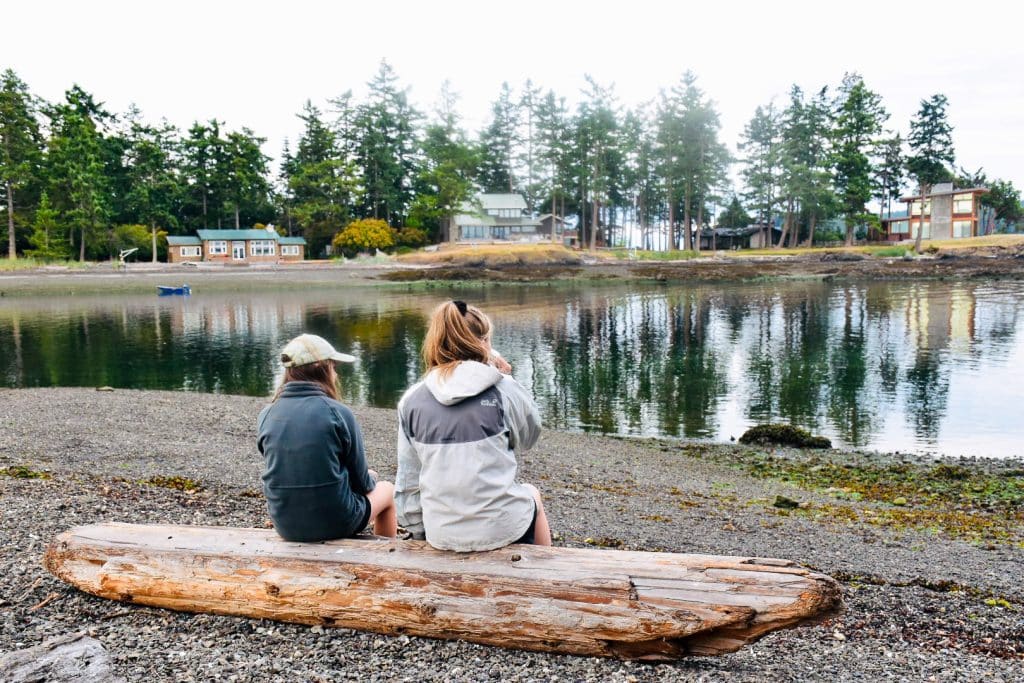
The guides were extremely knowledgeable and made the trip fun – we felt very safe on the water under their supervision. Kayaking on the sea was an unforgettable experience which I am so pleased that we had an opportunity to do.
I suppose you understand the risks of not seeing orcas when you book the kayaking expedition. We were certainly prepared not to see orcas after our visit to the Whale Museum in Friday Harbor. So, if the orcas show up, that’s the icing on the cake!
Thank you so much for reading my blog. For more stories, itineraries, and advice, check out my Related Posts and sign up to receive my blogs by email.
If you have a blog-related question, please do ask in the comments box below and I'll try to help.
A little request: if you use my photos, please credit Love Travel Planning on your social media or give me a shout out on Instagram @lovetravelplanning as I am growing my website. Huge thanks.
Join thousands of travelers looking for inspiration from our FREE Planet Travel newsletter!
Your step-by-step framework for stress-free, unforgettable trips — from first idea to final itinerary.





Your step-by-step framework for stress-free, unforgettable trips — from first idea to final itinerary.
Join thousands of travelers looking for inspiration from our FREE Planet Travel newsletter!