Rottnest Island, or Wadjemup to use its Noongar name, is almost always sold to you as a cycling destination. Ferry operators and tour companies push a single vision – hire a bike, loop the 22km island, tick off all 63 beaches at speed.
There is nothing wrong with that. But it is not the only way to do Rottnest, and for a lot of people it is not the best way either. I did the island on foot and by bus, carrying camera gear that does not mix well with midday sun and hills, and it turned out to be a better day than the one I had planned.
This guide covers the whole day trip – which ferry to take, how to get around once you land, where the quokkas actually are, and what is worth your time in the hours you have.
Rottnest sits about 18km off the coast, west of Fremantle and around 33km from Perth. It covers 19 square kilometres, roughly 11km long and about 4.5km at its widest, and it is a protected nature reserve of sweeping white beaches and turquoise water. There are no cars. That single fact shapes the whole day, and it is why the island feels as quiet as it does.
It is also home to the world’s largest population of quokkas, which are thriving here in a way they are not on the mainland. Quokkas (“kwoka” in Noongar) are small marsupials closely related to wallabies and kangaroos, and they are the reason the island has the name it does.
Seventeenth century Dutch explorers took one look at them, decided they were large rats, and called the place “Rottenest”, or rats’ nest. Willem de Vlamingh spent six days exploring the island from 29 December 1696 and the name stuck. Quokkas are considerably cuter than rats.
There are two ferry operators, SeaLink and Rottnest Express, and three departure points:
Victoria Quay, Fremantle: 25 to 35 minutes. The shortest crossing and the best option if you are prone to sea sickness.
Elizabeth Quay, Perth CBD: Around 1.5 hours. Takes you down the Swan River.
Hillarys Boat Harbour, north of Perth: Around 45 minutes.
My tour was booked for the 8.30am departure from Perth CBD and I went to Fremantle instead, having got my British Queens mixed up. I arrived at the terminal in a panic and the SeaLink staff at Fremantle rebooked me onto their 9am crossing without fuss.
It turned out to be a better trip than the one I had booked. The Fremantle crossing is direct and short, and the return times work in your favour; leaving from the CBD, the return ferry usually goes at 4.30pm, but from Fremantle it leaves at 4pm and you get an extra hour on the island because you arrived earlier.
We prebooked and it is the sensible thing to do, particularly in summer. If you would rather have the whole thing bundled, there are packages that combine the ferry with the island bus tour, which takes the guesswork out of the morning. That is what I used and I would use it again.
This is the shape of the day if you are not cycling. Adjust the arrival time depending on which port you leave from.
| Time | Activity | Where and notes |
|---|---|---|
| 08:30 | Depart Perth CBD | 09:00 if you are leaving from Fremantle |
| 09:05 | Arrive (Fremantle ferry) | Thomson Bay. Walk to The Basin and Bathurst Lighthouse |
| 10:30 | Arrive (Perth ferry) | Thomson Bay. Coffee and a pastry from the bakery |
| 11:15 | Island tour | Board the island bus tour |
| 13:00 | Lunch | The Settlement |
| 14:00 | History and culture | The Quod and the Wadjemup Museum |
| 15:00 | Sightseeing | The Salt Lakes and Vlamingh Lookout |
| 16:30 | Departure | Board the ferry back |
Book lunch or dinner in advance during peak season, December to March. The popular places fill quickly and there are not many of them.
The island is car free, so you have three options – bike, bus or your own feet. Most people take a bike. If that is you, we have a separate guide.
Most visitors do, and for a fit group with a full day it is a lovely way to see the island. The Island Ride is 22km with real hills and takes three to five hours. If you want the details on hiring, costs, electric versus pedal bikes and whether cycling suits your group, that is all in our Rottnest Island bike hire guide. Everything below assumes you are not on one.
This is the bit nobody explains properly. There are two completely different bus services run by different operators, and knowing which is which will improve your day:
Run by the ferry companies. A 1.5 to 1.75 hour loop where you stay on the bus and a guide talks you through the island, including the lighthouses and the Porpoise Bay shipwreck, in air conditioning. This is the cheat code for seeing the whole perimeter without effort. It is what I used.
Run by Quokka Coaches. This is the island’s public transport: a hop-on, hop-off service that circles the island all day with 19 stops. Use this when you want to be dropped at a specific remote beach such as Ricey Beach or Fish Hook Bay and collected later.
You can buy Island Explorer tickets online before you travel or from the main bus stop in The Settlement between 8am and 3pm. Quokka Coaches also run guided tours with commentary, which need booking ahead.
Plenty is walkable from where the ferry lands, which is covered further down. The island is small enough that you can combine the bus for distance and your feet for everything near the settlement.
Ferries arrive at Thomson Bay on the eastern side of the island, where you will find The Settlement – a cluster of buildings holding restaurants, a general store, souvenir shops, the museum and the bike hire outlets.
Stock up before you go anywhere. The General Store on Somerville Drive, next to the well-known Rottnest Bakery, is where I picked up electrolyte drinks and extra water. Do not underestimate the Western Australian sun. Hydration is what stands between you and the afternoon slump, or worse, sunstroke. There are limited options elsewhere on the island, so buy what you need here.
If you have caught an early ferry, Dome does a solid breakfast and was doing brisk business when Lucy’s family stopped there before their cycling day. Avocado and eggs on toast sets you up properly.
As you get off the ferry, look for the Past-Present-Future-Forever monument, a welcome to the island from the Whadjuk Noongar people, the traditional owners.
The good news is that they are everywhere. I had assumed they would be shy and hard to find, and that is not the case at all. Lucy’s family saw them at Parker Point, at the Wadjemup Lighthouse, at the side of the road, and running between the tables of the bar back in The Settlement.
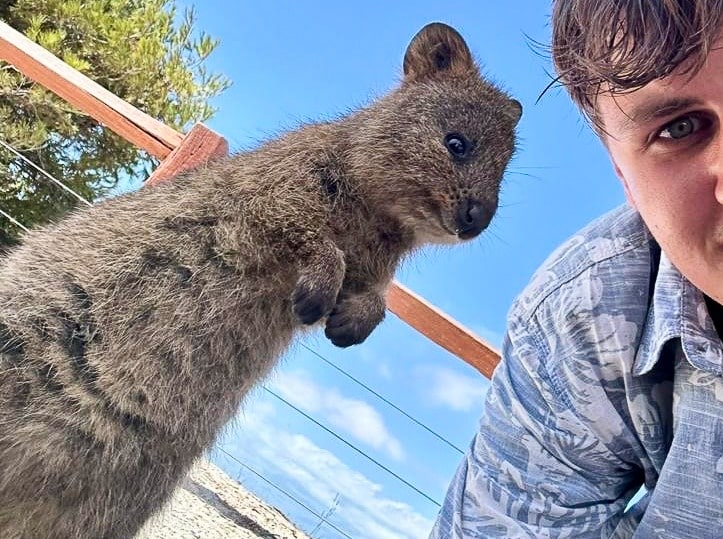
Quokkas look like they are smiling when you catch them at the right angle, which has turned the quokka selfie into a thing. Even though they are tame, it is harder than it looks to get the angle right. Expect to take twenty photographs and keep one.
Here is something our bus guide told us that changed how I thought about the day.
There is a stark difference in the health and lifespan of quokkas depending on where on the island they live. The ones in the main settlement often live only three to four years. They are in high traffic areas, they have become dependent on people, and more dangerously on human food. Feeding them is strictly illegal, but they have learned to scavenge dropped scraps and treats, and that diet causes real damage – lumpy jaw and malnutrition among other things.
Quokkas living away from the settlement eat native succulents and shrubs, which give them the hydration and nutrients they need, and they can reach twelve years.
So use the hop-on, hop-off bus and get out of the settlement. Take it to a remote stop such as Ricey Beach, Stark Bay or the Wadjemup Lighthouse, find a shaded spot and wait. Seeing a healthy wild quokka come out of the bush is a far better experience than watching a sad one under a restaurant chair, and you are not contributing to the problem.
If you want to see quokkas elsewhere in Australia, they live on some smaller islands off the Western Australian coast including Bald Island near Albany, and there are small populations in forest and coastal areas between Perth and Albany. There are quokka signs at the Valley of the Giants Tree Top Walk at Walpole, though we have never actually seen one there. Rottnest is where you go.
I am not much of a beach sitter or a snorkeller, so I spent the time either side of the bus tour walking the highlights near Thomson Bay.
A simple loop from the settlement:
Bathurst Lighthouse: About 15 minutes on foot. The white tower against that sky is a photographer's dream and it is the easiest good photograph on the island.
The Basin: Another 15 minutes. Arguably the best swimming spot on Rottnest, protected by a reef so the water is calm and clear. Also, predictably, very busy.
In the afternoon I walked up to Vlamingh Lookout for the panoramic view. It is named after Willem de Vlamingh, who landed here in the late 1690s, and it is a properly peaceful spot.
From there the path drops down to the road running between the Salt Lakes. It felt like another planet – completely silent and visually striking.
The salt lakes turn a vivid pink in February because of the high salinity.
Most people come to Rottnest for a holiday. For the Noongar people it is a place of deep mourning, and Wadjemup means “place across the water where the spirits are”.
Between 1838 and 1931 the island was used as a penal establishment for Aboriginal men and boys. Over 3,600 were brought here, many in chains from all over Western Australia, for offences as minor as killing livestock on their own land.
Walking through The Settlement you will pass a circular building known as The Quod, built in 1863 and 1864. For decades it was used as tourist accommodation, which is difficult to think about, because it was originally the prison where those men were held in cramped and horrific conditions. It was finally closed as accommodation in 2018 after decades of protest by Aboriginal people.
If you are on foot rather than rushing back to a bike, you can stop here. It is a stark contrast to the cafes and holiday atmosphere a few metres away.
A short walk from the jetty, and worth 45 minutes if you have them. It gives you the context for everything else on the island, including the prison era and the fact that Rottnest holds the largest unmarked burial ground in Australia.
Understanding that history makes the beauty of the place feel more precious, and makes the case for looking after it more obvious.
The island is not short of activities, and plenty of them do not need a bike.
A day trip was enough for us, but staying over gives you the island in the early morning and evening when the day trippers have gone.
There are no Airbnbs, but there is plenty of choice: boutique accommodation at The Lodge Wadjemup, Samphire Rottnest, and eco-sustainable luxury tents at Discovery Rottnest Island. There is also a campground, a hostel and self-contained units including beachfront bungalows, cabins and cottages.
Staying over also gives you time for more of the eateries – Geordie’s Café, Frankies on Rotto, The Lane Café, the Rottnest Bakery, Lexis on Rotto, Isola Rottnest and Lontara.
For a day trip from Perth or Fremantle, though, one day on Rottnest without a bike is a properly good day out. You see more than you expect, you are not wrecked by 2pm, and you come home with better photographs.
Thank you so much for reading my blog. For more stories, itineraries, and advice, check out our Related Posts and sign up to receive Lucy's blogs by email.
If you have a blog-related question, please do ask in the comments box below and I'll try to help.
This blog was written by Tom at Smyto Creative.
A little request: if you use my photos, please credit Smyto Creative on your social media or give me a shout out on Instagram @smytocreative as we are growing this website. Huge thanks.
Join thousands of travelers looking for inspiration from our FREE Planet Travel newsletter!
Your step-by-step framework for stress-free, unforgettable trips — from first idea to final itinerary.