


As part of our Pacific Northwest road trip, we booked a sea kayaking tour in search of orcas who roam the Salish sea routes of the San Juan Islands, USA. The promotional materials for the kayak tours show wonderful photographs of majestic orcas swimming past and breaching near enthralled kayakers on these trips, but they also make it clear that orca sightings are obviously not guaranteed. So, what’s it like on a sea kayaking tour in the San Juan Islands, USA, and does it matter if the orcas don’t show up?
Table of Contents
Book a multiday kayaking trip with Sea Quest Kayak Tours
We booked our multiday kayaking trip with Sea Quest Kayak Tours which involved two days on the water and one night of wild camping one of the San Juan Islands, USA. Sea Quest Kayak Tours offer longer trips, but two days was all that we could spare on our road trip itinerary.
I would thoroughly recommend Sea Quest Kayak Tours for such a trip. All their communications were excellent, and the tour leaders are experienced sea kayak guides with specialisms in biology or environmental science, so you are in both safe and interesting hands.
Packing for your sea kayaking trip
Sea Quest Kayak Tours send you a full equipment list once you book your sea kayaking trip with them.
Whilst the number and size of bags you can fit in your kayak is limited, the items for an multiday kayaking trip still add up, so you need to give careful thought about what you take, and how it affects your overall holiday luggage allowance if you are on a longer holiday.
We rented sleeping bags and pads from Sea Quest Kayak Tours to save on some luggage space, but still needed to take an extra suitcase on holiday to hold all the kayaking gear for 4 people – we just left this in the boot of the car until it was needed in Friday Harbour. The items for the multiday kayaking trip then had to be distilled into 4 or 5 small dry bags per person which could be stuffed into the storage areas of the kayaks, like jigsaw pieces!
What to expect on a 2-day sea kayaking tour
At the start of the sea kayaking tour
We met our guides at Friday Harbor port where we loaded all our bags and equipment onto a trailer ready for transportation to the departure beach. In total we were a group of 16 people on the tour – 1 Aussie, 4 English and the rest Americans – plus 2 tour guides. Our girls (aged 12 and 15) were the youngest in the party, but there were 2 older teens in the group.
When we were all present and correct, we boarded a Scooby Doo transfer bus and drove across San Juan to Smallpox Bay on the west side of the island, where we divided up our provisions and loaded the kayaks, spreading out the weight of the food and tents.
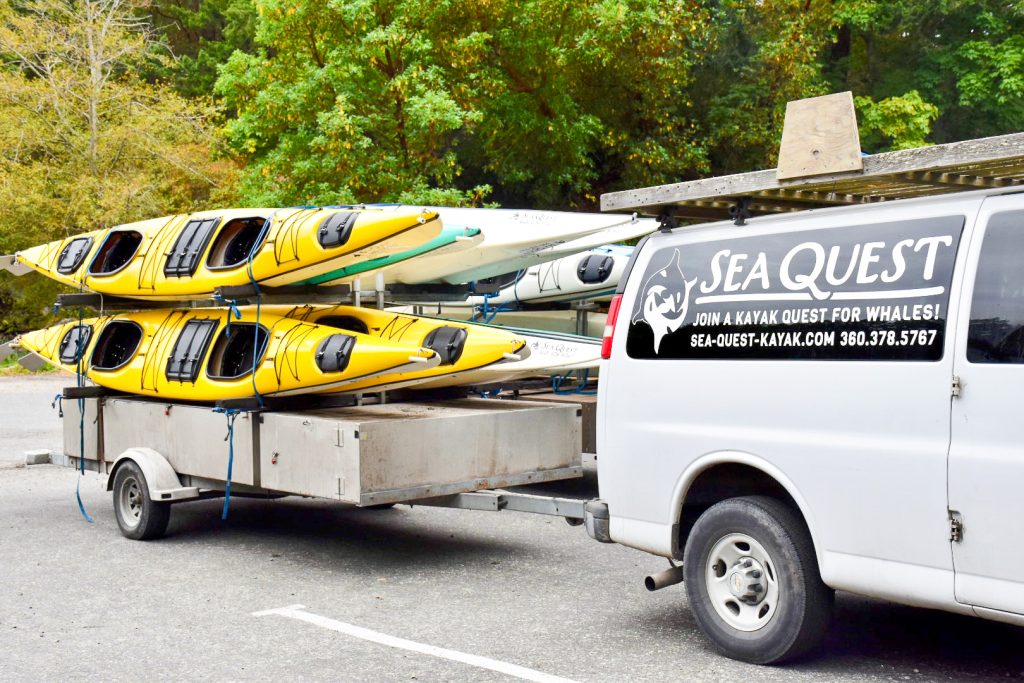
I must admit to feeling nervous at this point – nervous about what was in store for us, how difficult it would be, and whether we would be fit enough!
Smooth paddling in top quality kayaks
We used top-quality sea kayaks for the trip which were over 20 feet long and steady in the water. Double kayaks tend to be more stable than the solo versions, particularly when filled with all your equipment and food supplies. Our elder daughter paddled a double kayak with one of the tour guides, and our youngest daughter shared a triple cockpit kayak with Mum and Dad.
All the kayaks required a waterproof skirt to be fixed on to the board of the kayak to prevent water splashing inside, but if you have ever tried attaching these you will know that it’s harder than it looks and took some time to master. Challenge number one!
Day 1 of our sea kayaking trip on the water
Conditions – the conditions on the first day of our sea kayaking trip were a little damp, but thankfully not too windy. The previous week had enjoyed gorgeous weather in the area, more fitting with San Juan’s claim to having the ‘driest microclimate along the Washington Coast’ due to the protective position of the Olympic Mountains nearby.
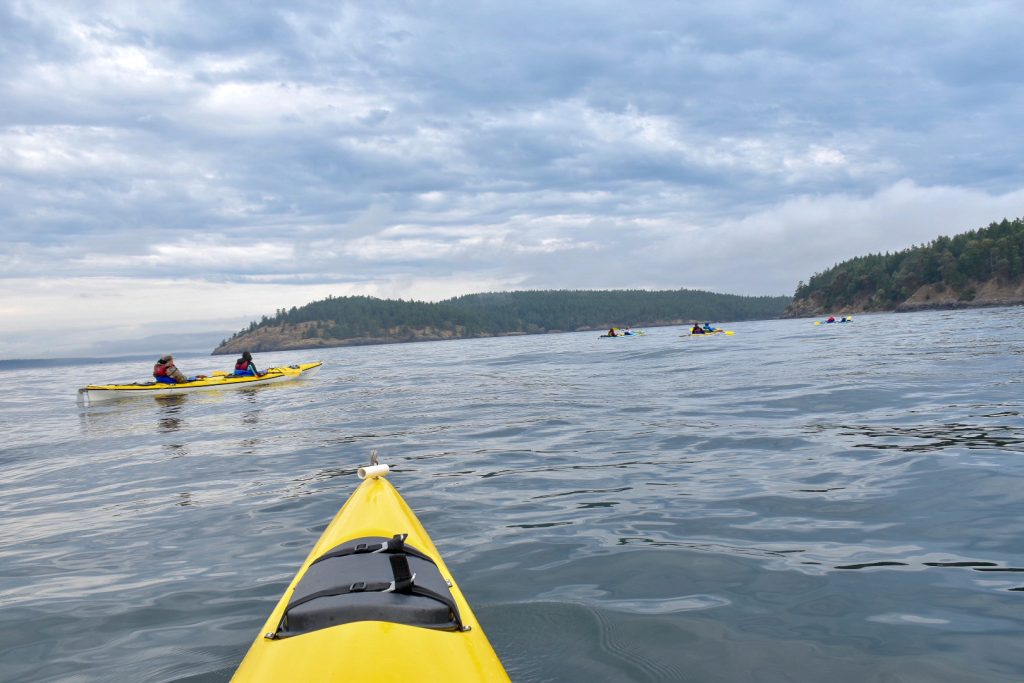
Beach lunch – we kayaked north up the west side of San Juan Island and enjoyed the ease of kayaking with the current, before stopping at a pebble beach for a lunch of hummus bagels and fresh cherries. There were Lion Jellyfish on the beach, which can sting even if they are on the ground, so we had to be careful where we stepped.
Swimming for the brave – only one of the group was brave enough for a swim, and it was a very quick one, as the waters are so cold – apparently it would only take 20 minutes for someone to get into trouble in the chilly waters here.
Bull Kelp – after lunch we continued kayaking north and around Henry’s Island and hit a large area of Bull Kelp in the water – strong enough for the Salish people to have used it as line to haul in halibut due to its remarkable tensile strength. Bull Kelp is also nutritious and tasty to eat, which we sampled straight from the water. Actually, it was quite tasty.
House ogling – I particularly enjoyed the next section of our sea kayaking trip as we paddled by some gorgeous houses along the coast – these houses cost millions as they are west facing so enjoy the sunsets and views of passing whales on the migration routes. Most of the houses have boat launches, huge windows overlooking the view, tree houses and hot tubs outside, which all made for great rubbernecking from the water!
Madrone trees – there were also plenty of madrone trees along the coast which I had never seen before – peeling like onions, resulting in blotchy, multi-coloured bark, some of which were bright orange.
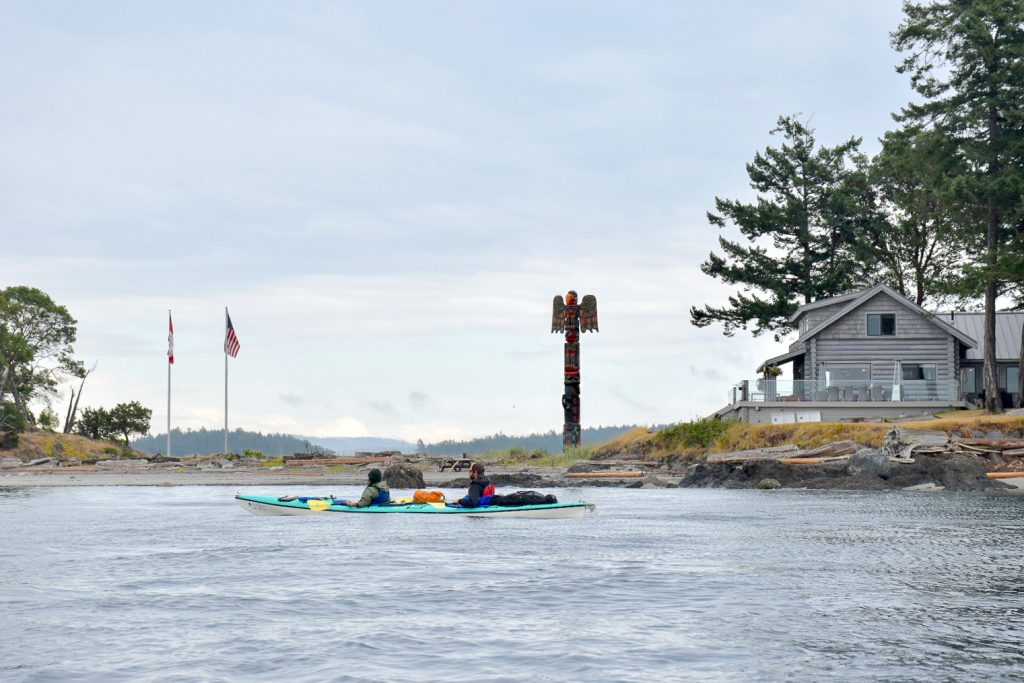
International waters – towards the end of the day’s journey, we spotted a house on a small island with a totem pole in the garden, flying both the US and Canadian flags as the house straddles the border between the two countries. We were paddling through international waters although only made land in the USA.
Camping on Posey Island, USA
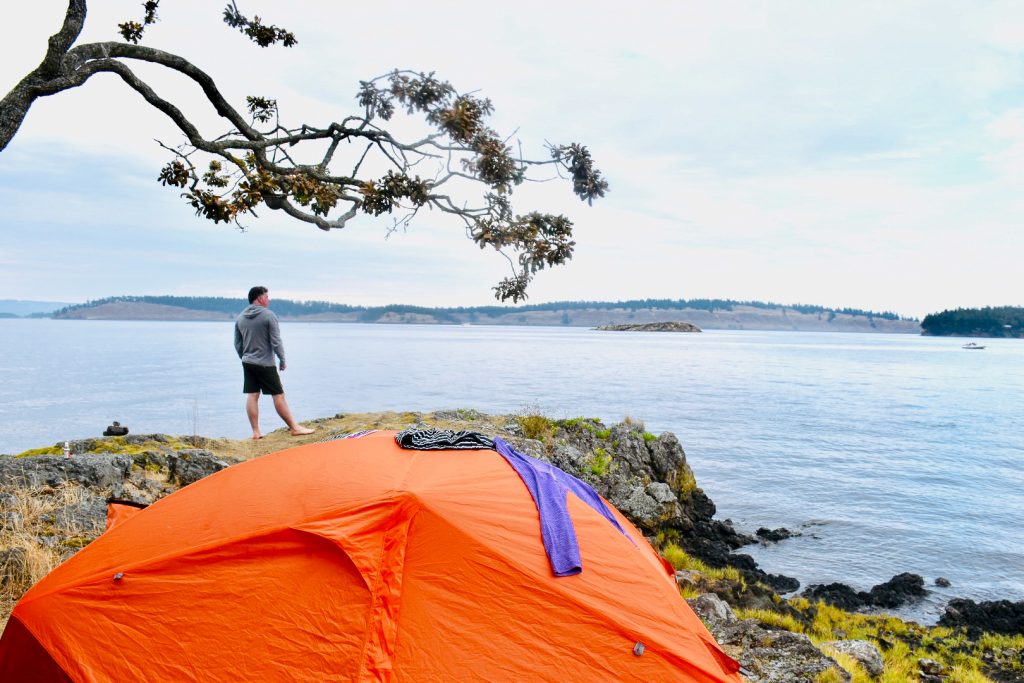
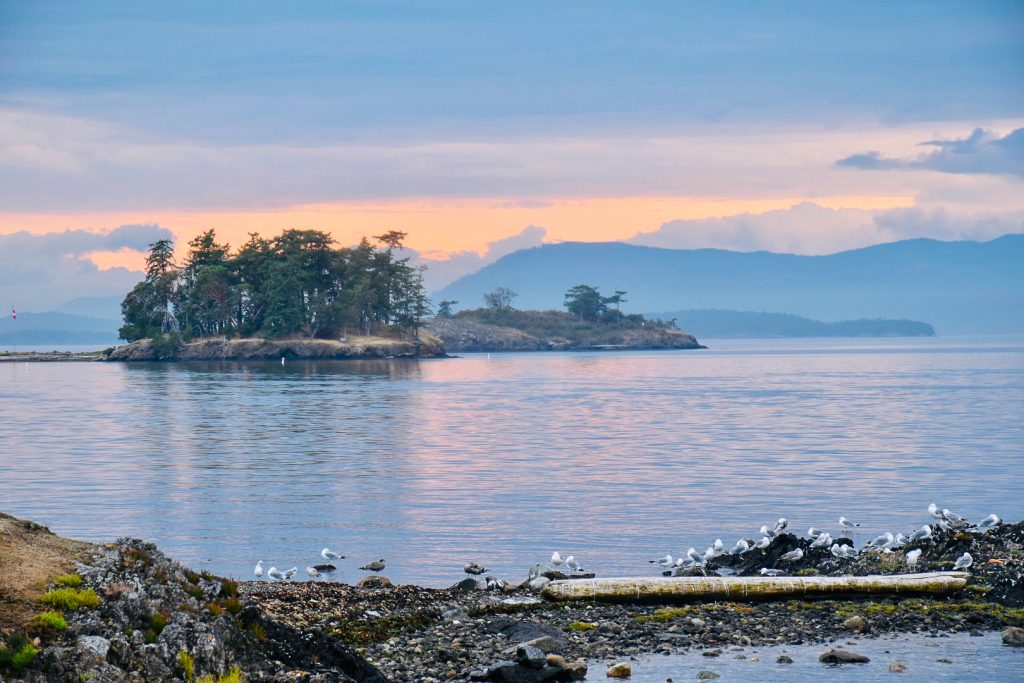
Eventually we arrived at our reserved campsite on tiny Posey Island, USA, for the night. We pitched our two-man tents overlooking the water and then rested our tired arms. Posey Island is on the flight path of the float plans heading into Roche Harbour, so we enjoyed watching the little plans taking off and landing around us. After a while we were joined by some curious harbour seals who played in the water in front of our tent which was a highlight.
The tour guides set out dinner on a long table for a communal camp meal of burritos, when we could get to know our fellow paddlers a little better. For those able to stay awake long enough, S’mores were made around an evening campfire, and someone produced a guitar for a sing-along – I’m not sure where the guitar had been hidden on the kayaks!
Somewhere amongst all of that there was a terrific sunset capping off an all-round memorable day, despite not having spotted any orcas.
Day 2 of our sea kayaking trip on the water
Camp was awoken by the sound of Gershwin’s Summertime being played on the guitar as the sun rose – what a wonderful alarm call. Then, when we surfaced from our tent, our two harbour seal friends were sitting on the rocks opposite our tent watching us. Hello guys!
After a breakfast of scrambled eggs on toast, cleverly using leftover veggies from last night’s burritos, we needed to strike camp and repack the kayaks ready to hit the water again (leaving no trace of our stay behind). As our guide liked to say, “Let’s roll on off and keep on rolling!”
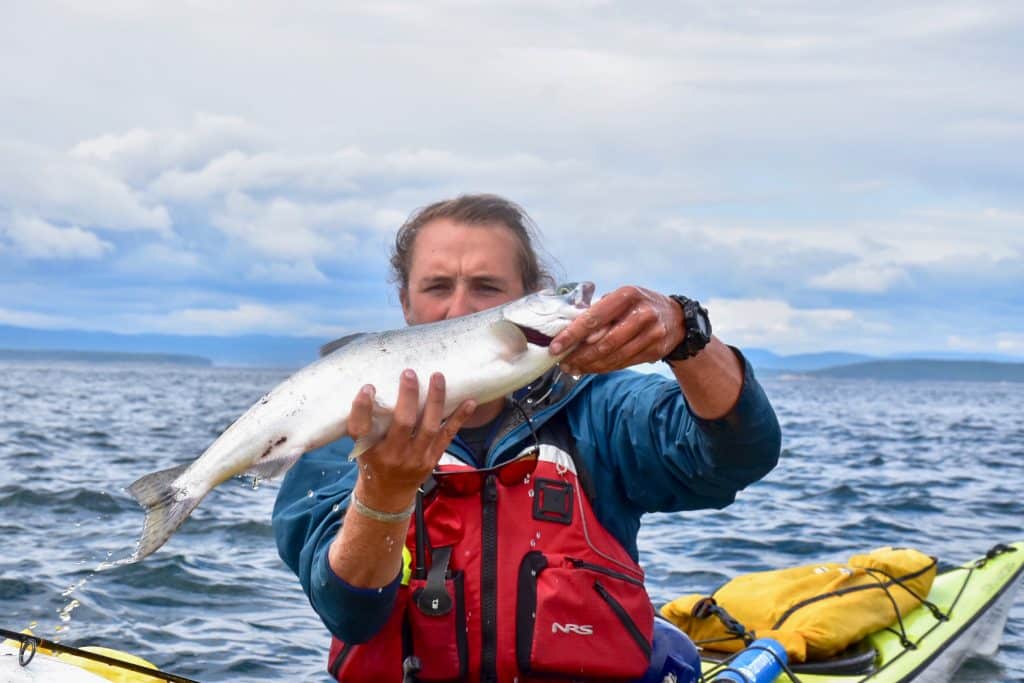
Before long we were kayaking through a school of jumping salmon and one of the guides, who had been running a fishing line from his kayak, reached into the water, and pulled out a Chinook salmon which we all admired before he released it back into the ocean. The guide commented that was a first for him…and for us…
Shortly after the salmon catch, our guide produced a dead, Yellow-eyed Rock Fish from the water which the seagulls had been playing with. These fish are endangered so, if you catch a live one, you must put it back, but because they are bottom feeders, they must be weighed down to help get them back to the bottom of the ocean.
As we approached Smallpox Bay for the end of our kayaking experience, the realisation hit that the orcas weren’t going to show up for us on this trip. So where were the orcas?
So, where were the orcas?
Salmon eating orcas – this area is famous for its orca sightings because it is on the route for migrating Chinook salmon, which the orcas come to feed on during the summer months (May to September). However, the building of dams and over-fishing of the salmon has led to fewer salmon in the water, and in turn, fewer Southern Resident orcas who feed on them.
Conservation efforts have included taking out dams on one of the rivers to allow the salmon to pass through the area again and get to their spawning places – this was working until a hatchery was built further along the river, so 2 steps forward and one step back.
Northern Transients – seal eating orcas called Northern Transients are faring better and there have been more sightings of this type of orca passing through the channels. Northern Transients however have a different issue to deal with, namely the ingestion of toxins – plankton takes in nasties such as plastic particles and detergent toxins before being eaten by herring, which in turn are eaten by seals, and then by the orcas. Toxins are passed along the food chain and intensify as they go which is not good for the orcas at the end of the chain.
The Whale Museum in Friday Harbor was displaying whale sighting figures for the J-,K- and L- pods, which noted only 2 whale days between 20th May and 10th August 2019, as opposed to 16 whale days in the same period the previous year. The Sea Quest website notes that 2013, 2019, and 2020 were terrible years for killer whale watching in the area. Unfortunately for us, we took our trip in 2019 and so were unlucky to hit one of the terrible years for killer whale watching in the area (but I guess it’s worse for the orcas!).
Despite these rather erratic results, the San Juan Islands remain the best place in the USA for seeing killer whales. The Sea Quest website is currently reporting much better results, for example, in June 2024 they have had whale sightings nearly every day which is good news – for the orcas and for those kayakers hoping to spot one. Good luck everyone!
How hard was the 2-day kayaking tour?
The kayaking on Day 1 was much easier than on Day 2, most likely because we had fresh arms and were full of excitement. We were on the water for around 5 hours but made regular stops – either to shore, or to look at things from the water, such as the Bull Kelp, fish or bird sightings. There was always something to look at or learn about from the guides.
The kayaking felt harder on Day 2, either because of the wind or because we were kayaking against the current – I can’t remember now which it was, but either way, the result was a much harder paddle on top of already tired arms. That said, I would have been more than happy to have continued kayaking if booked onto one of the longer tours, as it was such a wonderful experience.
Note – I found that one of the hardest things was keeping my hands dry. If your hands get wet then it’s harder to grip the paddle and you are at risk of wrinkly hands and blisters, so pack gloves with grip pads, plus a spare pair as dry backups.
After being transported back to Friday Harbor we picked up some food supplies from a grocery store and headed back to our AirBnB to take showers and make dinner. I don’t think we moved from the sofa all night after all that fresh sea air and exercise – but what a way to work out!
Final thoughts on our sea kayaking tour in search of orcas…
Despite not having seen any orcas on our 2-day sea kayaking tour, we thoroughly enjoyed our experience and having been at one with nature in such beautiful surroundings. We met some lovely people and learnt a lot about the area, its wildlife, and the water ecosystem.
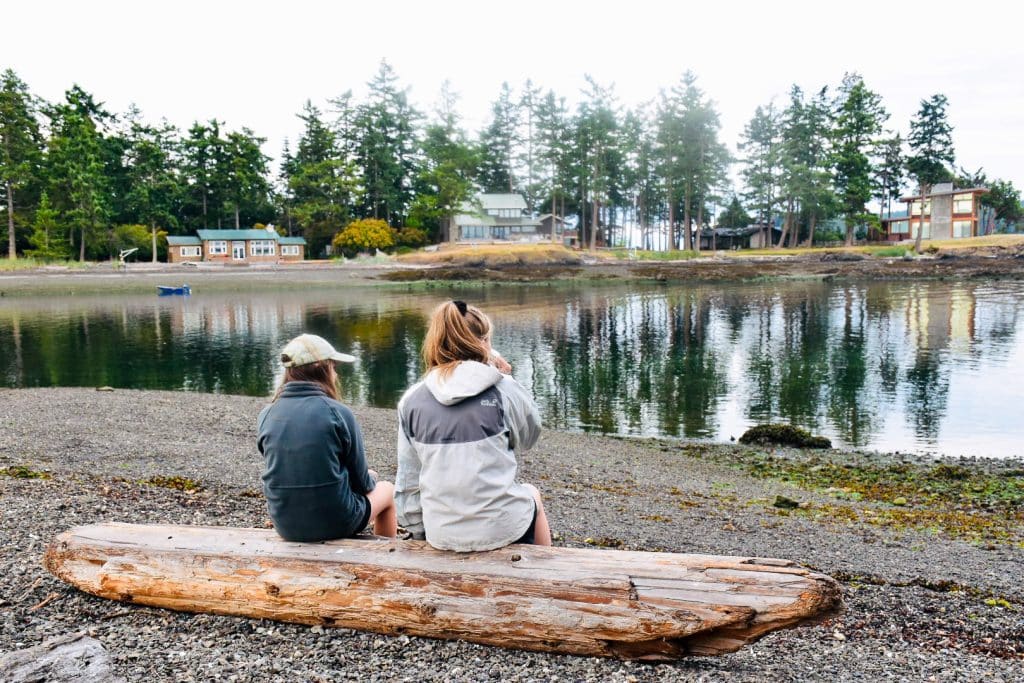
The guides were extremely knowledgeable and made the trip fun – we felt very safe on the water under their supervision. Kayaking on the sea was an unforgettable experience which I am so pleased that we had an opportunity to do.
I suppose you understand the risks of not seeing orcas when you book the kayaking expedition. We were certainly prepared not to see orcas after our visit the Whale Museum in Friday Harbor. So, if the orcas show up, that’s the icing on the cake!
Thank you so much for reading my blog, I hope you found it useful?
For more stories, itineraries, and advice, check out my Related Posts and sign up to receive my blogs by email.
If you have a blog-related question, please do ask in the Comments box and I’ll try to help…
Request please – if you use my photos, then please credit Love Travel Planning on your social media or give me a shout out on Instagram @lovetravelplanning as I am growing my website. Huge thanks.
Enjoy your travels!
Subscribe to my monthly newsletter!
Stay up to date with my travel stories, advice and planning tips


Leave a reply
You must be logged in to post a comment.