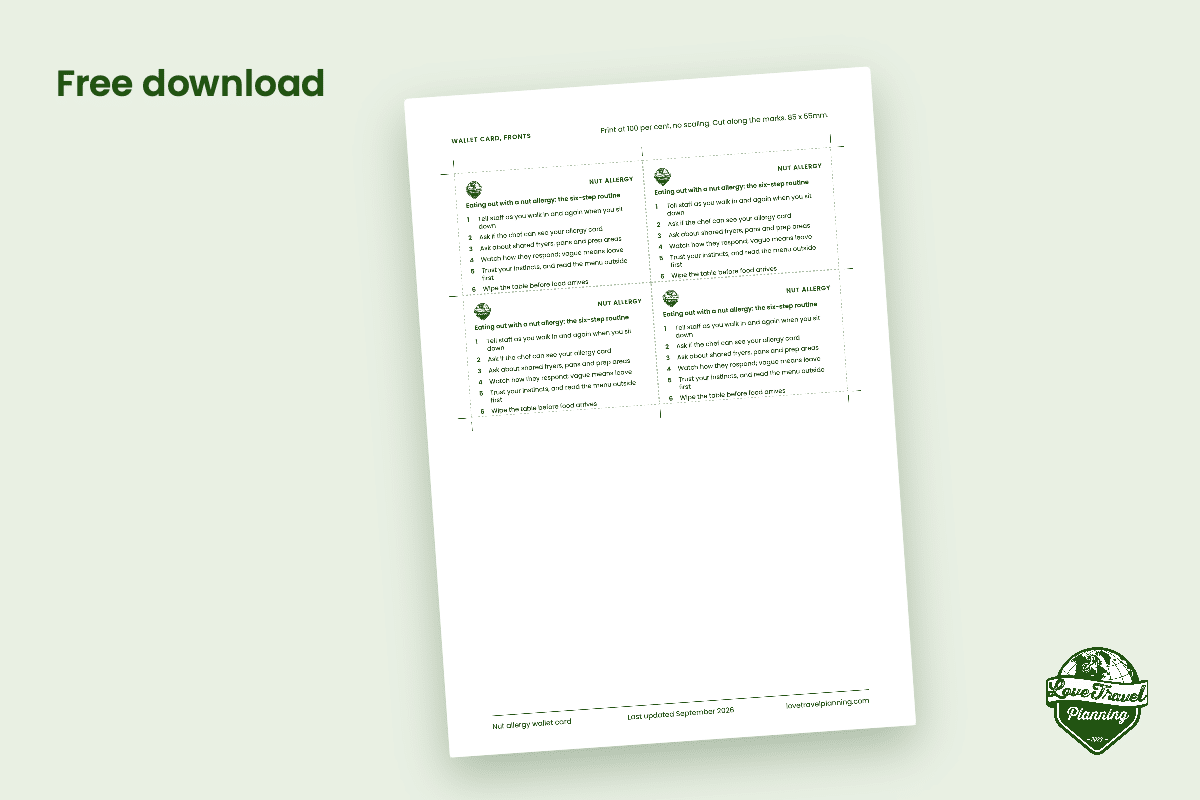
If you live in the UK with a food allergy, you quickly get used to how structured things are. Most menus clearly list the 14 major allergens, restaurant staff are generally familiar with allergy protocols, and laws like Natasha’s Law make sure pre-packaged foods are labelled properly.
While eating out still requires caution – I’ve been caught out a couple of times, the system around you is designed to help reduce the risk of reaction. But, once you travel abroad, that familiar safety net often disappears.
Many countries don’t have standardised allergen labelling. In some places, menus contain no allergen information at all, and staff may not always understand the concept of cross-contamination. For travellers with allergies, this means shifting from passive trust to active preparation.
The good news is that with the right tools and habits, eating safely abroad is absolutely possible. In fact, some travellers find that they become more confident managing their allergy once they learn how to navigate unfamiliar food environments. Here are the strategies that make finding allergy friendly restaurants while travelling far easier…
Table of Contents
Useful apps and tools to check before you travel
The first mistake many travellers make is relying purely on Google searches once they arrive. Typing “nut free restaurants near me” into Google Maps rarely produces useful results. Instead, it tends to show vegan cafes or gluten-free bakeries, which are designed for dietary preferences rather than medical allergies. Instead, it’s worth getting to know some useful apps and tools you can use on the move, before you travel.
TrustDiner
TrustDiner is the child of @MayContain on Instagram, and has quickly become one of the most useful platforms for allergy travellers, particularly for people coming from the UK. It works like TrustPilot, or TripAdvisor, but specifically for allergy experiences. Diners leave feedback about how restaurants handled their allergy, whether staff understood cross-contamination and whether they felt safe eating there.
Because the reviews come from people with real allergies rather than general diners, the insights are often far more useful than standard restaurant reviews. Coverage is strongest in the UK and Ireland, but the platform is expanding quickly across Australia and the United States, making it increasingly useful for international travel.
Spokin and AllergyEats
If you’re travelling in North America, these two apps are widely used within the allergy community. Both platforms allow users to rate restaurants specifically on allergy awareness. Reviews often include details that you rarely see elsewhere, such as:
- Whether the kitchen uses shared fryers.
- How staff handled ingredient questions.
- Whether chefs were willing to modify dishes.
This type of detail can be incredibly helpful when deciding whether a restaurant feels safe enough to try.
Useful Google tricks
Google Maps can still be useful, but only if you search in the local language. For example, if you search in English for “nut-free restaurant” in Italy, you may get very few results. But searching for “senza frutta a guscio” can surface restaurants that cater to allergies but don’t necessarily advertise to English speaking tourists.
Translation tools have also become much more useful for travellers in recent years. Apps like Google Lens allow you to take a photo of a menu and see an instant translation directly on your phone, which can be incredibly helpful when trying to understand ingredients.
You can also use Google Translate to identify the local term for your allergen before searching on Google Maps. Using the correct local wording often surfaces far more relevant results than searching in english.
Carry allergy cards to avoid translation problems
One of the biggest risks when travelling with allergies is a simple misunderstanding. You might think you’ve explained your allergy clearly, but language barriers, cultural differences and busy restaurant environments can easily lead to mistakes.
This is where allergy cards, or chef cards, can make a huge difference. An allergy card is a small printed card that explains your allergy in the local language, including:
- The ingredients you must avoid,
- Examples of foods that may contain them,
- And, the seriousness of cross-contamination.
Instead of trying to explain everything verbally, you simply hand the card to your server, who can pass it directly to the chef. Organisations like Equal Eats and Allergy UK provide professionally translated cards for dozens of languages. We are also in the process of creating our own — which will be free and available at a click of the finger!
Many experienced allergy travellers strongly recommend using physical cards rather than digital ones. Handing a printed card to a waiter tends to feel more formal and encourages them to take the request seriously. It also avoids the awkwardness of asking a busy server to read a long explanation on a phone screen.
Learn the hidden allergens in different cuisines
Another common mistake when travelling with allergies is trying to avoid entire cuisines altogether. For example, people with nut allergies are often told to stay away from Asian or Middle Eastern food completely. While these cuisines do use nuts more frequently in certain dishes, avoiding them entirely can mean missing out on some of the world’s most interesting food cultures.
For years I avoided restaurant-made Asian food altogether. Then, on a recent trip to Western Australia, I ended up having one of the best Chinese meals I’ve ever had at Miss Chow’s in Margaret River. The restaurant operates a completely nut-free kitchen, and although sesame is present, the staff are extremely aware of allergies and happy to guide diners safely through the menu.
Experiences like this are a good reminder that avoiding whole cuisines isn’t always the answer. A better approach is understanding where allergens are commonly hidden within different dishes and cooking styles.
South-East Asian cuisine
Peanuts are widely used in Thai and Vietnamese cooking, but the bigger hidden risk is often peanut oil (groundnut oil) or peanut flour used as a thickener in sauces. Because peanut oil is one of the most common cooking oils used in the region, it may not always be listed on menus. In many cases it’s simply assumed as part of the cooking process.
For travellers with severe peanut allergies, this can make South East Asia one of the more challenging regions to navigate when eating out. Personally, this is a risk level I’m not comfortable with, and for that reason I tend to avoid travelling in parts of South-East Asia where peanut use is widespread. Other travellers with allergies may choose to visit but take extra precautions, such as researching restaurants carefully and using translated allergy cards.
The key takeaway is that understanding how ingredients are commonly used within a cuisine helps you decide what level of risk you are comfortable with when travelling.
Cashew nut allergies
In the UK, we’re used to creamy curries being thickened with yogurt or cream. However, in many parts of India and Thailand, chefs traditionally use a paste made from ground cashews or almonds to thicken sauces.
Because the paste blends so smoothly into the curry base, it can easily be mistaken for dairy, and menus don’t always list it as an ingredient. If you’re ordering dishes as korma or creamy masala, it’s worth asking whether the base contains ground cashews or nut pastes.
I have had a couple of reactions from cashews in curries without knowing that was what I was reacting too, learning the hard way is never fun.
Seafood allergies
Seafood allergies can also be complicated here because sauces frequently contain shrimp paste or fish sauce, even in dishes that appear vegetarian. When ordering curries or stir-fries, it’s worth checking exactly what the sauce base contains rather than relying on the menu description alone.
Middle Eastern cuisine
In Middle Eastern cooking, the main allergen to watch is sesame. Tahini (sesame paste) is used in many traditional dishes, including hummus, babe ghanoush, dressings and breads. Because it is such a staple ingredient, it may not always be highlighted on menus. Even in Australia, they use ‘Turkish bread’ quite often, which has sesame in it, but you won’t see it advertised on most menus.
Nuts can also appear unexpectedly in rice dishes or meat fillings, so it’s always worth asking if a dish contains sesame, pine nuts, or pistachios, even if they aren’t visible.
Western European cuisine
Across much of Europe, main dishes are often relatively straightforward in terms of ingredients. However, bakeries, pastry shops, and dessert counters can carry a much higher risk of cross contamination. Pistachios, almonds and hazelnuts are widely used in pastries, cakes and gelato and preparation areas are often shared. Even if a dessert doesn’t contain nuts itself, the chances of cross-contamination can be quite high.
Pesto
Most people know that classic green pesto contains pine nuts. However, regional variations can be quite different. For example, Pesto alla Trapanese, a Sicilian red pesto, traditionally used almonds as the base ingredient. Some restaurants also substitute pine nuts with cashews because they are cheaper and easier to source.
One of my saddest days as a student at university was having an allergic reaction to pesto pasta (which was one of my favourite dishes), after the brand I used changed their recipe from pine nuts to cashews without advertising they had changed the ingredients.
If you’re ordering pesto pasta abroad, it’s worth checking whether the sauce contains almonds or cashews, even if the menu simply lists it as pesto.
Eastern European cuisine
Georgia (the country, not the US state) has become an increasingly popular destination for foodies. However, walnuts are a central ingredient in Georgian cuisine. They are ground into vegetable pates such as pkhali, blended into sauces for meat dishes like satsivi, and mixed into fillings for eggplant and vegetable dishes.
Because walnuts appear in so many traditional recipes, travellers with tree nut allergies should treat Georgian cuisine as a high alert environment and check ingredients carefully before ordering.
Mexican cuisine
Mexican food is often associated with corn, beans and chilli, but traditional mole sauces are far more complex. Many classic mole recipes include toasted peanuts or almonds, which are ground into the sauce along with spices and chocolate to create the rich, layered flavour the dish is known for.
In some modern restaurants, even dishes like beef chilli may include peanut butter to add richness. If you see dark, slow cooked house sauce on a menu, it’s always worth checking what goes into it.
Nuts hidden in garnishes
In some countries, nuts appear less as a main ingredient and more as a finishing touch. My worst allergy reaction happened in the UK when an English restaurant put peanuts in a banoffee pie without putting the allergen on the menu – I went into anaphylaxis quickly after.
In South Korea, it has become increasingly popular for restaurants to sprinkle crushed walnuts or almond slivers onto dishes like pizza, pasta or fried chicken to add texture. Even in Australia, they put sesame on everything! Pies, pizzas, sandwiches, there is no escape.
The rise of vegan cuisine
One of the newer challenges for travellers with nut allergies is the global rise of plant based cuisine. With many vegan restaurants now creating dairy alternatives using cashews, which blend easily into creamy sauces, cheeses and desserts. As a result, foods labelled “vegan” or “dairy free”, such as pizza, cheesecakes or pasta sauces, may actually contain large amounts of cashews.
Develop a restaurant safety routine
Once you arrive at a restaurant, having a simple routine can help reduce mistakes. When you’re hungry and in an unfamiliar place, it’s easy to forget the important questions, so many allergy travellers develop a consistent pattern they follow whenever they try somewhere new.
Step 1: Speak to staff on entry
Bring up your allergy as soon as you walk in, and then repeat it when you sit down with your server. Waiting until the moment you order can make it much harder for staff to adapt or check with the kitchen – they may also have an allergy menu for you to order off instead.
A simple line like “Before we order, I just want to let you know I have a severe nut allergy. Is that something the kitchen can accommodate?” usually works well. This gives staff time to speak with the chef and lets you gauge how confident they are in handling the request.
Step 2: Ask if the chef can see your card
If you’re carrying an allergy translation card, ask whether the waiter can show it directly to the kitchen. This avoids the risk of information being passed along incorrectly. In many restaurants, servers appreciate having something written down that clearly explains the allergy in the local language.
It also tends to prompt a more serious conversation with the chef about whether the dish can be prepared safely.
Step 3: Ask about preparation areas
Menus rarely tell the full story of how food is prepared. Simple questions can reveal a lot about the kitchen setup, such as:
- Is this cooked in a shared fryer?
- Are nuts used in the kitchen at all?
- Is the sauce prepared separately or in a shared pan?
The answers can quickly tell you whether the restaurant has clear processes for avoiding cross contamination.
Step 4: Watch how staff respond
Sometimes the most important information isn’t what the staff say, but how they say it. If a server immediately understands the seriousness of the allergy, checks with the kitchen and comes back with clear answers, that’s usually a good sign. On the other hand, if the response is vague, dismissive, or uncertain, it may be safer to move on and find another place to eat.
Step 5: Trust your instincts
Travelling with allergies sometimes means walking away from restaurants that don’t feel quite right, and that’s perfectly okay. One habit that I’ve developed when choosing restaurants spontaneously is to read the menu posted outside before going in. If a large portion of the starters and mains clearly contain nuts, it’s usually a sign that nuts are widely used in the kitchen.
As a rough rule of thumb, if around a third of the menu includes nut based dishes, I’ll usually choose somewhere else to eat. Kitchens that rely heavily on nuts tend to carry a much higher risk of cross-contamination.
It might feel frustrating to walk away from a place you were excited to try, but finding a restaurant where staff feel confident handling allergies almost always leads to a far more relaxed and enjoyable meal.
Step 6: Wipe down your table
If you decide to stay and eat, it’s worth quickly wiping down your table surface before your food arrives. Restaurant tables, cafe counters and even bar tops may have traces of allergens left behind from previous diners. While most places clean between customers, the wipe-down may not always remove small residues such as crushed nuts or sauces.
For that reason, I always recommend carrying a small pack of alcohol or antibacterial wipes when travelling. It only takes a few seconds to wipe the table, but it can remove a surprising amount of residue and help reduce the risk of accidental contact.
If you don’t have wipes with you, you can also ask the server if the table can be cleaned again before your meal arrives. Most restaurants are happy to do this if you explain you have an allergy. It’s a small habit, but one that can make eating out feel far less stressful when travelling with allergies.
How can you prepare for an allergic reaction when abroad?
Even with careful planning, allergic reactions can still happen. When you’re travelling, the difference between a frightening experience and a manageable one often comes down to how prepared you are before the trip begins. Having a clear plan in place can make a huge difference if something goes wrong.
Make sure your travel insurance covers allergies
Before travelling, check that your travel insurance policy explicitly covers allergic reactions and anaphylaxis. Severe allergies are usually considered a pre-existing medical condition, which means they need to be declared when you purchase the policy. If they aren’t listed, insurers may refuse to cover treatment related to an allergic reaction.
This is particularly important in countries where healthcare costs are high, such as the United States or parts of the Middle East. Emergency treatment can quickly become extremely expensive without proper insurance cover.
Keep your Adrenaline Auto-Injectors accessible
Medical guidance in the UK recommends carrying two adrenaline auto-injectors (such as EpiPen or Jext) at all times. When travelling, it’s important that these are easily accessible, rather than buried at the bottom of a backpack or suitcase. I recommend placing them inside a small sling bag or cross-body bag so they can reach them quickly if needed.
Using a brightly coloured medical pouch or red EpiPen case can also help others identify the medication quickly in an emergency.
Know the local emergency number
Emergency numbers are different in many countries, so it’s worth learning the local emergency number before you arrive. In some places the number may be 999, 112 (for most of Europe), or 911 (USA), but that isn’t always the case. Taking a moment to memorise the correct number, or saving it as an emergency contact in your phone, can save valuable time if you ever need urgent help.
Carry emergency contact details
If you’re travelling solo, it’s also a good idea to keep a written note of your emergency contact in your bag or wallet. In the unlikely event that you become incapacitated, emergency services or medical staff may need to contact someone on your behalf. Having those details easily available can make it much easier for them to reach family or friends quickly.
Leave a reply
You must be logged in to post a comment.