Looking across a grassy field to a row of trees with a green bridge in front. Behind the trees you can see the tops of a series of brick buildings and chimneys which look like those of a mill. Grey sky above

Salts Mill & Saltaire: A Complete Visitor Guide

There is a particular kind of calm that settles over you in Saltaire, and we think it is by design. After the rush and rumble of nearby Bradford, you step off the train into neat sandstone streets, a UNESCO World Heritage Site that somehow doubles as a genuinely lovely place to spend a Saturday.

At the heart of it stands Salts Mill, once one of the largest industrial buildings on the planet and now home to one of the finest collections of David Hockney’s work anywhere. We have lost whole afternoons here without noticing, drifting between art, books, pizza and a wander along the canal. It is history and culture and a really good lunch, all wrapped up in one tidy Victorian village. Here is how we like to do it.

⚡ Overview

Explore Saltaire, a UNESCO World Heritage village, and Salts Mill’s free Hockney gallery. Our guide to visiting: art, history, food and how to get there.


Part of the New Age Wonders of Yorkshire series.

Table of Contents

What's the story behind Saltaire and Salts Mill?

Saltaire is the work of one determined man with strong opinions about how workers ought to live. Sir Titus Salt (1803 to 1876) made his fortune in the Bradford textile trade, and grew so weary of the city’s filth and overcrowding that he did something genuinely radical: he moved his entire business out to a green site by the River Aire and built a whole village around it. The name is a neat blend of his surname and the river that runs through it.

Looking up at the exterior of sand coloured mill building. Two stories of buildings. Tower on top. Blue sky.
Exterior of Salts Mill

What did Titus Salt build?

Salts Mill, a vast and ruthlessly efficient textile factory, was the first piece of the puzzle, completed in 1853. From there, Salt and his architects Lockwood and Mawson laid out an entire community in an elegant Italian Renaissance style between roughly 1851 and 1871.

This was not just housing. It was schools, a hospital, almshouses, shops, bathhouses, a reading room, a magnificent Congregational church and Roberts Park for recreation, the whole apparatus of a healthier, happier workforce. Whether you read it as enlightened philanthropy or Victorian paternalism (and historians enjoy arguing both), the ambition is undeniable.

Why is Saltaire a World Heritage Site?

What makes Saltaire so special today is how completely it has survived. According to the UNESCO World Heritage Centre (whc.unesco.org), the village is an exceptionally complete and well-preserved industrial village, with only around 1% of its original buildings lost over time.

That near-total survival is precisely why it was inscribed as a World Heritage Site in December 2001, recognised for the profound influence its model had on industrial welfare and town planning far beyond Yorkshire, as far as Italy and the United States.

How did Salts Mill become an art destination?

The mill itself fell quiet in 1986 when textile production ceased, and for a moment its future looked uncertain. Then in 1987 the entrepreneur and art lover Jonathan Silver bought it and began one of the great reinventions in Yorkshire.

Rather than carve it into flats or flatten it, he filled it with art, books, food and independent business, and in doing so turned a redundant factory into a thriving cultural destination. The crowning touch was a partnership with Bradford-born David Hockney, whose work has graced the mill’s galleries ever since.

Tip: Spot the Llamas

Wander over the canal bridge into the park and look for two things; the statue of Sir Titus Salt himself, and a charming pair of bronze llamas. They are a nod to the alpaca and exotic wools that helped make Salt's fortune. Children love hunting them down, and frankly so do we.

What can you do at Salts Mill and Saltaire?

Saltaire rewards aimless pottering, but Salts Mill is the obvious place to begin, and you could happily spend half a day inside it alone.

Tip: Make the most of it

Salts Mill is free to enter, which we still find slightly remarkable for a Hockney collection of this calibre. Allow longer than you think: art, history, shops and lunch add up fast. Photography rules vary by gallery, so check before you snap the artwork, and be aware that exhibitions occasionally rotate or close, so a quick look at what is currently showing pays off.

What's the Hockney gallery like?

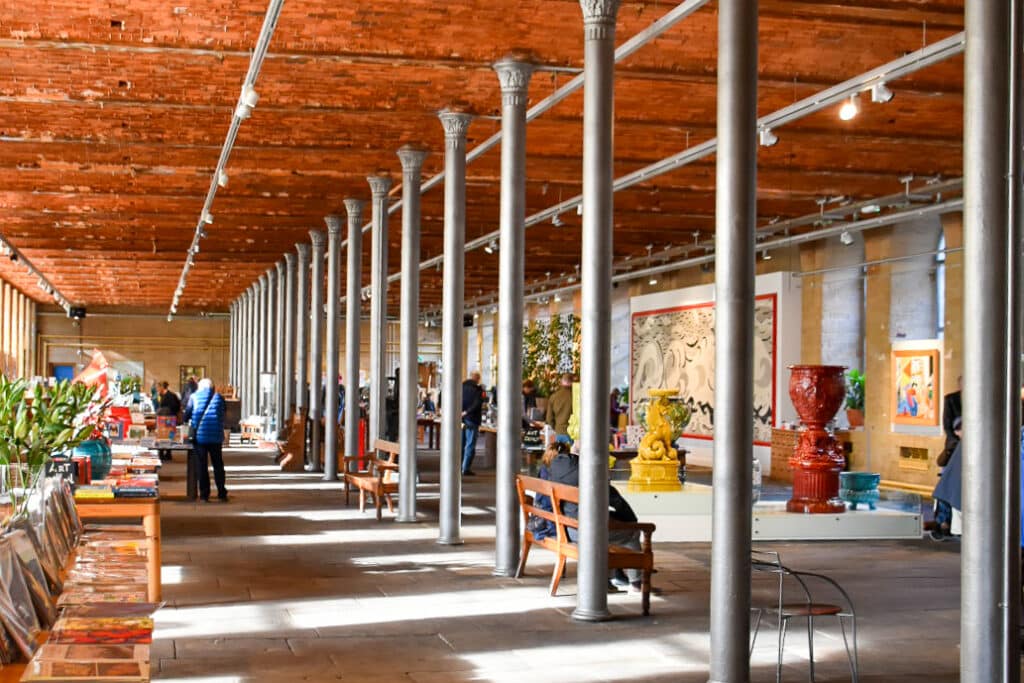
The undisputed highlight is the 1853 Gallery, devoted to the art of David Hockney. To stand among his bold, joyful work in the very mill of the Yorkshire town that shaped him is a genuine treat, and it is one of those rare world-class cultural experiences that costs nothing to walk into. Elsewhere in the building, exhibitions such as People & Process and the Saltaire History Exhibition bring the story of the mill and the lives of its workers back to life.

Inside a large open space with silver pillars and wooden roof. Filled with art work
Inside Salts Mill

Where can you eat inside the mill?

Salts Diner has been named among the very best museum cafés in the UK by The Guardian, and its hand-stretched pizzas and burgers are exactly what you want after a morning of art. For something lighter there is the Espresso Bar at weekends and the Café in the Opera for drinks and snacks.

Out in the village, Saltaire has built up a genuinely good little scene of independent cafés, delis and pubs over the years, ideal for a relaxed lunch or a coffee between galleries. The riverside and Roberts Park are also made for a picnic if the weather plays along.

What else is inside the mill?

Then there are the shops. The mill is a treasure trove of independents selling books, antiques, homewares, bikes and design pieces, the kind of place where you go in for a browse and come out with a coffee-table book you absolutely did not need.

In August 2024 the Peace Museum also moved into a new third-floor space here, supported by Bradford’s run as UK City of Culture and the National Lottery, adding yet another reason to climb the stairs.

What is there to do beyond the mill?

Beyond the mill, the village itself is full of character, and the best way to unlock its stories is the Salts Walks Experience, where guided tours led by costumed actors weave tales of Victorian life through the cobbled streets.

If you can time it right, the Saltaire Festival each September turns the whole village into a stage of music, art trails, theatre and food stalls, drawing crowds of well over 30,000.

Finally, do cross the River Aire to Roberts Park, a beautifully restored fourteen-acre Victorian park complete with bandstand, pavilion, gardens and riverside walks. On a sunny day it hums with picnicking families, and it is the perfect place to round off a visit with an ice cream and a sit-down.

Tip: Best time to visit

Late spring and summer bring the village to its best, with Roberts Park in full leaf and the riverside walks at their loveliest. September is festival time and wonderfully lively. If you prefer Saltaire calm and contemplative, a crisp weekday morning in autumn is hard to beat, with the mill quiet and the light low and golden.

Statue of Titus Salt in Roberts Park, Saltaire

How do you get to Saltaire?

Saltaire sits in Shipley, West Yorkshire, around four miles north of Bradford, on the banks of the River Aire and right alongside the Leeds-Liverpool Canal (which, conveniently, is another of our New Age Wonders and makes a brilliant pairing).

By train

This is comfortably one of the most accessible World Heritage Sites in the country. Saltaire Station sits directly opposite Salts Mill, with regular direct services on the Airedale Line to Leeds (around 15 minutes), Bradford Forster Square (12 minutes), Skipton (30 minutes) and Ilkley (25 minutes).

You can be standing in front of a Hockney within a quarter of an hour of leaving Leeds, which we think is one of Yorkshire’s great little travel facts.

By car

There is free parking at Salts Mill, with the entrance via Saltaire Road, plus some limited on-street parking and additional paid car parks within the village. Spaces fill on sunny weekends and festival days, so arrive earlier than you think you need to.

Cost and access

The village is free to wander and Salts Mill is free to enter, with charges only for the occasional special experience, guided walk or event. The streets are cobbled in places and the mill has multiple floors, so factor that in if you have mobility needs.

Exterior of a tall sand coloured mill building. 4 storeys. 4 rows of windows
Exterior of Salts Mill

What to pack and plan

Comfortable shoes

For cobbles, mill floors and a canal stroll.

Backpack / tote bag

The bookshop and independents will tempt you, and you will need something to carry your spoils.

An appetite

For that Salts Diner pizza.

A look at the current exhibitions

Before you go, so you know what is on.

Where to stay in Saltaire?

For a place to stay, Saltaire and neighbouring Shipley and Bingley offer characterful options within easy reach, and you are perfectly placed to combine the village with Bradford’s cultural offerings, the canal, and the wider Airedale.

If you would rather base yourself somewhere with more buzz, Leeds is only fifteen minutes away by train, putting several more of our New Age Wonders within comfortable reach.

Can you walk to the canal from Saltaire?

One of the joys of Saltaire is that it slots so neatly into a longer day out. From Roberts Park, you can pick up the towpath of the Leeds-Liverpool Canal and follow it on the lovely three-mile walk towards Bingley and its astonishing Five Rise Locks, one of the great spectacles of Britain’s waterways.

We have done this walk more times than we can count, and it never loses its charm: wooded stretches, the river alongside, and that satisfying sense of travelling between two New Age Wonders on foot. There is a café and the much-loved Fisherman’s pub up at the locks, and an easy train back from Bingley when your legs have had enough.

Tip: Combine this with...

Saltaire in the morning, the canal walk to Bingley Five Rise Locks in the afternoon, and a pub stop to finish. It is one of our favourite low-effort, high-reward days in West Yorkshire, and it links two of our seven New Age Wonders in a single outing.

A canal leads from the bottom right to the middle left. Tow path to the left of the canal. Stone wall on the right hand side with a large old mill building to the right hand side. A stone chimney painted black at the top stands to the left of the mill. It says Damart on it
Photo of Leeds to Liverpool Canal taken by Smyto Creative

Is Saltaire worth visiting?

Saltaire is the kind of place that quietly restores your faith in things. A factory that could have been demolished, a village that could have crumbled, and instead a thriving, living World Heritage Site where you can look at world-class art for free and then eat an excellent pizza in the building where it hangs.

We come back again and again, and we always leave a little lighter than we arrived. If you only have time for one West Yorkshire day out, make it this one.

Discover more wonders

This post is one of seven deep dives into the New Age Wonders of Yorkshire. Head back to the New Age Wonders of Yorkshire overview to find them all, or return to the main Wonders of Yorkshire hub to explore our Natural, Ancient, Medieval, New Age and Modern wonders in full.

Other New Age Wonders in this series:

Love Travel Planning
Thank you for reading

I hope you found it useful

Thank you so much for reading my blog. For more stories, itineraries, and advice, check out our Related Posts and sign up to receive Lucy's blogs by email.

If you have a blog-related question, please do ask in the comments box below and I'll try to help.

T
Guest writer

This blog was written by Tom at Smyto Creative.

📸

A little request: if you use my photos, please credit Smyto Creative on your social media or give me a shout out on Instagram @smytocreative as we are growing this website. Huge thanks.

Enjoy your travels! ✈️
Get Planet Travel

Join thousands of travelers looking for inspiration from our FREE Planet Travel newsletter!

Thanks! Check your inbox to confirm.

Leave a reply

FREE GUIDE

The Platinum Travel Planning Roadmap

Your step-by-step framework for stress-free, unforgettable trips — from first idea to final itinerary.


FREE GUIDE

The Platinum Travel Planning Roadmap

Your step-by-step framework for stress-free, unforgettable trips — from first idea to final itinerary.

Get Planet Travel

Join thousands of travelers looking for inspiration from our FREE Planet Travel newsletter!

Thanks! Check your inbox to confirm.