


Vatican City is the world’s smallest country by land area at just 0.44 square kms, and Rome’s most popular tourist attraction. It is home to the Pope, Head of the Catholic Church, and a destination of pilgrimage for many. The main attractions in Vatican City are based around St Peter’s Square and include St Peter’s Basilica and its dome, the Vatican Museums and the Sistine Chapel.
You will need a good chunk of time on your Rome itinerary for your visit as there is a lot to see and it is always busy. Here’s some advice for organising a successful visit to the Vatican.
***May 2025 – Welcome to Pope Leo XIV***
Best times to visit The Vatican
The busiest days at The Vatican
Sundays – the Vatican Museums are closed on Sundays, except for last Sunday in each month when it’s free (and therefore the busiest). This means it is not a good day for seeing the Sistine Chapel.
- When in residence, the Pope will appear from the window of his apartment at 12noon on a Sunday to read a short speech and make a public blessing. So, if you would like to be present for this, that is a different reason to visit the Vatican City on a Sunday.
Wednesdays – most Wednesdays feature a general audience with Pope (Papal General Audience), which is a ticketed event where the Pope comes out into the crowd to make a public blessing.
- We happened upon this by accident and whilst we were not in the ticketed area, could still see the Pope moving through the crowd in his Popemobile. This was interesting to watch but meant that we could not access the Basilica as we had hoped, so plan around this depending on your preferences.
Saturdays – Busy with weekenders.

Better days to visit The Vatican
Here are some guidelines to help you visit when it is less busy:
- Mondays, Tuesdays, Wednesdays, and Thursdays are better days to visit.
- Ideally visit in low season and avoid visiting in the middle of the day.
- Double check that there are no special events during the week of your visit.
- Consider visiting on days with extended visiting hours if available, as it might be quieter in the evenings.
- Buy your tickets in advance.
How to structure your day at the Vatican
The Vatican Museums, Sistine Chapel, and St Peter’s Basilica
For this Rome itinerary, book a Tour of the Vatican Museums through Get Your Guide which ends with the Sistine Chapel and includes a short cut into St Peter’s Basilica. Not all tours however include this short-cut, but if you can book one of these tours, it saves you having to queue up separately to go inside the Basilica.
Note – whilst you might gain entry to the Basilica, this does not necessarily grant you access to the dome which has a separate security queue.
Ascending the dome of St Peter’s Basilica
If you want to climb the dome of St Peter’s Basilica on your Rome itinerary, it requires a separate ticket from entering the Basilica itself which you can buy on-line or at the ticket office (cash only). Entrance to the Dome is at the portico of St Peter’s Basilica and you will need to go through a security check before entering.
The advice is to come as early as possible and climb the dome – it opens daily from 7.30am. Then take a tour of the Vatican Museums which includes entry to the Basilica afterwards. So effectively you start and end with different aspects of the Church.
These activities will take a full morning (1 hour for the Dome, 2 hours for the Vatican Museums and 1 hour for the Basilica) on your Rome itinerary, so eat breakfast before leaving and then you will be more than ready for lunch when you exit St Peter’s Basilica!
The area can be a bit confusing with so many flag waving tour guides so make sure you are clear on your meeting points and who you are meeting. You may also notice some groups of pilgrims holding crosses rather than flags.
Note – you cannot see the Sistine Chapel on its own, you can only see it at the end of the Vatican Museum tour.
Notes on what to wear when you visit
You should dress conservatively to visit St Peter’s Basilica as it is a place of worship. In short – no bare knees, midriffs, or shoulders, taking care with long shorts or knee length skirts, which could be deemed not appropriate. Go for long skirts and trousers where you can. Jeans and sandals are okay. Take a scarf to cover your shoulders if needed.
What to expect on your visit to the Vatican
St Peter’s Square (Piazza San Pietro)
St Peter’s Square is worth a visit, even if you decide not to go inside the Vatican Museums or St Peter’s Basilica. Depending on your starting point, if you walk from the Castel Sant’Angelo down via della Conciliazione, you will arrive at St Peter’s Square in style as the impressive buildings of the Vatican get closer and closer.
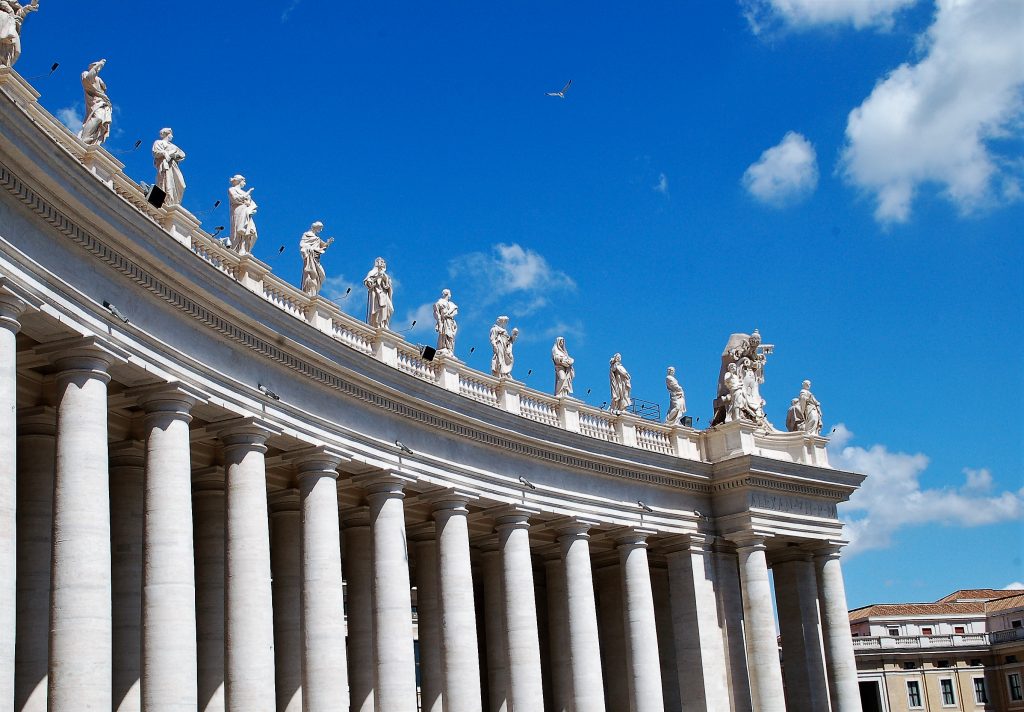
St Peter’s Square is impressive – large enough to hope 300,000 people and surrounded by an imposing colonnade made up of 284 columns, designed by Gian Lorenzo Bernini. 140 statues of saints sit at the top of the columns, made by the disciples of famous sculptor Bernini. The centre of the square features a 25m high obelisk which was brought from Egypt in 1586 and two fountains.
As you explore the area on your Rome itinerary, look out for:
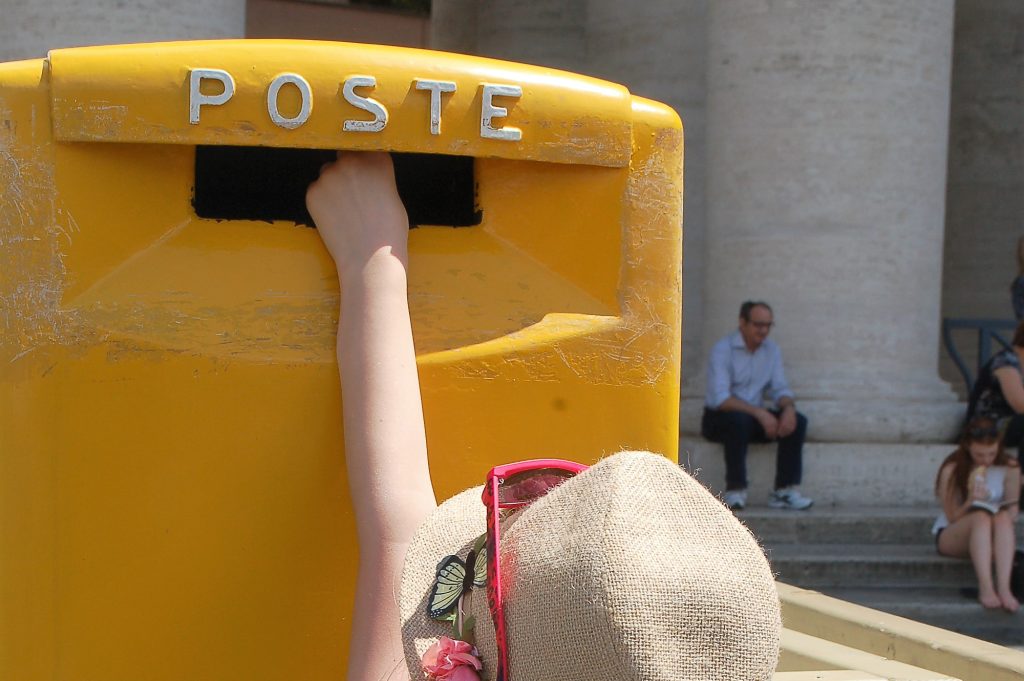
- The Vatican post office – The Vatican has its own post office and yellow post boxes, one in St Peter’s Square and one on the roof of St Peter’s Dome. Take your postcards with you ready to post from here and they will have a special stamp when they arrive at their destination.
- The Swiss Guard – wear colourful outfits which differ depending on their duties, all based on designs from the early 1500s. The Guards are employed to protect the Pope and also St Peter’s Basilica. In fact, they constitute, the world’s smallest army.
- Parts of the Leonine Walls – built in the 9th century to protect St Peter’s Basilica during medieval times.
St Peter’s Basilica
St Peter’s Basilica is a Renaissance era church – it is a basilica and not a Cathedral because it does not have a bishop. It is one of the largest churches in the world, holding up to 20,000 people, and the holiest temple of the Catholic Church, making it a place of pilgrimage for many.
The Basilica is named after St Peter, one of Jesus’s disciples who became the founder of the Catholic Church. He was executed and buried where the Basilica stands now. This is not the original basilica, which was torn down in 1506, before a new one was completed in 1626.
Inside St Peter’s Basilica look out for:
- The Pietà by Michelangelo, a beautiful sculpture of Mary sadly contemplating the body of Jesus which she holds in her lap. It is on the right-hand side as you come in. Be amazed that Michelangelo made it when he was only 22 years old, and it is the only sculpture of his which he has signed.
- Statue of St Peter on his throne – this bronze statue depicts the Apostle seated on a marble chair holding the keys of heaven in his left hand and giving a blessing with his right. You will note that his right foot is worn from the touches of the devoted.
- Bernini’s Baldachin – this is a large Baroque sculpted bronze canopy over the altar of St Peter’s Basilica in the Vatican.
- The Vatican Grottes (Tombs of the Popes) – these are a system of vaults and chambers which serve as the final resting place for many of the Popes and Italian monarchs over the years. Note – there is a separate tomb for St Peter called the Vatican Necropolis which lies underneath the Vatican Grottes and can be booked on a separate tour.
The dome of St Peter’s Basilica
The dome, which is 136m (447 ft) high, was started by Michelangelo, but finished by Carlo Maderno in 1614. If you want to climb to the top on your Rome itinerary, you must enter by a special entrance and go through security clearance, so make sure that you are in the right queue!
The ascent is made in two stages:
- Climbing 231 steps or taking the elevator.
- Climbing the final 320 steps which become steeper and narrower as you go – the steps are not for those who suffer from vertigo or claustrophobia. Sadly, there is no lift for the second section.
However, those who make the journey are rewarded with incredible views of from the top.
The Vatican Museums and the Sistine Chapel
The Vatican Museums hold the world’s largest collection of private art. The Vatican Museums comprise several buildings, having been added to over time, which is why they are ‘museums’ in the plural.
The Sistine Chapel
Sistine Chapel ceiling – You will reach the Sistine Chapel at the end of your tour of the Vatican Museums and it has a real showstopper of a ceiling, painted by Michelangelo between 1508 and 1512. Be prepared for neck-ache after grazing up at the incredible ceiling whilst shuffling along with the crowds in line! There is no avoiding this as it will be busy, but worth it.
Also note The Last Judgement painted by Michelangelo which covers the whole alter wall of the Sistine Chapel. It depicts the second coming of Christ and the final and eternal judgement of God of all humanity. He completed it in 1541, having started it 25 years after completing the ceiling of the Sistine Chapel.
Note – as the Vatican Museum tours are two hours long, and quite hard core in terms of viewing art (High Renaissance Art), we decided not to include the Vatican Museums when visiting with our children and visited it on another occasion. If travelling with children, perhaps substitute it with something from my blog What to do in Rome with Children.
Grab Lunch outside the Vatican Museums
Depending on the timings of your visit to the Vatican Museum, you might be very hungry after the tour and art viewing. For ease you could eat at the café style eatery or the pizzeria inside the Museum, but to get away from the crowds and enjoy a less touristy option then walk to a restaurant outside the museums, such as La Soffitta Renovatio (8 minutes’ walk) – family run restaurant with good pizza and homestyle Roman dishes.
Take a taxi to L’Aventine Hill for a lovely surprise
After a restorative lunch, take a taxi to Piazza de Cavalieri de Malta on L’Avertine Hill. Look for the queue of people lining up by the huge green wooden doors and get in line. They are queuing outside a building once owned by the Knights Templar/Knights of Malta. When it’s your turn, you can look through the keyhole in the doors for a very special view – don’t google it, keep it as a lovely surprise!
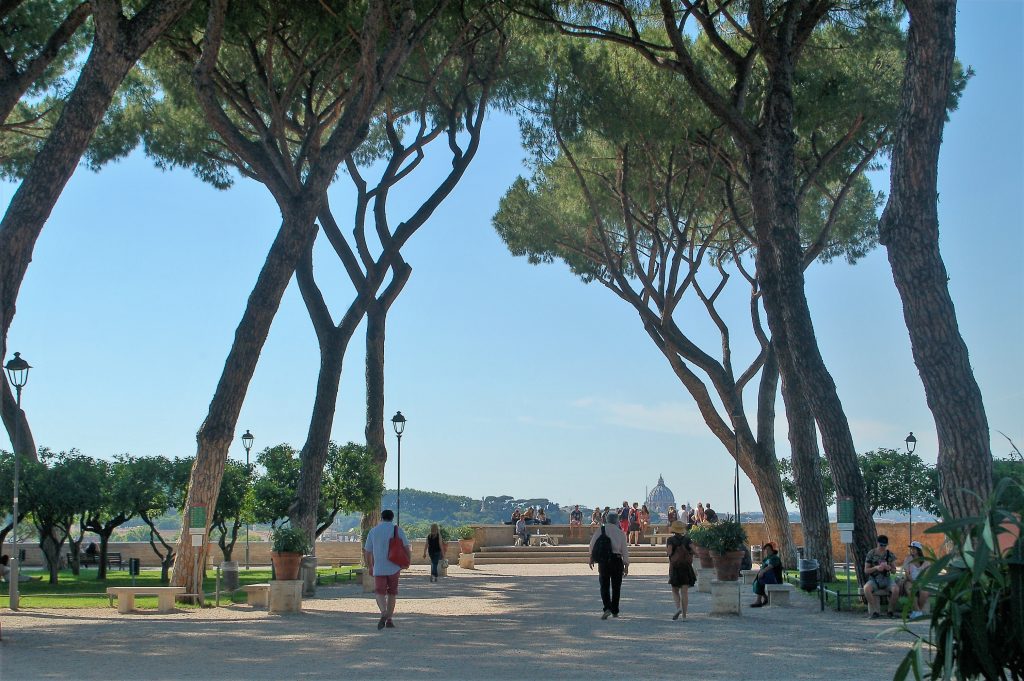
L’Aventine is a lovely area for a stroll on your Rome itinerary, so after looking through the keyhole, stroll down the hill in the direction of Circus Maximus. Stop at the beautiful gardens on the left, Giardino degli Aranci, as you descend and admire the views from the terrace of where you were this morning, sit in the shade of the trees, fill your water bottle from the fountains and watch the world go by in this ‘garden of oranges’.
We arrived on a Sunday morning and the church bells were ringing and birds tweeting in the shade of the trees – lovely.
Circus Maximus
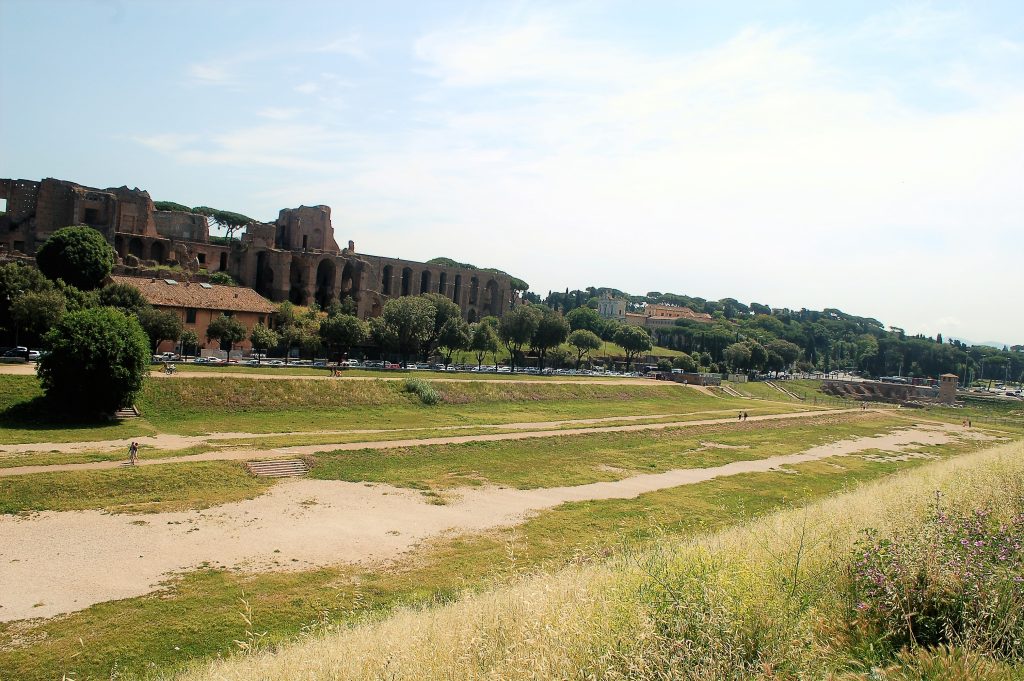
Sat the bottom of L’Avertine Hill you will find the area known as Circus Maximus, a long area of grass where the chariot racing used to take place. To be honest, there’s not much to see now other than the shape of the track, but when you stand on the ground, you can get a sense of the scale of the chariot racing arena. I’m not sure what I was expecting but thought they might have made more of the sight in terms of bringing it to life historically.
Bocca della Veritas
Around the corner from Circus Maximus, is the Bocca della Vertias, or the ‘mouth of truth’. If the queue’s not too big, line up to put your hand into the sculpture’s mouth and make a statement – if the statement is a lie, then it’s said the mouth of truth might snap your hand off!
I wouldn’t go out of your way to visit, but as you’re passing….
Ponte Palatino bridge to Trastevere
Unless you have other plans for dinner tonight on your Rome itinerary, I would suggest taking the Ponte Palatino Bridge to Trastevere and seeking dinner at one of the neighbourhood restaurants. Once again, soak up the atmosphere and enjoy La Dolce Vita.
Thank you so much for reading my blog, I hope you found it useful?
For more stories, itineraries, and advice, check out my Related Posts and sign up to receive my blogs by email.
If you have a blog-related question, please do ask in the Comments box and I’ll try to help…
Request please – if you use my photos, then please credit Love Travel Planning on your social media or give me a shout out on Instagram @lovetravelplanning as I am growing my website. Huge thanks.
Enjoy your travels!


Leave a reply
You must be logged in to post a comment.