A long time ago, pre-family, I visited Venice on an interrailing trip, staying in the youth hostel, eating squares of pizza for lunch and trying to see the city on the cheap. It was somewhere I always hoped to bring my other half and the kids, but somehow we didn’t make it until the kids had nearly left home. As it turns out, Venice with teenagers was great fun, so better late than never.
We went in the UK October half term with older teens, and this is the plan I’d use again: what worked, what didn’t, and how to shape five days so everyone gets something out of it.
Yes, Venice is a brilliant city for teenagers. There are no cars, you hop around on boats, there’s something worth photographing on every corner, and with a couple of booked activities to give the days some shape, ours rated it one of their favourite trips.
Venice’s relationship with the water makes it a very different kind of city break. There are no cars, so everyone can wander freely, and getting anywhere usually involves a boat, which our teens never tired of. Add in gelato to cool down, a long and slightly gruesome history, and Instagram-friendly views on every bridge, and there’s a lot to keep older kids interested. There’s plenty for the adults too, not least aperitivo time.
The flip side is that Venice involves a lot of walking and a lot of bridges, and a day of churches back to back will lose a teenager fast. We found the trick was mixing it up: one big sight, one activity and plenty of time to wander and eat.
A quick note on ages: we’ve only been to Venice with teenagers, so this guide is written for families with older kids. There were lots of families with younger children in our hotel, and I suspect their days looked quite different, with less walking, fewer churches and more breaks.
This is how I’d shape five days in Venice with teenagers, built from what we did on our half-term trip. Each day leans on one neighbourhood, so you’re not criss-crossing the city, and each one has its own more detailed guide if you want the full picture.
Get your bearings around St Mark’s Square, then head up the Campanile at dusk to watch the lights come on. Our San Marco guide covers the Doge’s Palace, the Basilica and how to dodge the worst of the crowds.
Follow our self-guided Venice walking route from the Rialto to the Zattere, stopping for cicchetti on the way and finishing with a gelato at sunset.
Spend the day at the Art Biennale if it’s on, then take a ghost walk through Cannaregio after dark. Our guide to hidden Venice in Castello, Cannaregio and Santa Croce has more on the quieter corners.
Catch the vaporetto out to the islands. This was the kids’ favourite day of the whole trip, and our Murano and Burano day trip guide explains how to do it without a tour.
Paint your own mask in a workshop on Giudecca, then save the gondola ride for the afternoon light.
If you only have three days in Venice with teens, I’d keep days 1, 2 and 4.
To be honest, we probably wouldn’t have booked a gondola ride without the kids. They’re pricey and a bit corny. Despite that, drifting through the canals with the city reflected around you was very special.
There was a bit of a gondola traffic jam at the embarkation point as people got in and out, but our gondolier quickly took us into quiet side canals where the only sound was the splash of the oar. It was enjoyed by all, even if he did spend most of the ride on his mobile phone, which slightly ruined the romance.
We booked ours through GetYourGuide, and the Venice: Shared Gondola Ride is a good option for families because sharing the boat keeps the cost down.
The vaporetto (water bus) turned out to be one of the most useful things on the whole trip. We used it to get out to the islands, to cross the city quickly and to rescue tired feet at the end of the day. Line 2 was particularly handy, zigzagging along the Grand Canal so we were never far from a stop.
They’re used by locals and visitors alike, so expect queues at busy times of day. Sometimes it’s the simple things teenagers enjoy, and jumping on and off the vaporetto was a hit. Our guide to getting around Venice covers tickets, passes and the cheap traghetto crossings of the Grand Canal.
Booking a couple of activities gave our days some structure, and it meant the teens had something to look forward to beyond “more walking”.
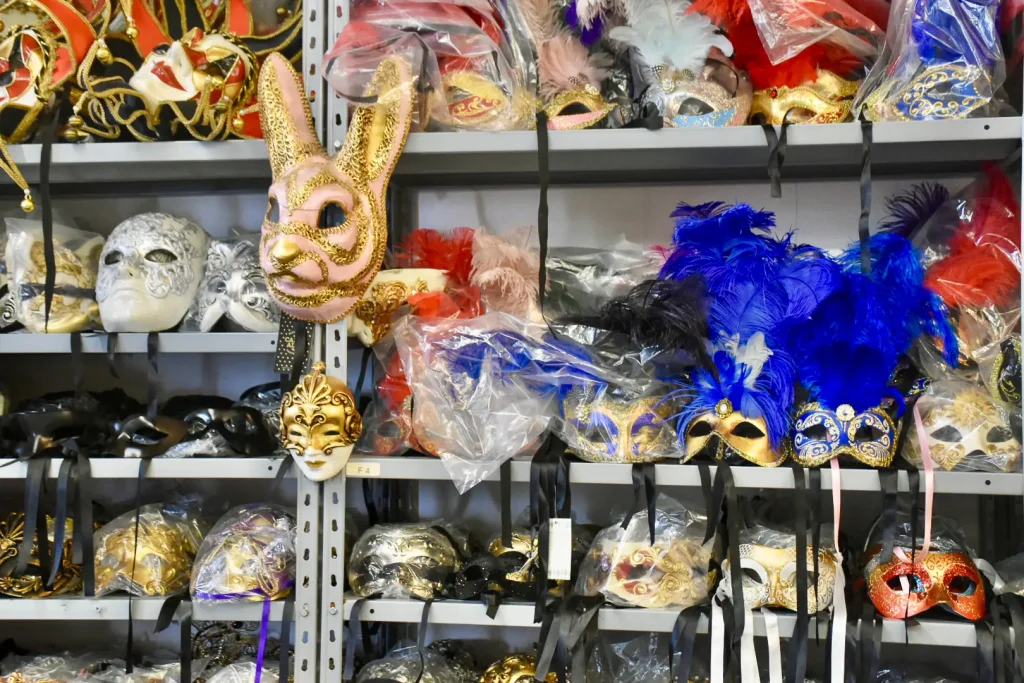
We booked a Venetian mask-making workshop at Carta Alta on the island of Giudecca, partly so we could get out to Giudecca and have a look around too. Our host met us outside an old brewery that’s been converted into artists’ workshops around a courtyard, and started by explaining the role of masks in Venetian history. He showed us masks his company had made for films including Spider-Man 2 and Fifty Shades of Grey.
We then spent a very happy hour and a half painting papier-mâché masks in a Baroque style: a strong base colour first, then a contrasting metallic for highlights, then ribbons to finish. We were all pleased with the results, and it’s a souvenir that means a lot more than a shop-bought mask. The workshop is still bookable as Venice: Venetian Masks Workshop on GetYourGuide.
We were in Venice over Halloween, so a ghost walk felt like the obvious choice for one evening, though Venice has more than enough dark stories to fill a tour any time of year.
Ours was Venice: Mysterious Tales of Ghosts and Murders, which included the tale of Marco Polo’s wife and her unhappy end. Walking the narrow alleys of Cannaregio after dark was a bonus in itself, as the streets were so much quieter than in the day.
The most obvious viewpoint in Venice is the top of St Mark’s Campanile, the bell tower in St Mark’s Square. The queues always seem to be long, partly because you go up in a small lift, so book timed tickets online before you travel.
Our tip is to go at dusk and watch Venice spread out below you as the lights come on. It was quite magical, with a great view over the domes of St Mark's Basilica.
For something more unusual, climb the Scala Contarini del Bovolo, a spiral staircase wrapped around the outside of a palazzo (“bovolo” means snail in Venetian). It’s tucked away in San Marco roughly halfway between St Mark’s Square and the Rialto Bridge.
The view from the top is lovely and very Venetian: rooftops, washing lines and potted plants on balconies, with the Basilica and Campanile in the distance. We booked ahead online, and the ticket includes a small exhibition space too.
One of the best-known Grand Canal views used to be the free rooftop terrace at the T Fondaco dei Tedeschi shopping centre, near the Rialto. I left booking too late and every slot was gone ten days before we travelled. The store has since closed, so it’s no longer an option. If you want a third viewpoint, the bell tower of San Giorgio Maggiore, across the water from St Mark’s, is the one I’d try next time for a view back across to San Marco without the Campanile queues.
If you’re visiting in a Biennale year (the Art Biennale runs in even-numbered years, alternating with Architecture), don’t miss it. It’s a sort of Art Olympics where countries create installations around a shared theme. We were there in 2024 and the pavilions were wonderfully wacky. The two main sites are the Giardini and the Arsenale, both in Castello, and one ticket covers both.
We split up in the Giardini so everyone could go at their own speed, met back at the entrance at an agreed time, then compared notes over an aperitivo on how differently each country had interpreted the theme. Even if your kids aren’t particularly arty, I think they’d enjoy it.
Venice also has top-class galleries, including the Accademia for Renaissance art and the Peggy Guggenheim Collection for modern art, both in Dorsoduro. Both offer free or reduced entry for younger visitors, so bring ID for the teens. We skipped them after a big Biennale day, but they’re on the list for next time. And the city’s churches are full of paintings by Venetian masters like Tintoretto and Titian, which you can see up close without museum crowds. I enjoyed them; the teens would have been happy with just one.
Venice is famous for cicchetti, small bar snacks traditionally eaten with an early evening drink in a bàcaro (a Venetian wine bar). We went to Cantinone Già Schiavi in Dorsoduro, where there was already a queue down the street at 5pm. After a lot of pointing at the counter we came away with some very tasty bites: tuna and celeriac, prawn mayo, salami and jalapeño, gorgonzola and pear.
The last thing the owner said as we headed outside was “attenzione ai gabbiani”, watch out for the seagulls. We’d been warned. Venice’s gulls are bold, so keep a firm grip on anything edible.
The spritz comes from the Veneto, and there are a few versions to try:
Aperol Spritz: The sweet, orange one that's become popular everywhere.
Campari Spritz: More bitter, and my personal favourite.
Select Spritz: The local's choice, similar to a Campari Spritz.
Limoncello Spritz: Mouthwash with bubbles!
If your teens are 18 or over, they can help you pick a favourite. They’re stronger than they look, though, and you really don’t want to end up in a canal.
There’s gelato all over Venice, but one of the best known is Nico on the Zattere in Dorsoduro. Time it for sunset and walk along the waterfront promenade with your cone. We also loved Gelatoteca Suso, near the Rialto.
If you can, avoid the summer, when the crowds are at their biggest and the heat makes all those bridges harder work. Autumn, winter and spring are all better bets.
We went in the October half term, hoping for cooler weather and fewer people than summer. In fact it was unseasonably warm at about 20°C with clear blue skies every day, which was a lovely surprise. It didn’t feel especially busy until our last day, 1 November, which is All Saints’ Day and a public holiday in Italy. There was a noticeable jump in visitors arriving for the long weekend, including a few dignitaries with their entourages. If your half term overlaps an Italian holiday, plan your big sights for the quieter days.
Late autumn is also the start of acqua alta season, when high tides can flood the lower parts of the city, though the MOSE flood barriers now hold back most of the highest tides. If you’re thinking of the February half term instead, it sometimes overlaps with Carnival, which is spectacular but very busy. Our guide to visiting Venice responsibly explains what to expect.
There are options for every budget, and the right choice depends on how much you want to be in the thick of it. We stayed at the JW Marriott Venice because it had good room options for families, and we collect Marriott Bonvoy points (our guide to travel reward points explains how we use them).
The hotel is on its own island, so it felt like a retreat from the crowds. A shuttle boat runs regularly to St Mark’s Square, and catching it after breakfast and watching the Venice skyline come towards us across the water was a joy. On the flip side, the boat back was one more thing to manage after a long day of sightseeing. With a view like that, though, it’s not too much of a hardship.
If you’d rather walk out of the door into the city, staying in one of the sestieri (districts) themselves means late-evening wanders and no boat timetables to watch. Dorsoduro and Cannaregio are good choices for families wanting a more local feel. Staying on the mainland in Mestre is usually cheaper, but you’ll spend more of each day commuting in and out, and you miss the evenings when the day-trippers have gone home.
Venice is a living city, not a theme park. Fewer than 50,000 people now live in the historic centre, and on a busy day visitors can easily outnumber them. As a family, a few small choices make a real difference: stay overnight rather than day-tripping, eat and shop in local places, keep to the right on narrow streets, and don’t sit on bridges or church steps.
Venice also charges some day visitors an access fee to enter the historic centre. So far it has run as a trial on selected days in spring and early summer, during daytime hours only, so an October half-term trip like ours has fallen outside it.
Teenagers aged 14 and over count as adults for the fee. If you’re staying overnight anywhere in the Municipality of Venice, Mestre included, you don’t pay, but on fee days everyone in your group aged 14 or over needs to register for a free QR code. Under-14s neither pay nor register. The dates and rules can change from year to year, so check the official Venice access fee website before you go. Our guide to visiting Venice without adding to the problem goes into more detail.
In closing
We found it easy to fill our days in Venice with teenagers. We'd have been happy just wandering the streets and canals for hours, but booking a few activities gave the trip some structure, and that worked well for the kids.
When we asked them for their favourite day, the answer was unanimous: the trip out to Murano and Burano. Overall, Venice was a big hit with all of our older teens, and if you've been putting it off like we did, don't wait as long as we did.
Buon viaggio!
Thank you so much for reading my blog. For more stories, itineraries, and advice, check out my Related Posts and sign up to receive my blogs by email.
If you have a blog-related question, please do ask in the comments box below and I'll try to help.
A little request: if you use my photos, please credit Love Travel Planning on your social media or give me a shout out on Instagram @lovetravelplanning as I am growing my website. Huge thanks.
Join thousands of travelers looking for inspiration from our FREE Planet Travel newsletter!
Your step-by-step framework for stress-free, unforgettable trips — from first idea to final itinerary.